


Lancker, Albert Ferdinand, his code name was Evert, born 02-03-1894, in Utrecht, Netherlands, 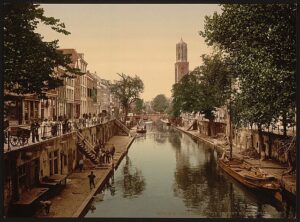 the son of Leonhart Frederick Lancker and Hendrika Carolina, born Kennedy. Albert joined the military at the age of sixteen. After completing his military training in Kampen, he left for the Dutch East Indies in October 1921 as a first lieutenant in the
  . Back in the Netherlands, he was promoted to captain after two years.
In May 1940, he commanded a battalion of the 41st Infantry Regiment. His unit, which was stationed behind the Zuid-Willemsvaart canal in the Peel region, was forced to retreat. Via Breda and Zeeuws-Vlaanderen, he and his men ended up in Dunkirk. He was not given permission to cross over to England. He had to surrender to the Germans with his unit. On 03-06-1940, Albert returned to the Netherlands. In order to be released from German captivity, he signed the “Declaration of Honor” demanded by the occupying forces. This meant that he had to refrain from any activity against the occupiers. In June 1940, after the demobilization of the armed forces, Lancker voluntarily reported for the Labor Service.
In October 1940, he resigned from the Labor Service. From that moment on, he cooperated with the Order Service (OD). He organized illegal activities in The Hague, Amsterdam, and Utrecht. From December 1940, he was wanted by the SD.  He went into hiding in The Hague. From his hiding places, he undertook various actions. In the summer of 1942, he was linked to the liquidation of an SD agent. He was wanted by the SD. In the fall of 1942, Lancker decided to go into hiding at Hotel De Uitkijk, on the Hellendoornse Berg,
 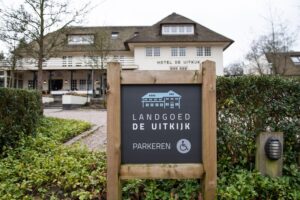 in the municipality of Hellendoorn. From that moment on, he operated under the alias De Jong. At the end of 1942, he went into hiding with the widow G. Bakker-van ‘t Roth at Ommerweg 24 in Hellendoorn. From his hiding place, Lancker built up an illegal organization.
From the beginning of the war, Queen Wilhelmina (1880-1962),  Prince Bernhard (1911-2004),
  Prime Minister Pieter Sjoerds Gerbrandy (1885-1961),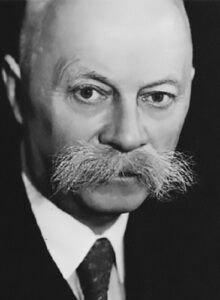
 and the members of his War Cabinet at the national level aimed for good cooperation between the Order Service (OD),
 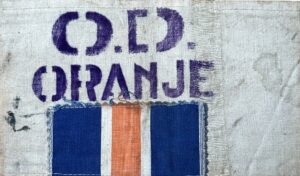 the Resistance Council,
  and the National Strike Teams (LKP). Promoting this unity was desired to rally the Dutch people behind the first post-war government and the monarchy. The promotion of this objective was called coordination. Agents who were parachuted into occupied the Netherlands by the Intelligence Bureau (BI) and the Bureau of Special Assignments (BBO)
  were tasked with promoting the coordination of the Dutch resistance. This coordination would take shape starting in November 1944 and would lead to the establishment of the Interior Forces (IF).
For this purpose, on the nite of August 28-29, 1944, agents Jacob “Jaap” Beekman (1919),  Jacob Roelof “Jaap” Hinderink
  , and Johan Luykenaar were parachuted by the BBO in the vicinity of Voorthuizen, above the Veluwe. Beekman was a radio telegraphist. He was given a hiding place in Hellendoorn. He was added to the staff of the Twente Brigade of the RVV. From that moment on, Lancker had a direct radio connection to the BBO and the Dutch government in London via Beekman. Hinderink and Johannes Hendrik “Joop” Luijkenaar got to work training the members of the sabotage groups and preparing drop zones for parachuting personnel, weapons, and equipment. The drop zones were set up in the areas around Piksen, Stegeren, Ommen, and Bruinehaar.
As was the case throughout the country at that time, more and more people in Hellendoorn and neighboring Nijverdal were faced with the choice of either working in Germany under the Labor Service or finding a way to evade the Labor Service. Many young men, mostly from Protestant families, chose to go underground. They evaded the Labor Service and went into hiding. It therefore took Lancker little effort to place young men under his authority in a dozen locations in the northwest of Twente and neighboring Salland. He appointed the men as his local commanders and instructed them to gather a dozen people around them each.
In the summer of 1943, Lancker came into contact with Jan Thijssen (1908-1945). 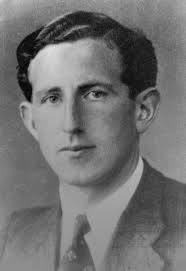
 Thijssen was the founder and leader of the Council of Resistance (RVV). Thijssen and his colleagues traveled throughout the country to unite resistance groups under the umbrella of the RVV. Lancker became commander of the Twente Brigade of the RVV. Shortly afterwards, Lancker’s subordinate commanders set up sabotage groups in Nijverdal and Wierden.
In early June 1944, Lancker came into contact with Frits Hazelhoff 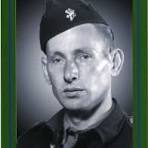 from Den Ham. Hazelhoff was the leader of one of the resistance groups that had been active in the northeast of Overijssel for some time. Hazelhoff joined Lancker. Lancker instructed Hazelhoff to set up sabotage groups in Vroomshoop and the surrounding area. In the weeks that followed, Hazelhoff formed illegal cells in Vroomshoop and the surrounding areas. These areas were divided into two circles, namely the “Vroomshoop Circle” and the “Mariënberg Circle.” Frits Hazelhoff became commander of the “Vroomshoop Circle,” which included Den Ham, Vriezenveensewijk, Vriezenveen, and Daarle. W. Hento became commander of the “Mariënberg Circle,” which included Mariënberg, Bergentheim, Heemse, Hardenberg, and Gramsbergen. Hento was also an employee of the National Organization for Assistance to People in Hiding (LO) in Hardenberg and he was station chief in Mariënberg.
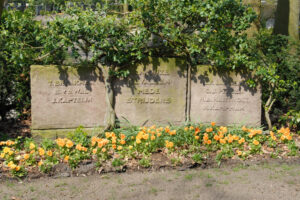
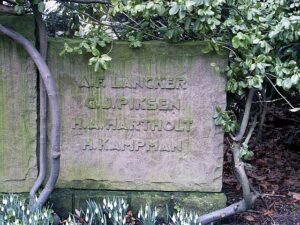
Death and burial ground of Lancker, Albert Ferdinand “Evert”.
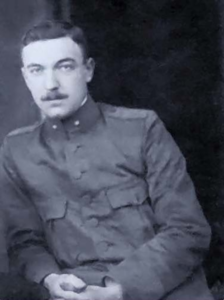
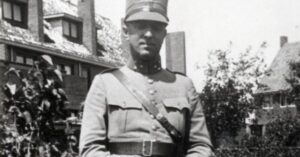
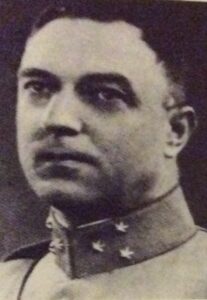
On 11-02-1945, Evert Lancker and his courier Ria Hermans arrived at Nieuwboer’s house in Hoge Hexel. Since September 1944, the house had been the headquarters of the BS District Salland. A short time later, an SD service car stopped in front of the house. Four armed members of the SD got out. They were the German Büchner and the Dutchmen Blankensteijn, Rutgers, and Veefkind. Johannes Hubertus Veefkind interrogated Mr. Nieuwboer, the head of the public school in Hoge Hexel. From the manner of the interrogation, it could be deduced that the SD officers were looking for hidden weapons. They also suspected that illegal work was being carried out in the house. They conducted a search. At that moment, they saw that there were several people in the adjoining room. They were Evert Lancker 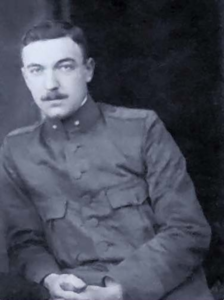 the brother of Albert and his courier Ria Hermans, Mrs. Nieuwboer, her son Ton Nieuwboer, her daughters, and Leo Blomkowski, a German deserter in hiding. The people had to show their identity cards. The inspection of the identity cards yielded nothing. The coats on the coat rack were searched for weapons. The search of the clothing revealed a rubber truncheon. The SD officer was distracted when Nieuwboer suddenly pulled up the weights of the hallway clock, which made a rather rattling noise. While searching, he accidentally skipped Lancker’s coat. As a result, he overlooked the pistol in Lancker’s coat pocket.
Lancker, Tom, and Leo were then instructed to accompany them to the SD office in Almelo. They put on their coats. Lancker quickly found his weapon and, after assessing the situation, shot Büchner and Blankensteijn, the two SD officers standing closest to the front door. He then fled through the back door. Veefkind and Rutgers gave chase. Shots were fired at Lancker. Lancker was fatally wounded by two bullets. He died in the Hexeler Flier behind the Meijer brothers’ house on Braambelt. According to some sources, he shot himself in the head because he did not want to fall into the hands of the Germans. Other sources did not confirm this incident. However, it was confirmed by the Wederden Historical Circle in its historical magazine “Weder Aardigheden” (number 50, August 2012). In the article “Finally certainty about the death of Captain Lancker,” Mr. A. Palthe writes that the Wierden Historical Society has two photos of Lancker’s dead body. The eyewitness who had to transport Lancker at the time stated that he had seen a small hole (entry wound) at the front of the neck and a large wound (exit wound) at the back of the head. This proves that it was suicide.
The people who remained in the house fled. When Veefkind and Rutgers returned to the house, they took their dead and wounded colleague with them to Almelo. A little later, an SD Kommando arrived in Hoge Hexel. The members of the Kommando looted Mr. Nieuwboer’s house and then set it on fire. Two days later, a resident of Wierden, who had nothing to do with the incident, was shot dead in Bornestraat in Almelo in retaliation.
After Lancker’s death, Herman Doppen  became the commander of the BS District Salland. He moved the headquarters of the BS District Salland to Heeten. From 24-02-1945, agents Karel Christiaan “Robbie” Mooiweer (Bloemendaal, 14 april 1923 – 1971)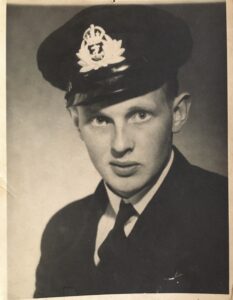
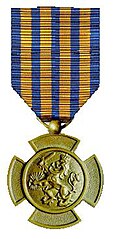 , Pieter Bouman (1924-1997),
  and Menco Rein Mulder (1923-1945)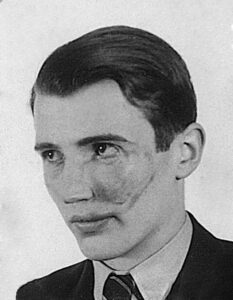
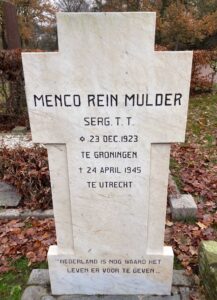 continued the work of agent Gerrit Bertus “Ben” Buunk.
  On 05-03-1945, Major Hendrik Brinkgreve
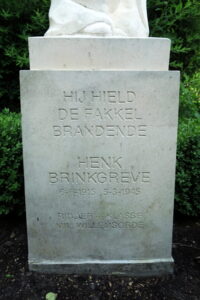 was accidentally arrested in Losser. He drew his pistol, and during the ensuing firefight, Brinkgreve was killed by the Germans. Jan Thijssen, along with one hundred and sixteen prisoners, including about ten employes of the Radio Service and the Eastern Broadcasting Group, was executed by firing squad at the “Woeste Hoeve”
 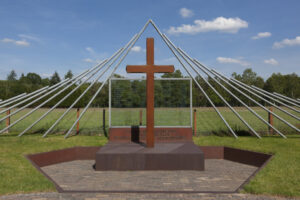 on the road to Apeldoorn on 08-03-1945.
In mid-March 1945, Buunk was transferred by the SD to the House of Detention in Zwolle. 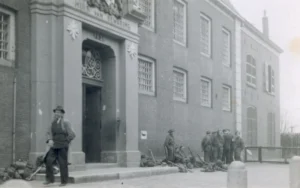 On 04-04-1945, Buunk, along with five other resistance fighters, including D., was executed at the Geldersedijk in Hattem. Eskes, Floris van der Laaken,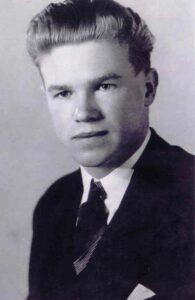
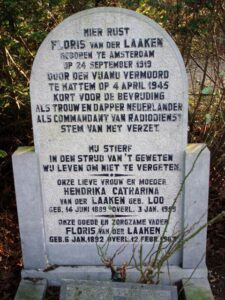 and John Austin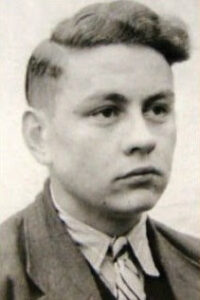
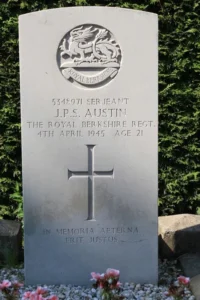 were lined up in front of the firing squad and executed.
Scouting Lancker was founded in Wierden on 27-03-1998, and is named after Albert Ferdinand Lancker. The last meeting for members was on 13-12-2013. Every yearon Remembrance Day,the entire Scouting Lancker group gathered at themonument of Captain A.F.Lancker. 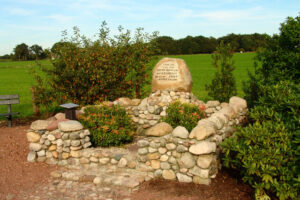
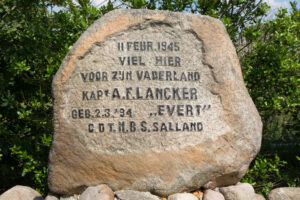
Lancker, Albert Ferdinand “Evert” is buried at the Dutch War Graves Municipal Cemetery Hellendoorn, Ninaberlaan 34, 7447 AE Hellendoorn.
Message(s), tips or interesting graves for the webmaster: robhopmans@outlook.com


Leave a Reply