

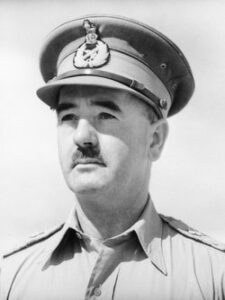
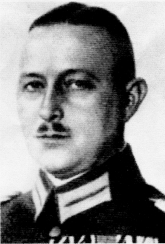
Morshead, Sir Leslie James “Ming the Merciless”, born 18-09-1889, in Ballarat, City of Ballarat, 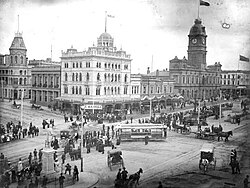 Victoria, Australië, to Mary Eliza, born, Rennnison (1851–1921). Leslie had four brothers, William Rennison Morshead (1878–1965), Henry Hosken Morshead (1882–1937), Thomas Davey Morshead (1887–1890) and Ernest Davey Morshead, (1893–1916).
Leslie became a teacher and then joining the AIF 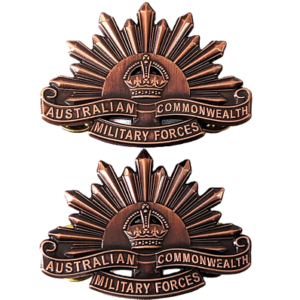 in September 1914 as a lieutenant, Morshead was posted to the 2nd Battalion. By the time he landed at Gallipoli on 25-04-1915 he was a Captain; by August, when he fought at Lone Pine, he had been promoted to Major. After Gallipoli he was promoted to Lieutenant Colonel and given command of the 33rd Battalion,
 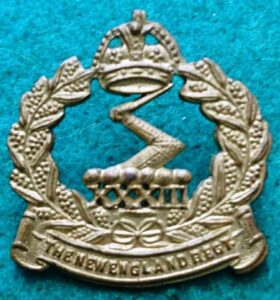 which arrived in France in November 1916. Morshead led the battalion successfully through Messines and the Passchendaele campaign of late-1917, was awarded the Distinguished Service Order,
  and continued to command through the battles Villers-Bretonneux and Amiens in 1918. Morshead joined General Monash’s staff for the demobilisation of the AIF and returned to Sydney in December 1919. He married Myrtle Woodside
 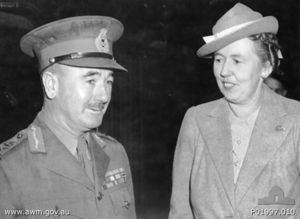 in November 1921. Having failed to make a success of a soldier-settlers’ block in Queensland, Morshead returned to Sydney to work in shipping, gaining promotions and posts in several Australian cities and in England. He remained active in the militia, commanding two battalions and reaching the rank of Temporary Brigadier. In October 1939 he was given command of the 18th Brigade, sailing for Britain in May 1940. The following February Morshead was promoted to Major General in command of the 9th Division,
  then in the Middle East. Reputed to be a tough commander who could be blunt with senior officers, Morshead led his division through the siege of Tobruk where his aggressive defence denied the Germans a breakthrough but earned him the ire of some subordinates concerned at the level of losses. His success at Tobruk was followed by promotion to Lieutenant General and command of the AIF in the Middle East. Morshead, at the risk of alienating his British superiors, argued to keep the 9th Division together in the face of British demands to detach individual brigades. He led the division through the battle of El Alamein, conducted by General Bernard Law “Monty” Montgomery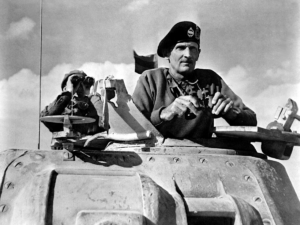
 where the 9th Division’s contribution was considered vital to the victory. During the battle, Leslie regularly visited both the front and the wounded behind the lines. Returning to Australia in 1943, Morshead took command of II Corps in October and then in November was elevated to command both New Guinea Force and the Second Australian Army. In May 1944 he was given command of I Corps, leading them through the final battles of the war in Borneo. After the war, he chaired a military court of enquiry into Major General Gordon Bennett’s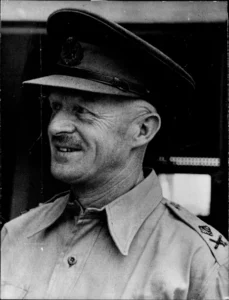
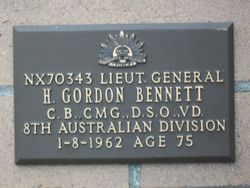 departure from Singapore in February 1942. Morshead refused offers of military and diplomatic posts, as well as the Governorship of Queensland, returning instead to the shipping industry as manager of the New South Wales branch of the Orient Line; later he became its Australian general manager.
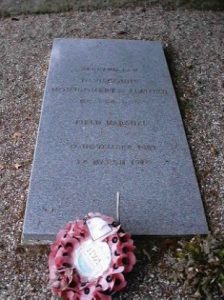
Death and burial ground of Morshead, Sir Leslie James “Ming the Merciless”.
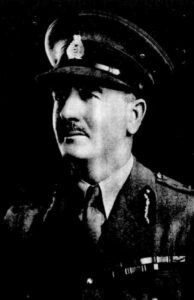
He held a number of other directorships and civil appointments and was involved in right-wing politics before becoming ill with cancer in the mid-1950s. Morshead died in Sydney on 26-09-1959, age 70.
Source: Australian War MemorialAustralian soldier, teacher, businessman, and farmer. His military career spanned both world wars. During World War II, he led the Australian and British troops at the Siege of Tobruk in 1941 and at the Second Battle of El Alamein, achieving decisive victories over Erwin Johannes Eugen Rommel‘s

 Africa Corps
  . A strict and demanding officer, his soldiers nicknamed him “Ming the Merciless”, later simply “Ming”, after the villain in the Flash Gordon comics. In world War I he became commander of the 33rd Infantry Battalion, which he led on the Western Front at Messines, Passchendaele, Villers-Bretonneux, and Amiens. Between the wars he made a successful business career with the Orient Steam Navigation Company.
  In 1939, he was appointed to command the 18th Infantry Brigade of the 6th Division in the Second Australian Imperial Force. In 1941 he became commander of the 9th Division, which he led in the Siege of Tobruk and the Second Battle of El Alamein. He returned to Australia in 1943, where he was appointed to command II Corps, which he led during the New Guinea campaign. In 1945 he commanded I Corps in the Borneo campaign. In later life he served as president of the Boy Scouts Association of New South Wales
  and the Big Brother Movement,
 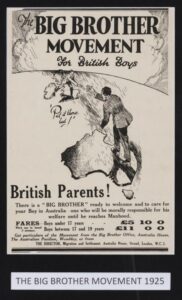 a British youth emigration support scheme, and was a trustee of the Gowrie scholarship trust fund, which provided assistance to the descendants of Second World War veterans.
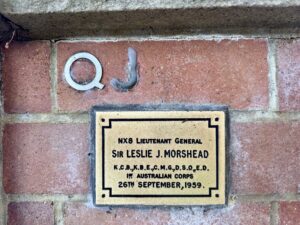
Sir Leslie James “Ming the Merciless” Morshead is buried at the Northern Suburbs Memorial Gardens and Crematorium, North Ryde, City of Ryde, New South Wales, Australië. Section, East Terrace, Wall QJ, Niche 1.




Leave a Reply