



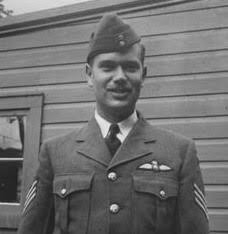
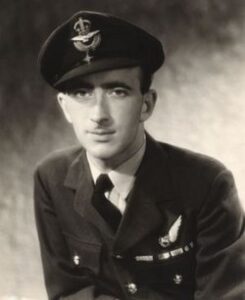
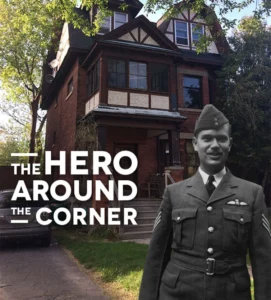
Burpee. Lewis Johnstone, born on 05-03-1918 in Ottawa, Canada,  one of the three children of Lewis Arthur and Lilian Agnes Burpee. His father was the manager of Charles Ogilvy, a large department store in the city.
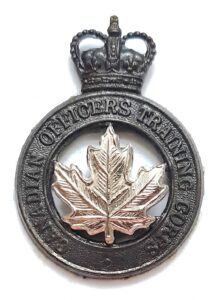
 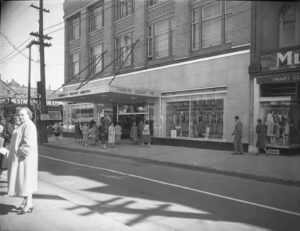 He went to Elgin Street Public School and Lisgar Collegiate School in Ottawa, and then on to Queen’s University in Kingston, Ontario, where he got a degree in English, History and Politics. He was also a member of the college’s Officer Training Corps.
  When war came, he joined the RCAF/The Royal Canadian Air Force
  enlisting in December 1940.
Burpee qualified as a pilot in September 1941 and embarked for the UK shortly afterwards. It took about a year for him to start operations, since after training on Wellingtons, he was then sent for heavy bomber training. While training he crewed up first with fellow Canadian, air gunner Flight Sergeant Joseph “Gordie” Brady 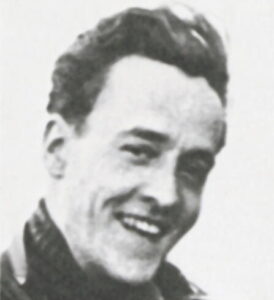 and then with flight engineer, Guy “Johnny” Pegler.
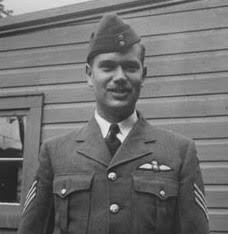
 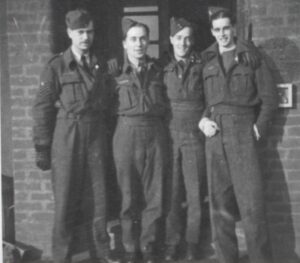 Guy (“Johnny”) Pegler pictured on the far right, standing next to Gordon Brady. Their skipper, Lew Burpee is on the far left. Picture taken in 106 Squadron, probably late 1942.
The three were finally posted to 106 Squadron  in October 1942. Air gunner William Long joined his crew in December 1942. These four would fly together throughout their time in 106 Squadron and then transfer to 617 Squadron.
  The CO of 106 Squadron at this time was of course the famous Dam Buster Guy Penrose Gibson.

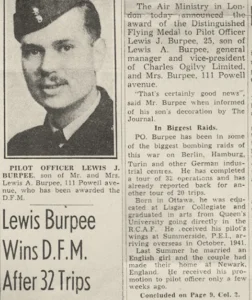
After three trips as a “second dickey” Burpee undertook his first trip as a captain on 07-11-1942 on a mission to bomb Genoa. This was abandoned, but his first successful operation was later that month. He went on to complete some 25 further operations and was recommended for the DFM. Distinguished Flying Medal. The citation stated:
He has consistently displayed the greatest determination in the execution of whatever tasks were allotted him. Berlin, Nuremburg, Stuttgart, Genoa and Turin are some of the many objectives he has attacked with satisfactory results and in recent weeks he has taken part in the highly successful raids on Lorient (aiming point photograph), St Nazaire and both of the Essen attacks. He also flew on the daylight attack against Milan in October 1942. Flight Sergeant Burpee has shown coolness and courage throughout his operational tour and has performed his duties conscientiously and efficiently.
Gibson obviously knew Burpee as a pilot from his old squadron and rated his abilities positively. He was happy to have him in 617 Squadron as one of the three pilots from his previous assignment. Burpee was in fact the only one of the three who transferred directly – by the end of March 1943, both David John “Dave” Shannon 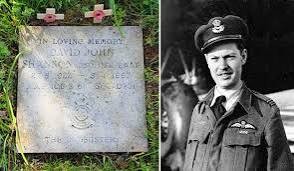 and John Vere “Hoppy” Hopgood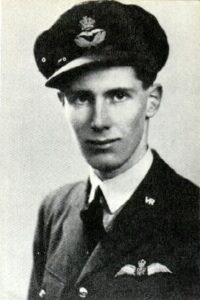
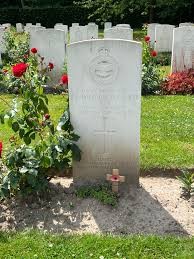 had already been posted out to other duties. However much Gibson rated Burpee as a pilot, a few weeks previously he had thought that he wasn’t yet ready for a commission, writing on his application: “This Canadian is an excellent type of N.C.O. but should be given more experience of service life before being given a commission.” But Gibson was then overruled by his station commander, Air Commodore Edward Irvine “Peter” Bussel,
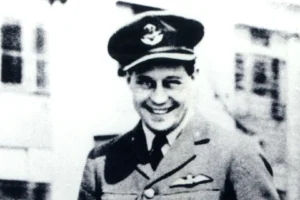
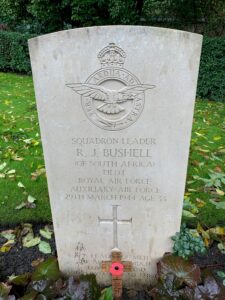 who wrote that Burpee was “Possessed of the attributes of an officer… Strongly recommended for commissioning.” (National Archives of Canada). The commission duly came through shortly after he joined 617 Squadron, and was backdated to the beginning of March.
Burpee had other things besides flying on his mind, since he had got married in September 1942 and his wife was now expecting their first child. In Enemy Coast Ahead, Gibson wrote that he had spoken to Burpee on his arrival in 617 Squadron: “He had just married a young English girl and was busy trying to find her a house not too far away. He was telling me that he had found it a very difficult job.”
AJ-S 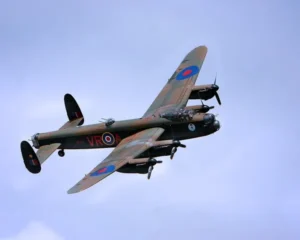 left the ground at 0011 on the morning of Monday 17 May, and never made it as far as the German border. While still over Holland, and approaching the gap between the heavily defended airfields at Gilze-Rijen and Eindhoven, AJ-S strayed off course.
Eindhoven, the birthtown, of the webmaster is liberated by the 101 Airborne Division “Screaming Eagles,
 under command of Major General Maxwell D. Taylor.
It climbed slightly, probably in an effort to determine its exact position, but was then caught in searchlights and hit by flak. It crashed on the edge of Gilze Rijen airfield, six miles south west of Tilburg. Its mine exploded on impact, demolishing a large number of buildings and doing damage estimated at 1.5 million guilders.
The demise of the Burpee crew was seen by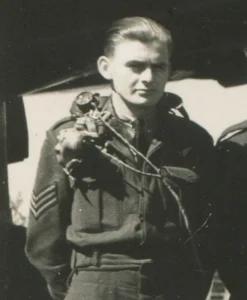 , bomb aimer in AJ-F, and Douglas Edward Webb,
  a minute or so further back in AJ-O’s front turret. Its last minutes were also seen by a German witness, a Luftwaffe airman based at Gilze Rijen called Herbert Scholl, interviewed by Helmuth Euler. He was of the opinion that AJ-F was in fact not hit by flak at all, but was dazzled by a searchlight beam hitting it horizontally. The pilot tried to fly even lower, and then hit some trees.
The next morning, Scholl went to the crash site and saw that it was a total wreck. Only the rear turret and tail unit were intact, and he saw rear gunner Gordon Brady’s body, which didn’t appear to have any sign of injury. He noticed that Brady was scantily dressed, wearing thin uniform trousers and lace up shoes with holes in the soles.
After the crash, only the bodies of Burpee, Brady and Weller were positively identified. The other four were buried in a communal grave. They were first interred by the Germans at Zuylen Cemetery, Prinsenhage, but after the war all seven bodies were exhumed and reburied in Bergen-op-Zoom War Cemetery. 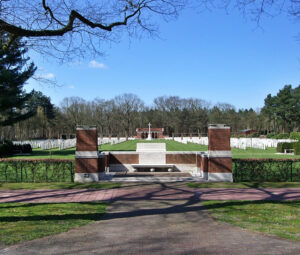
Lewis Burpee was one of the four aircrew who flew on the raid knowing that their wives were pregnant. Richard Trevor-Roper 
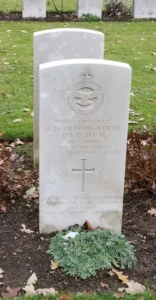 and David Maltby would live to see their children being born. Burpee and Charles Brennan would not. After her husband died, Mrs Lillian Burpee travelled across the Atlantic in order to meet her in-laws for the first time, and have her baby in Canada. Their son, also called Lewis Johnstone Burpee, was born on Christmas Eve 1943.
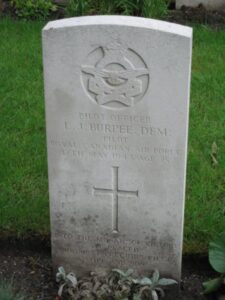
Death and burial ground of Burpee. Lewis Johnstone.
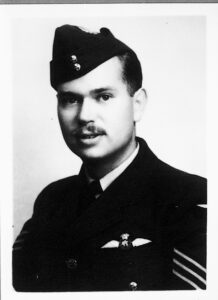
Lewis Johnstone Burpee, died in a crash, age 25, over (Gilze-Rijen/Noord-Brabant, Netherlands. After the war all seven bodies were exhumed and reburied in Bergen-op-Zoom War Cemetery. After the crash, only the bodies of Burpee, Brady and Weller were positively identified. The other four were buried in a communal grave. They were first interred by the Germans at Zuylen Cemetery, Prinsenhage, but after the war all seven bodies were exhumed and reburied in Bergen-op-Zoom War Cemetery. Plot: 23. Row: B. Grave: 3.


Leave a Reply