

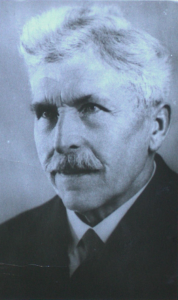
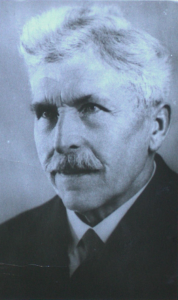
Harst, Matthijs Hendrik van der, born 24-02-1870 in Den Haag,  Netherlands, as the youngest in a family with 7 children to the bookbinder Matthijs Hendrik Thijs van de Harst (11-02-1828, The Hague) and his wife Wilhelmina Hendrika Johanna, born Abels (10-09-1828/08-11-1907). Matthijs married on 02-11-1892, to the maid, Alida Beijersbergen in 1892, with whom he had four children. His granddaughter from this marriage was the writer Kitty Coster.
  After the death of his wife Alida in 1909, Matthijs married Francisca Johanna Antonia Mastenbroek in 1910, from whom he divorced in 1912. In 1918, he married Maria Johanna Eckhardt, this marriage was dissolved in 1936.
Matthijs Hendrik was a carpenter by profession and owned a construction company. For the majority of his life, he lived in The Hague. From 1924 to 1931, he lived in Soesterberg, Amersfoortsestraatweg 91.  “This tall, striking figure with the notable gray hair was a great friend of our Louis de Visser
 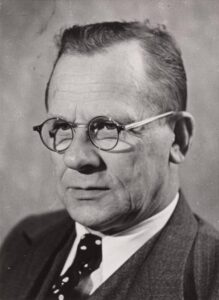 (a communist politician) and a sympathetic member of the CPN,” states the CPN archive.
  The Communist Party of the Netherlands (CPN) was a Dutch political party that was founded in 1909 under the name Social Democratic Party (SDP) as a split from the SDAP,
  and merged into Groen Links in 1990. About a year after the merger, the party organization – then the oldest in the Netherlands – was officially dissolved. The party represented the mainstream of communism (Marxism-Leninism and until 1956 Stalinism) within the Dutch political system.
Matthijs joined the resistance. He worked, among other things, for the illegal newspaper “de Waarheid” (a communist newspaper) and he spread messages from the English radio (the BBC radio provided airtime for broadcasts in the languages of occupied countries; Radio Oranje was the name of the Dutch broadcast).
De Visser believed that Matthijs van der Harst made better propaganda as a non-member of the CPN. Matthijs distributed De Waarheid, 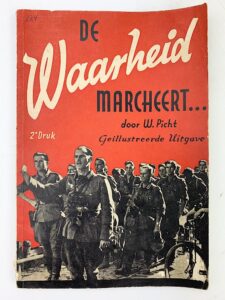 the illegal resistance newspaper of the CPN, and news bulletins. In 1941, he was arrested for this in The Hague and held for three weeks in the Scheveningen prison, and had “the rare luck to be released.” He then left for Amersfoort. During a house search on 20-02-1945, he was arrested again and transferred to the prison in Apeldoorn and from there to the De Kruisberg prison in Doetinchem.
 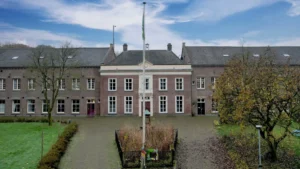 During World War II, between 05-09-1944, and 27-03-1945, hundreds of resistance fighters and Allies were held captive by the German Sicherheitsdienst
  in the De Kruisberg prison. Many were labeled as death candidates. 72 of them spent the last hours of their lives there before they were executed. 94 Others were taken by train to the German camp Neuengamme.
 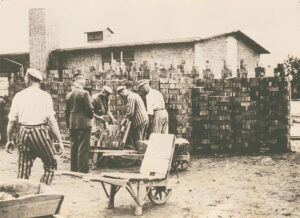 Of them, only a few survived.
Death and burial ground of Harst, Matthijs Hendrik van der.
In the nite of March 6 to 7, 1945, an attack took place, unintentionally, on Rauter, Johan Baptist Albin “Hanns,


 the highest representative of Heinrich Luipold Himmler‘s
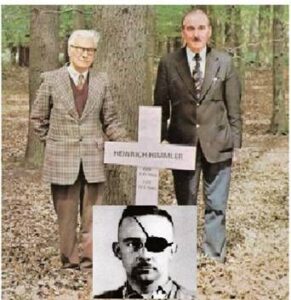 SS
SS  and head of the police in occupied Netherlands. Rauter was severely injured in the attack. As a reprisal for the attack, a total of 263 people were taken from prisons and executed at various locations in the Netherlands. At Woeste Hoeve (municipality of Apeldoorn),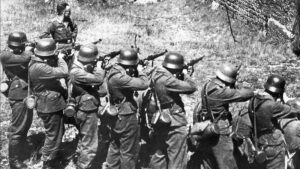
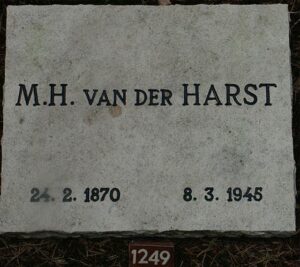
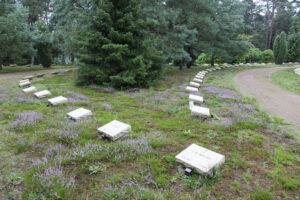
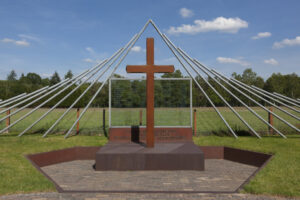 the largest reprisal action took place, where 117 men were executed by a firing squad. Matthijs Hendrik van der Harst, “our gray comrade” at 75 years old, was the oldest among them. The victims were buried in a mass grave at the Heidehof cemetery near Apeldoorn. After the liberation of Apeldoorn, all 117 victims were exhumed again and identified, except for two reburied After the liberation of Apeldoorn, all 117 victims were exhumed and identified. Matthijs Hendrik was reburied at the National Field of Honor in Loenen. Netherlands, Groenendaalseweg 64, 7371 EZ Loenen.


Leave a Reply