

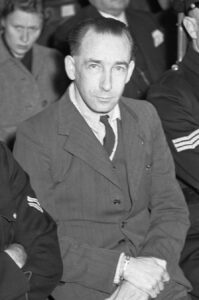
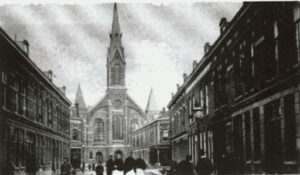
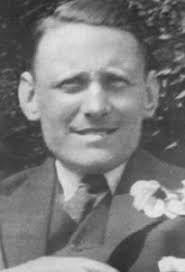
Anton van der Waals “Tom” was born 11-10-1912, in Rotterdam, 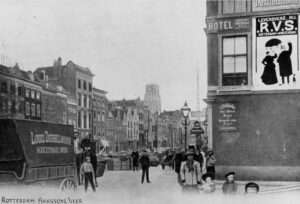 Netherlands, as an unexpected late addition to a family of four children: brother Johan “Jo” (8 years old), brother Gerard “Gerrie” (12 years old), sister Dirkje “Dit” (13 years old), and brother Frans (15 years old). The family was Reformed. He was baptized on 26-10-1912, in the Reformed church on Snellemanstraat in Rotterdam.
  His nickname became “Tom.” At home, he was crazy about building with Meccano. Due to the increasingly poor health of his parents, who were already advanced in age, his oldest sister took him under her wing. His father, Gerard van der Waals, was a painter with his own small business on Van Houtenstraat. He was seven years younger than his wife, Adriana Wouterina (Arie) Van der Waals-Cranendonk. His father came from a Protestant family in French-speaking Belgium. Van der Waals Sr. had also experienced a spiritual conversion in his youth and considered it extremely important for his family to live according to the Bible.
In 1928, Van der Waals took a position at the Rotterdam trading firm R.S. Stokvis, 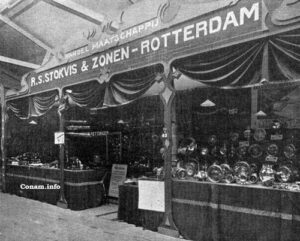 where he worked in an office. By then, he had become deeply fascinated by the radio and the technology behind it. That same year, his father set up a radio receiver in the living room, after which Van der Waals installed an antenna on the roof. In February 1929, he started a small repair shop for radios and motorcycles on Delfgaauwstraat, where his family home was located at the time. However, the business did not generate enough income to support him. In 1931, he enrolled in the technical trade school in Dordrecht. In February 1932, he left the trade school due to financial difficulties and disappointing results. Van der Waals began helping his father, who was struggling with poor health. When his father was hospitalized, his son took over for him. He always went out very well dressed.
Van der Waals married Francien Goedhart on 12-12-1934. 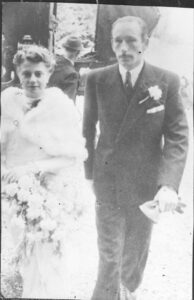 They divorced on 06-05-1936, because he allegedly concealed his membership in the NSB,
 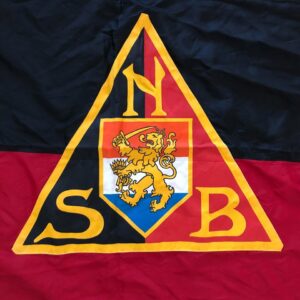 under command of Anton Adrian “Ad” Mussert,


 from her. During this period, he earned extra income as a repairman for radios and motorcycles. He made a radio invention, for which Philips NV reprimanded him; he was accused of infringing on their patent. He subsequently stopped developing his invention.
He moved frequently during this period and regularly placed ads for a housekeeper. This led to his meeting Johanna Hendrika (Jopie) Groos, whom he married on 15-02-1945 this marriage was dissolved.
In the late summer of 1939, Lodewijk de Hoop, director of Electrotechnisch Bedrijf De Hoop, frequently sent Van der Waals to the Port of Rotterdam, where he carried out repairs on submarines and other warships. During that time, he learned to speak English and German. After his military service, he regularly visited the “Royal Ships” café on Witte de Withstraat with the ship’s crew members. There he was introduced to the world of (counter) espionage.
After the bombing of Rotterdam 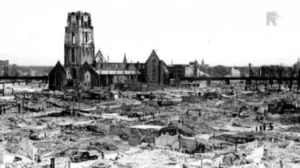 on 14-05-1940, chaos broke out in the city; businesses remained closed for several weeks, and looting was rampant. During those days, Van der Waals had, under mysterious circumstances, come into possession of two patented inventions, which he presented as his own creations: a radio improvement and a crankshaft-less internal combustion engine. In September 1940, he presented the inventions to Lodewijk de Hoop. De Hoop was suspicious and returned the documents. Through his older brother Johan, Van der Waals came into contact with Arij Pieter van der Meer, the 38-year-old director of the Paul C. Kaiser cookie factory. Van der Meer was very willing to cooperate and, as a member of a young resistance group, willing to pass the invention on to the British government. Van der Waals also presented himself as anti-German. Van der Meer introduced him to Jan Streef, a cadet at the Royal Military Academy
 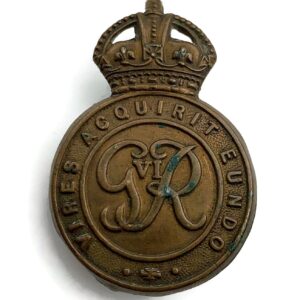 who was active in the underground. Following a meeting organized by Streef at Van der Waals’ apartment on April 24-04-1941, five of the seven members of the “Van der Meer” resistance group were arrested by the SD
  in the days that followed.
On 30-04-1941, Van der Waals was introduced to Joseph Schreieder, a German police officer and SS member. 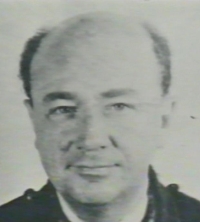
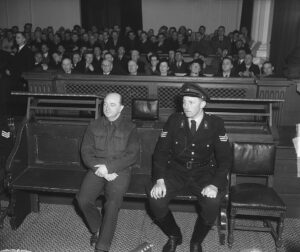 by a man named Möller, head of the Rotterdam branch of the Sicherheitsdienst (SD). Schreieder directed German counterintelligence operations from the Binnenhof in The Hague. Schreieder won Van der Waals over by assigning him to the Bierhuijs case. That case involved the murder of a member of the German Wehrmacht by Johannes “Hans” Bierhuijs
 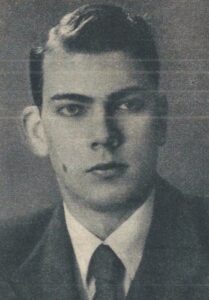 , a 22-year-old student at the MTS. Joseph Schreieder survived the war and died in Munich on 24-12-1990, age 86.
On 09-05-1941, after traveling from Haarlem to Rotterdam at Van der Waals’s request, Hans Bierhuijs was arrested there by the SD. The SD agents beat Bierhuijs black and blue while Van der Waals looked on. A note with the name “Boom” was found on Bierhuijs’s body. That same evening, Van der Waals was given the address of the 24-year-old MTS student Boom. The next day, Boom was arrested.
At Schreieder’s request, the Bierhuijs case was expanded to include the Heemstede resistance group, of which Bierhuijs was also a member. The group had been founded by Josef Albertus Klingen, 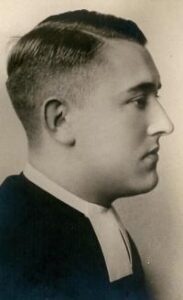 a Dutch religious figure and resistance fighter during World War II. who taught at the Jacobaschool in Heemstede. “Brother Josef” was also a radio amateur operating from the St. Jean Baptist de la Salle friary on Herenweg. Within a few days, Van der Waals had built up so much trust with Brother Josef that the latter shared all his secrets with him. Van der Waals no longer showed up for work at De Hoop, but remained on the payroll there because they did not dare to fire him. On 26-05-1941, Klingen was betrayed by the Rotterdam V-Mann Anton van der Waals and imprisoned in the Scheveningen Detention Center (Oranjehotel).
  On January 24 of the following year, he was executed by firing squad at the Waalsdorpervlakte, along with his closest associate, Hendricus Machiel Cornelis “Henk ” Schoenmaker, age 27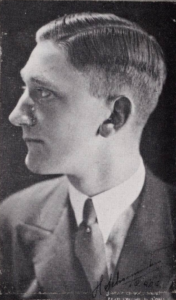
In the spring of 1941, a unified national organization for the diverse but numerous resistance groups in the Netherlands was still a long way off. In particular, the proliferation of different radio stations and the resulting anonymous messages sent to the British led to the development of a universal coding system by a professor from Delft. Henk Schoenmaker, a radio operator from Haarlem, was to personally deliver that system to England. On 06-05-1941, Schoenmaker and Willem Zietse, a naval officer, were arrested by the SD while traveling from Schiedam to Scheveningen. On 14-05-1941, Radio Oranje  played a specific verse of the Wilhelmus national anthem. For Brother Josef, this was the signal that Schoenmaker and Zietse had arrived safely. Naturally, the German headquarters participated in a ruse to deceive the resistance fighters. This deception was necessary to maintain the resistance fighters’ trust in V-Mann Anton van der Waals and thereby ensure the continuity of SD arrests. In this game, called the “Englandspiel” by the Germans, messages were sent under false identities that appeared to come from the resistance, in order to lure resistance fighters from England into German hands. On 26-05-1941, Brother Josef was arrested. Three days later, on 29-05-1941, the resistance men, Embert Spreeuw and Adrianus Antoniusvan Amerongen
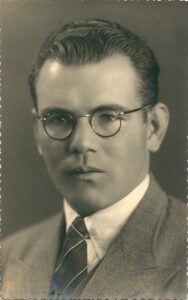
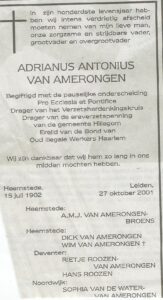
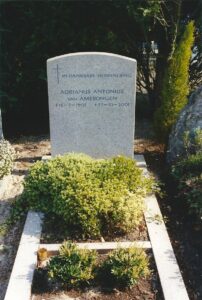 were also arrested.
Whenever Van der Waals was physically present at an arrest, he was also taken away in handcuffs. This was done to protect him from suspicion by members of the resistance who were watching the arrests as bystanders. Most members of the Klingen Group were taken to the Scheveningen prison (Polizeigefängnis), which the resistance called the “Oranjehotel.”
The E-Group was a resistance group named after Ernst Willem de Jonge 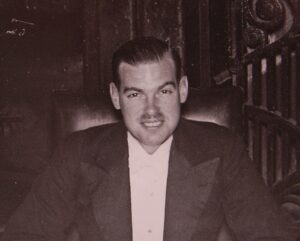
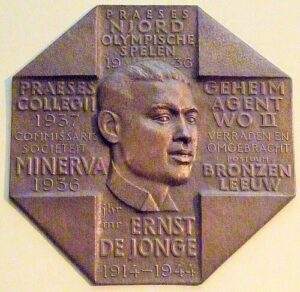 Ernst de Jonge, aged 30, was imprisoned in the Rawitsch/Ravensbrück concentration camp, where he died in September 1944.
Van der Waals had come into contact with him through Christian Corneille “Kees” Dutilh.
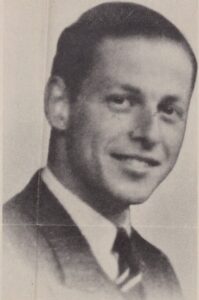
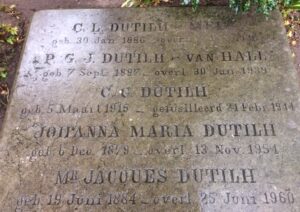 On his birthday, Leen Pot and resistance fighter Adrianus Aloijsius Felix “Lex” Althoff
 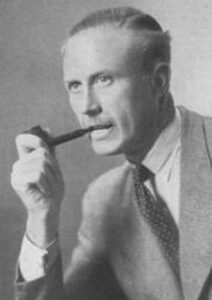 came to visit him; they were arrested. On the way to the Binnenhof, Leen Pot broke free, disappeared up the Spui, and fled into Vroom & Dreesmann. As a result, the E-Group lost its agent and its radio transmitter. From then on, messages were sent to England via the Swedish Route, but that was never a quick process. Lex Althoff while attempting to travel to England, was arrested and imprisoned at the Oranjehotel, Kamp Haaren, and Gansstraat Prison in Utrecht. Althoff was executed in Leusden (Leusderheide), 29-09-1943, age 39.
In January 1943, Kees Dutilh met a man who introduced himself as Anton de Wilde, who later turned out to be Van der Waals. De Wilde pretended he had just arrived from England; he had English cigarettes with him and detailed stories about life in London. Too detailed, Leen Pot thought, but Kees Dutilh trusted him. De Wilde, who was still working for Josef Schreieder, was tasked with infiltrating the E-Group. On March 10, Dutilh was arrested during a meeting with De Wilde; he was executed by firing squad on 24-02-1944 age28. Leen Pot felt unsafe and left in June via the Swedish Route.
In June 1943, word spread that Van der Waals had been murdered. In September, Van der Waals left Delfzijl for Sweden, just before he had Allard Lambertus Oosterhuis 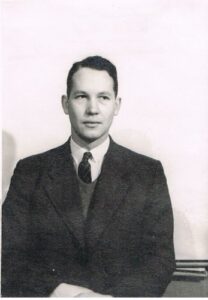 arrested, bringing the Swedish Route to an end. In Sweden, he was tasked with determining whether there were any clandestine contacts between Sweden and the Netherlands, but he did not learn much, so he returned in October. He settled in Loosdrecht under the name H.J. van Veen.
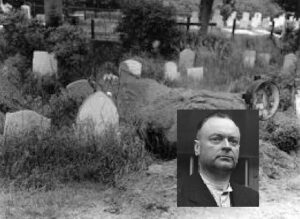
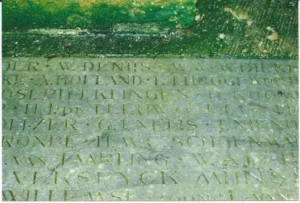
Death and burial ground of Waals, Antonius “Anton” “Tom”.
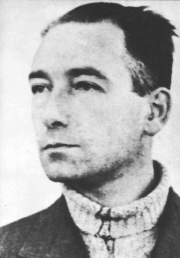
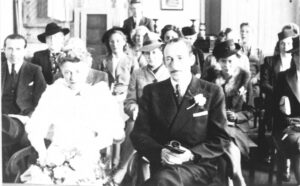

In 1945, van de Waals moved to Zuidlaren. He reported to Canadian Field Security, which handed him over to British Special Counterintelligence. He was deployed by Louis Einthoven, 
 head of the National Security Bureau, to infiltrate Germany, but was extradited to the Netherlands in 1947. In 1948, he was brought before the Court of Appeal in The Hague.
 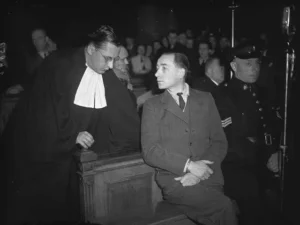 Van der Waals is often referred to as the greatest Dutch traitor of World War II. The outcome of his trial, which took place between April 1948 and January 1950, was that there was sufficient evidence of his guilt in the arrest of 83 resistance fighters by the Germans, of whom at least 34 were executed. Experts are convinced that the number of people handed over to the SD by Van der Waals is many times higher. He was sentenced to death and executed at the Waalsdorpervlakte on 26-01-1950, age 37.
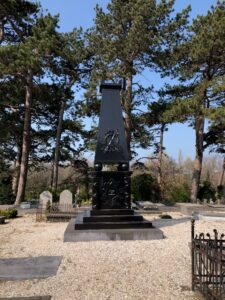
Although there is no public grave, these are the key details regarding his fate: Location of execution: He was shot at the Waalsdorpervlakte, a site that the Germans themselves had used during the war to execute members of the resistance. Disposition of remains: It was customary at the time for the bodies of executed war criminals to be buried in an unmarked grave or cremated to prevent the grave from becoming a pilgrimage site for sympathizers. Rumors: There are unconfirmed claims that his remains lie in an unmarked grave at a public cemetery in The Hague, but the government has never released any official details on this matter. Waalsdorpervlakte is in the Meijendel dune area near The Hague, Netherlands.
Message(s), tips or interesting graves for the webmaster: robhopmans@outlook.com




Leave a Reply