

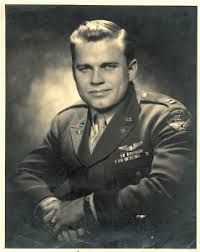
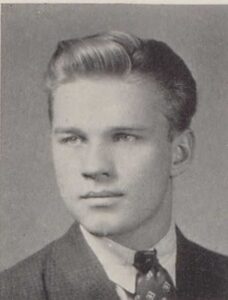
Lewis, Robert Alvin, born 18-10-1917, in Brooklyn, Kings, 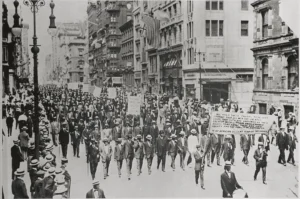 New York, United States, to George Washington Lewis
 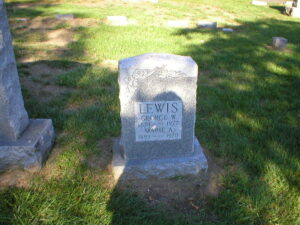 (1881–1972) and his wife Marie Anna Auguste Caroline, born Dietz Lewis (1885–1970).
Robert, in 1946 married with Mary Eileen, born Kelly Lewis (1924–2014).
He grew up in Ridgefield Park, New Jersey, where he attended Ridgefield Park High School,  graduating in 1937. During World War II, he had to wait after enlisting to be processed into the USAAF Officer Candidate School (OCS).
  Lewis went on to be a multi-engine test pilot in B-24, B-26, B-17 and B-29 bombers, which later led to him as co-pilot and his crew being selected for the Hiroshima bombing mission.
Lewis was field promoted to captain by General Curtis Emmerson “Iron Ass” LeMay

 after demonstrating the B-29 and training the general on how to fly it. LeMay addressed Lieutenant Lewis as “Captain Lewis” on the field at the conclusion of several days of training and testing. Lewis tried to correct the general as to his rank, but LeMay insisted on captain, with the field commission arriving several weeks later by USAAF mail to him based in the midwestern US at the time.
Lewis was always a “crew-first” pilot who survived two crashes due to electrical failure and engine failure. Articles from New York City area newspapers attested to his “cool head under stressful conditions”, ultimately leading to his selection as captain of a B-29 crew. Lewis led hundreds of bombing runs from Utah to Salton Sea in California leading up to his selection with his crew by Colonel Paul Warfield Tibbets.  In early June, Lewis and his co-pilot Dick McNamara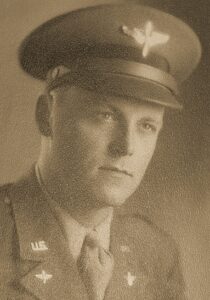
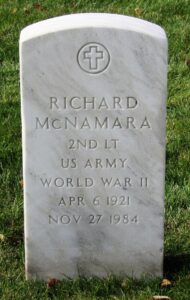 flew the entire crew and support crew from Utah to Tinian, in the B-29
  specially modified to carry Little Boy
  to Japan from the huge Tinian base that General LeMay controlled from Guam.
On August 6, 1945 – August 5 in the United States, due to the time difference – Lewis was the co-pilot of the Enola Gay  when it dropped Little Boy on Hiroshima.

 Normally the aircraft commander assigned to the Enola Gay, for this important mission he acted as co-pilot and co-commander, assisting Enola Gay’s new aircraft commander, Colonel Paul Warfield Tibbets. Lewis and his crew, minus their original co-pilot Dick McNamara, were Tibbets’ crew for the mission, and it included two specialists for the arming of Little Boy, the uranium-235 fission bomb.
The entire story was written by Lewis just before his death in 1983. His log, the only minute-by-minute recording on paper by any crew member that day, is part of his copyrighted historical manuscript owned by the Lewis children. 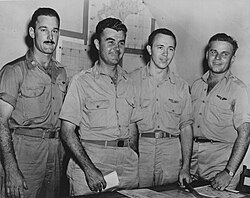 From left to right: Major Thomas W. Ferebee, Bombardier; Colonel Paul Warfield Tibbets, Jr., Pilot; Captain Theodore J. Van Kirk, Navigator; and Captain Robert Lewis, crew officer of the Enola Gay, the aircraft that dropped the atomic bomb on Hiroshima.
After the war, Lewis became a pilot for American Overseas Airlines,  specializing in the New York to London routes. He left in 1947 to rejoin his prewar employer, the Henry Heide Candy Company,
  where he became plant manager and personnel director of their factory in New Brunswick, New Jersey. He was granted at least three patents during his time at Heide. In the 1950s, Lewis lived with his family in Ridgefield Park, Maywood and Lake Mohawk. He and his wife had a daughter and four sons.
In New York City in 1951, Lewis met Hiroshima survivor Father Hubert Friedrich Heinrich Schiffer, S.J., here with Lewis 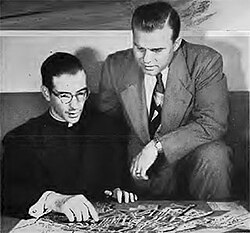
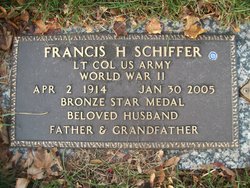 who was eight blocks from ground zero when the explosion occurred and was seriously injured. Schiffer invited Lewis to visit Hiroshima in August 1952 for the dedication of a “palace of prayer”, which Lewis accepted; however, there is no record of Lewis actually making such a visit. The two also appeared together at Fordham University in 1957, on the twelfth anniversary of the bombing, with Schiffer noting that they had become “very fast friends.”
Lewis described the Enola Gay‘s flight and the dropping of the bomb on Hiroshima in the television show This Is Your Life, in an episode not without controversy. The show had as its guest Reverend Kiyoshi Tanimoto 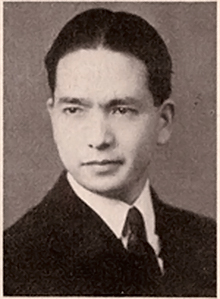 , a Japanese Methodist minister famous for his humanitarian work for the Hiroshima Maidens. Tanimoto was a U.S educated Methodist .. who had been living in Hiroshima at the time of the bombing and survived the explosion, as recounted in John Hersey’s 1946 book Hiroshima. When asked by host Ralph Edwards if he remembered his reaction on that fateful day, he remarked, “I wrote down later, ‘My God, what have we done?’ ”
Lewis became a self-taught stone sculptor, working in marble and alabaster, following a business trip to Florence where he saw some apprentices at work. One of his sculptures, titled ‘God’s Wind’ at Hiroshima?, 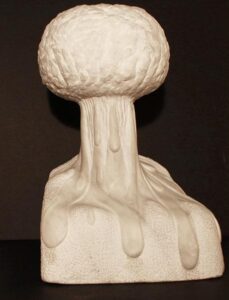 depicted a mushroom cloud. In the 1970s, Lewis lived in a small cottage on West Shore Trail in the quiet Lake Mohawk community of Sparta, New Jersey.
In 1971, Lewis sold his manuscript log from the Hiroshima mission, which he had written during the flight at the request of journalist William L. Laurence; it was auctioned by Christie’s and sold for $37,000. The manuscript was later resold to Malcolm Forbes, and after Forbes’ death was purchased by an anonymous buyer. Prior to the 1971 sale, Lewis made six hand-written copies of the log, one each for his wife and five children; one copy was sold in 2015 for $50,000.
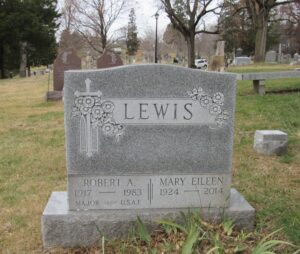
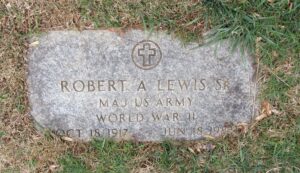
Death and burial ground of Lewis, Robert Alvin.
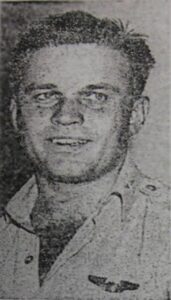
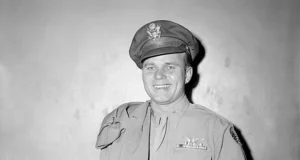
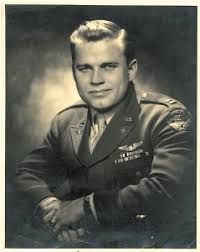
In 1975, Lewis took a position with the Estee Candy Corporation, until his retirement in 1981. Lewis lived in Smithfield, Virginia, for two years before his death on 18-06-1983 (aged 65) in Newport News, Virginia, U.S. of a heart attack at home; he was declared dead at Riverside Hospital in Newport News, Virginia.


Leave a Reply