

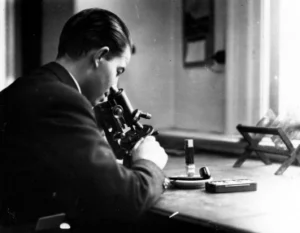
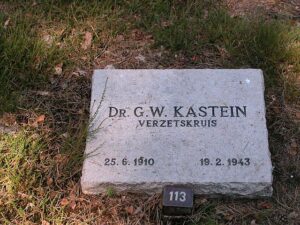
Kastein, Gerrit Willem, born 25-06-1910 in Zutphen, Netherlands, 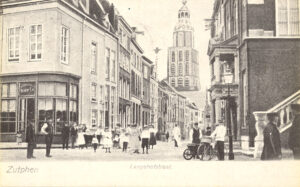 as the eldest son of Albertus Gerhardus Kastein and Gerdina, born Leurink. Gerrit studied medicine in Groningen, Heidelberg and Leiden and became a neurologist. In 1937 he obtained his doctorate with the dissertation Eine Kritik der Ganzheitstheorien. Kastein was married to the German Elisabeth Sachse. The couple had two children. In the thirties Kastein became a convinced communist, who also often gave lectures. For this reason he was kept under surveillance by the Dutch authorities. During the Spanish Civil War
  he accompanied an ambulance team as a doctor to provide assistance. He also provided medical assistance to the Hague communist and resistance man Arie Kloostra,
  whom he would later meet again during the armed resistance. He spoke out against racism and wrote a book about it. Arie Kloostra after the liberation of Dachau camp on 29-04-1945, left for home in an organized bus with other prisoners. Arie died age 80 in Epse, on 21-10-1998.
During World War II, Kastein became active in the resistance immediately after the Dutch capitulation. On 17-05-1940, he attended the founding meeting at the home of Anton “Toon” van der Kroft, 
 of the Hague branch of the illegal Communist Party of the Netherlands, CPN. The Vonk group was founded at that meeting. De Vonk is the name of several illegal papers during World War II. The associated Dutch resistance organization is referred to as De Vonk group. The name De Vonk is a translation of the Russian word Iskra, which was the name of an underground paper from 1903 that Lenin had smuggled from Switzerland to Saint Petersburg. Lenin
  had borrowed the name from Pushkin, who had written From the Vonk the flame will flare up, which meant the fire of the revolution. The name is therefore very symbolic for the combination of concepts such as communism, underground and revolutionary.
Gerritt was also one of the initiators of the Medical Resistance. Kastein’s first arrest attempt was on 02-09-1941, but Kastein was warned in time and went into hiding. Later in the war, he was in charge of the resistance group CS-6. This group, named after the address Corellistraat 6 where two members (the Boissevain brothers Jan Karel “Janka” and Gideon Boissevain “Gi”.) 
 lived, included Truus van Lier
 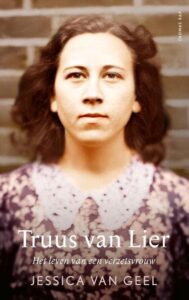 , she died age 22 in Sachsenhausen KZ, 27-10-1943, Verleun, Johannes Adrianus Jozef “Jan”,

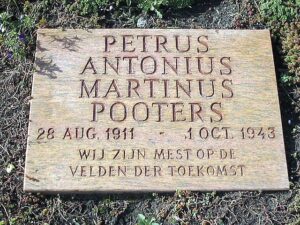
 , Pooters, Petrus Antonius Martinus “Pam”
 Reina Prinsen Geerligs,
 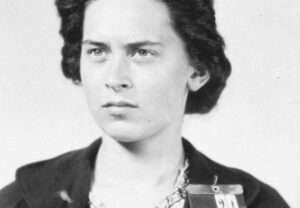 she died age 21 in Sachsenhausen KZ, 24-11-1943, Leo Herman Frijda,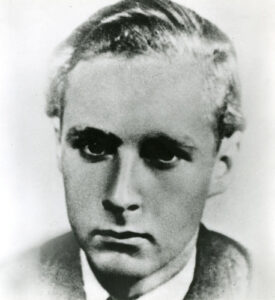
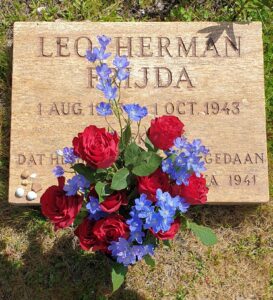 Leo, age 20 and 14 other CS-6 members were sentenced to death by the Polizeistandgericht and shot on 1-10-1943. His grave is also at the Bloemendaal Cemetery of Honour.
 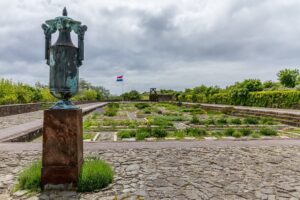 Hans Katan, age 24
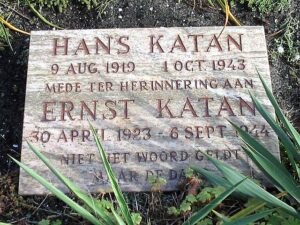 excecuted 01-10-1943, Sape Kuiper,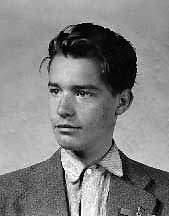
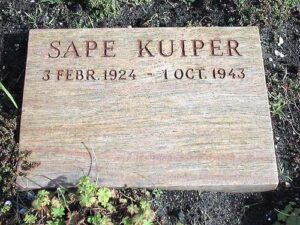 Walter Brandligt,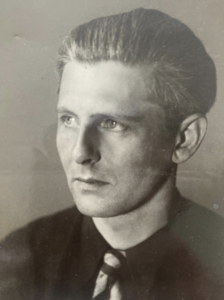
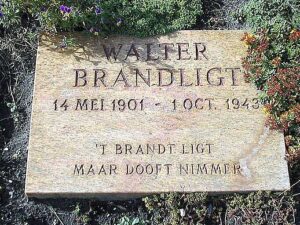 excecuted age 41 on 01-10-1943,the brothers Jan Karel Boissevain and Gideon Willem Boissevain and their second cousin Louis Daniel Boissevain
  , executed by the Germans, age 21 on 01-10-1943.
Kastein also worked closely with non-communist resistance groups. He had wanted to have photographs of German defence positions along the Dutch coast delivered to the Dutch government in London via such resistance groups and a ship to Gothenburg. However, the courier intended by these resistance groups turned out to be the V-Mann and traitor Anton van der Waals,  who played the film roll into German hands. Via a number of intermediaries, the last of whom was Christian Corneille “Kees” Dutilh,
 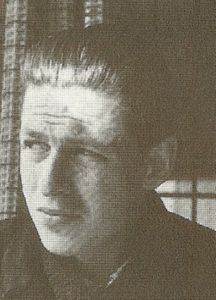 Van der Waals managed to get in touch with Kastein. Kees Dutilh, age 26, was executed on 24-02-1944 in the Fort near Rijnauwen
Van der Waals is sometimes called the greatest Dutch traitor of the Second World War. The outcome of his trial between April 1948 and January 1950 was that there was sufficient evidence of his guilt in the arrest of 83 resistance fighters in German hands, of whom at least 34 were executed. Experts are convinced that the number of people handed over to the SD  by Van der Waals is many times higher. He, age 37 was sentenced to death and executed on the Waalsdorpervlakte
 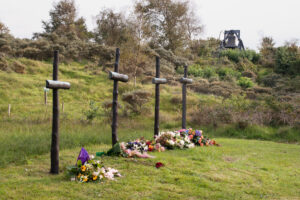 on 26-01-1950.
On 05-02-1943, Kastein was involved with Jan Verleun in an assassination attempt on Lieutenant General Hendrik Alexander Seijffardt, age 70 
 who died a day later as a result. During the trial against Verleun, he stated that he was accompanied by Kastein, but other sources state that Leo Frijda was present at the attack and that Kastein was only involved in the preparation. Seijffardt was nominated to become the new Minister of War and was therefore an interesting target for the resistance. It is striking that Seijffardt’s home at Van Neckstraat 36 was 200 metres from Kastein’s home at Van der Aastraat 14. On 07-02-1943, Kastein committed another assassination attempt, this time on NSB ( member jurist Hermannus Haak Steenhart Reydon (Voorschoten, 06-12-1896 – Leiden, 24-08-1943, age 46)
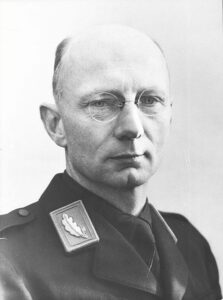
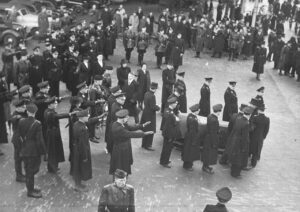
 who was a Dutch National Socialist activist and civil servant and traitor.
On 19-02-1943, Kastein was supposed to meet with communist resistance fighter Piet Wapperom 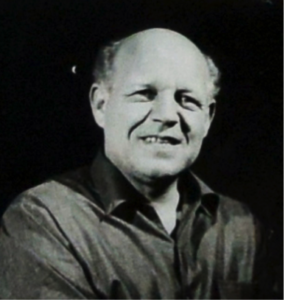 in café De Kroon in Delft. They were supposed to discuss a plan to set fire to all employment agencies in the Netherlands at the same time, in order to thwart the sending of Dutch men to Germany. However, Wapperom had already been arrested in Utrecht by the Rotterdam Sicherheitsdienst. A note of the meeting was found in a notebook during a search. Wapperon survived the war and died in Den Haag 22-11-1967, age 54.
The Rotterdam Sicherheitsdienst (SD) put Wapperom down with a broomstick in his trouser legs, so that he could not run away, as bait in the café. Exactly on time at 10 o’clock in the morning, Kastein entered and was immediately seized and taken to a car outside with false number plates. Ernst Knorr 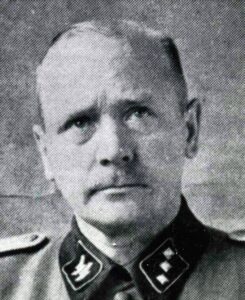
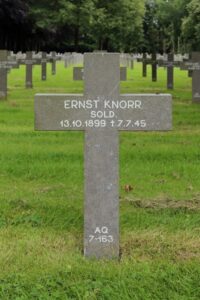 of the Hague Sicherheitsdienst was waiting in the car. When placed in the car, a struggle ensued, during which Kastein managed to pull a pistol from his jacket pocket and shoot, wounding Knorr, age 54, quite seriously. When the car drove away, a puddle of blood was left behind on the street.
Dr. Ernst Knorr was an SS officer with the rank of SS-Untersturmführer (second lieutenant). He led the SD. He was part of Referat IV-A (Bekämpfung Kommunismus) of the Sicherheitsdienst in The Hague and was known as the executioner during interrogations.
When frisking, the SD found a notebook with a written down meeting with the communist resistance fighter Lucas Spoor  later that day. Lucas Spoor lives with his wife and two children in The Hague during the war and is an instrument maker by profession. Lucas is a member of the CPN, the Communist Party of the Netherlands, and works with Vrij Nederland. On 11-08-1944, aged 37, Lucas is shot by the Germans in Vught.
Death and burial ground of Kastein, Gerrit Willem.


When they arrived at the Binnenhof, Kastein declared himself willing to cooperate in going to that meeting. The meeting was in the coffee house in Voorburg near the Laan van Nieuw Oost Indië station in The Hague. 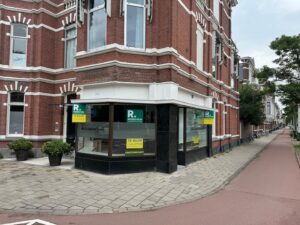
There, SD officer Johannes Hoffman got out and walked to the coffee house that was ten meters from the road. Kastein, who was handcuffed, managed to grab a pistol from between his legs and shot SD officer Martin Kohlen in the leg in the car, jumped out of the car and ran away, but he was quickly overtaken. He was placed in the car and when it drove away, four armed men stormed out of the café. The car drove to the Binnenhof, where Kastein had to get out. He managed to pull a pistol from his abdomen again and shot himself in the chest, but the weapon bounced. Kastein was taken to the interrogation room on the second floor in the extension above the entrance to Binnenhof 7 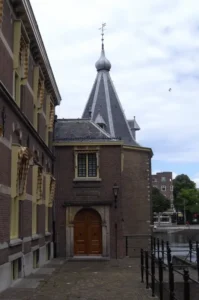 and tied to a chair. The SD officers left for consultation, while an SD officer stayed behind. Kastein jumped up unexpectedly and dived – according to one version of the story, chair and all – through the closed window on the north side. He suffered a fractured skull and died a few hours later. A colleague of Kastein from another hospital and the wife of yet another colleague, who came to inquire about her arrested husband, witnessed Kastein’s fall.
Gerrit Willem Kastein was posthumously awarded the resistance cross  1940-1945. With Lou Jansen

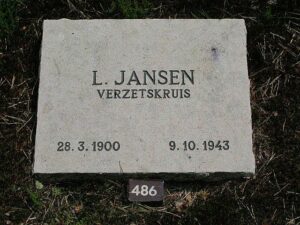 and Hannie Schaft,
 Kastein formed the three communists who were awarded the resistance cross. A road in The Hague and a street in Leiden and Hoogvliet were named after Kastein. He is buried in the Loenen field of honor.


Leave a Reply