

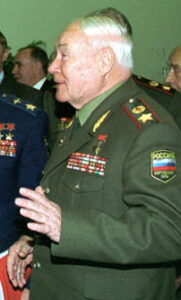
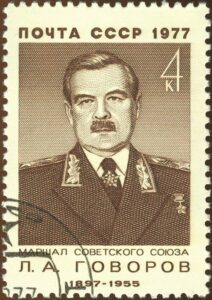
Govorov, Leonid Aleksandrovitsj, born 10-02-1897 in Gouvernement Vjatka, Moscow, 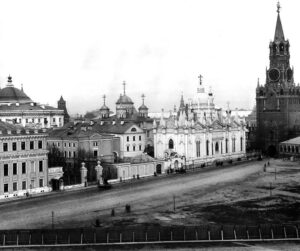 as the eldest of four sons of Alexandr Grigoryevich Govorov and Maria Aleksandrovna Govorova, after him came Nikolaj, Michail, and Vladimir.
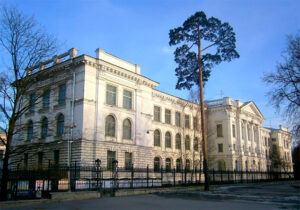
  His father worked as a river boatman, a sailor for the Stakheyev merchants’ steamship company, and as a clerk at the Realschule in Yelabuga. His mother was a housewife. Leonid attended the vocational school in Yaransk and then the Realschule in Yelabuga, where he graduated in 1916. He went to the shipbuilding department of the Saint Petersburg Polytechnic Institute.
  In December 1916, he was mobilized into the Army of the Russian Empire. He was sent to the Konstantinovsky Artillery School.
 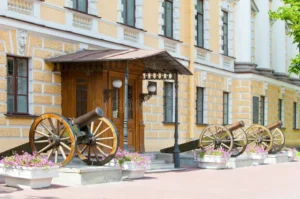 In June 1917, as a non-commissioned officer, Govorov was given command of a mortar battery from the Tomsk garrison. In March 1918, he was demobilized and returned to his parents in Yelabuga, where he got a job at a cooperative.
Trained as an artillery officer, he joined the Red Army  in 1920. He graduated from several Soviet military academies, including the Military Academy of Red Army General Staff. He participated in the Winter War of 1939–1940 against Finland as a senior artillery officer.
In World War II, Govorov rose to command an army in November 1941 during the Battle of Moscow. 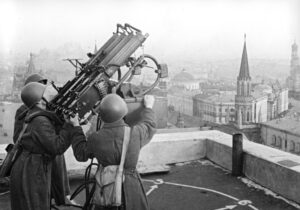 He commanded the Leningrad Front from April 1942 to the end of the war. He reached the rank of Marshal of the Soviet Union in 1944, and was awarded the title of Hero of the Soviet Union
  and many other awards. He was the father of Soviet General Vladimir Govorov.
When the Russian Revolution broke out and the Russian Army disintegrated, Govorov returned home, but was conscripted into the White Guard  army of Admiral Alexander Vasilyevich Kolchak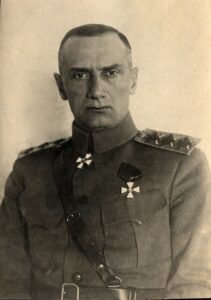
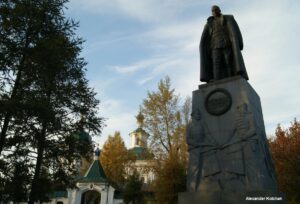 in October 1918, serving in an artillery battery with the 8th Kama Rifle Division of the 2nd Ufa Army Corps in the Western Army, fighting in the Russian Civil War. Govorov fought in the Spring Offensive of the Russian Army, a general drive westwards by White forces in the east. He deserted in November 1919, fleeing to Tomsk, where he took part in an uprising against White authorities as part of a fighting squad. Govorov joined the Red Army in January 1920, serving in the 51st Rifle Division as an artillery battalion commander. With the division, he fought in the Siege of Perekop in November, during which Soviet forces drove Pyotr Wrangel’s
 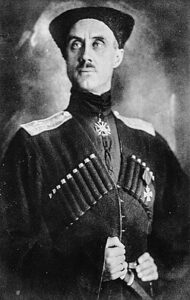 White Army out of Crimea. Govorov was wounded twice during the year and was awarded the Order of the Red Banner
 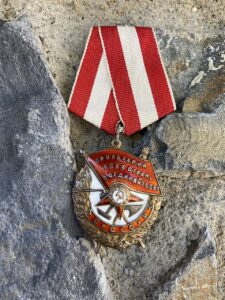 in 1921 for his actions in Crimea.
In 1923 he met in Odessa, and later married Lydia Izdebska, 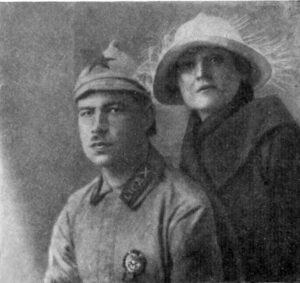 the daughter of a former manager of a Polish estate. In 1924 their son Vladimir, the later General was born.
Govorov obtained further military education, graduating from the Artillery course in 1926, the Higher Academy course in 1930, and the Frunze Military Academy 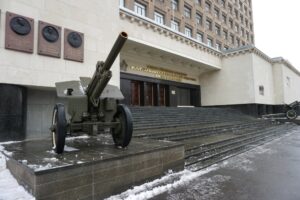 in 1933. In 1936, Govorov was among the first officers who attended the newly founded Military Academy of Red Army General Staff,
 from which he graduated in 1938.
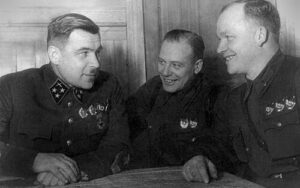
From 1936, he was head of artillery in the Kiev Military District. In 1938 he was appointed as lecturer in tactics at the Dzerzhinsky Artillery Academy. In 1939, he finished his first research publication. This was the period of Joseph Stalin‘s Great Purge.  Govorov was close to being arrested, but in the end survived thanks to the intervention of the Soviet Russian politician Mikhail Ivanovits Kalinin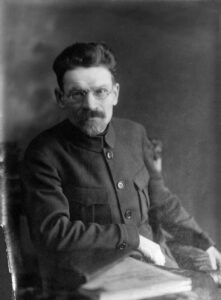
 and continued to rise in rank.
The brothers Nikolaj, Michail, and General Vladimir Govorov all became commanders of the Red Army. Nikolaj graduated from school in 1918, fought in the White Army with Leonid, and deserted. Afterwards, he served in the Red Army, demobilized for health reasons. Michail fought with the Basmachi, in 1932 he unexpectedly died of typhus. Vladimir served in the Red Army, in 1941 he was arrested and sentenced to 10 years in the camps, in 1943 he was released after Leonid Govorov’s personal request to Joseph Stalin.
In 1939 the Soviet Union invaded Finland, and Govorov was appointed chief of artillery of the 7th Army,
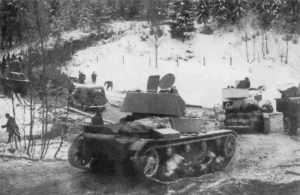 as his research while at Dzerzhinsky Artillery Academy was about assaulting and penetrating fortified enemy positions. He commanded the massive artillery assault that allowed the Soviet break through along the Mannerheim Line in 1940. For this he was awarded the Order of the Red Star
 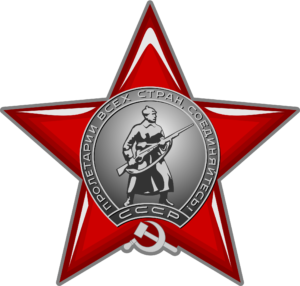 and promoted to the rank of division commander. He was then appointed Deputy Inspector-General of Artillery of the Red Army.
After Nazi Germany invaded the Soviet Union in June 1941, Govorov commanded the Artillery on the Western Front in Belarus from August to October 1941. During the Battle of Moscow, he was appointed Chief of Artillery of the 5th Army,  under the command of Major General Dmitri Danilovich Lelyushenko.
 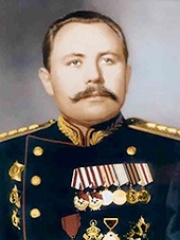 After Lelyushenko was wounded on 18 October Govorov assumed command of the army. During the Soviet counter-offensives in the winter of 1941–42, his army liberated Mozhaisk. As a result, he was promoted to the rank of lieutenant-general of artillery.
On December 1, Günther Adolf Ferdinand “Hans” von Kluge, 
 with his 4th Army (Wehrmacht)
  broke through 10 km of the defense of the 5th Army (Soviet Union) and the 33rd Army (Soviet Union) and reached Akulovo. Govorov personally led the defense on the battlefield and stopped the breakthrough by December 4. On December 6, the Klin-Solnechnogorsk operation began by the troops of the right wing of the Western Front, in which from the second half of December units of the right wing of the 5th Army actively participated. On December 11, a general offensive began. On 02-01-1942, Govorov received his second Order of Lenin for his contribution to the December counteroffensive near Moscow.
In April, Govorov was admitted to the hospital with appendicitis, and I. I. Fedjouninski replaced him as commander of the 5th Army.
From July 24 to November 24, 1944 units of the Leningrad Front, under the leadership of Govorov, carried out the Narva, Tallinn offensives and the Moonsund landing operations, defeated the German Army Detachment Narwa, and expelled the enemy from Estonia. From October 1, by order of Stavka, a name of the high command of the armed forces, he simultaneously fulfilled the task of coordinating the actions of the 2nd Baltic Front and 3rd Baltic Front in the Riga operation, alongside his command of his Front. After the liberation of Riga on October 16, the 3rd Baltic Front was disbanded and the 1st and 2nd Baltic Fronts began the encirclement of Army Group Courland. By decree of the Presidium of the Supreme Soviet on 27-01-1945, Govorov was made a Hero of the Soviet Union with the Order of Lenin and the Gold Star. 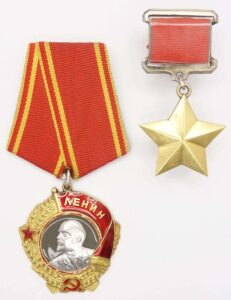 From early February, he was simultaneously appointed commander of the forces of the 2nd Baltic Front. On April 1, the front was disbanded and all units became part of the Leningrad Front. He led the Battle of Courland against Army Group Courland. On May 8, Army Group Courland capitulated.
By a decree of the Presidium of the Supreme Soviet of 31-05-1945, Govorov was awarded the Order of Victory 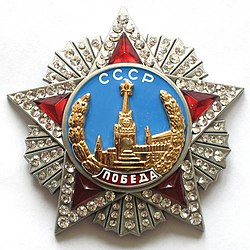 for the victory over German troops at Leningrad and in the Baltic states. On 09-07-1945, he became the commander of the Leningrad Military District, formed on the basis of the Leningrad Front. From April 1946, he was the chief inspector of the ground forces. From January 1947, he was the Chief Inspector of the USSR Armed Forces.
  From 07-07-1948, he also became the commander of the Vojska PVO, the air defense unit of the Soviet armed forces. Since March 1950, Govorov was simultaneously the Deputy Minister of Defense of the USSR. Under his leadership, the USSR underwent a structural reorganization of the control over the air defense forces, with antiaircraft missile systems, jet fighters, and the latest radar stations being adopted by the air defense units.
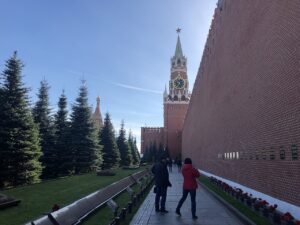
Death and burial ground of Govorov, Leonid Aleksandrovitsj.
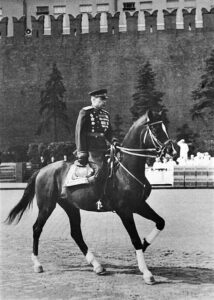
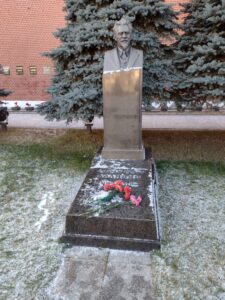
Govorov suffered from high blood pressure due to stress from the war. In July 1954, he suffered an attack of angina pectoris, which ended in a heart attack. On 02-03-1955, he suffered a third heart attack. He died on the night of 19-03-1955, age 58, at the Barvicha sanatorium near Moscow. After his death, he was cremated and the urn containing his ashes was interred in the Kremlin Wall Necropolis on Red Square in Moscow.



Leave a Reply