

Hermann Goering was an extravagant person.


In February, 1938, Goering became head of Germany’s armed forces. The following year he officially became Hitler’s deputy and legal heir. He obtained a vast income from his various official posts and converted an old Berlin palace into his official residence. Goering also made money from his own newspaper, Essener National Zeitung and from stock in the aircraft industry.
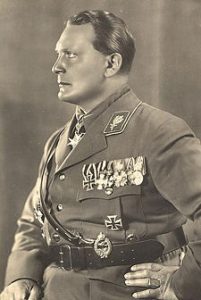
Goering was known for his extravagant tastes and garish clothing. He had various special uniforms made for the many posts he held; his Reichsmarschall uniform included a jewel-encrusted baton. Hans Ulrich Rudel,  the top Stuka pilot of the war, recalled twice meeting Goering dressed in outlandish costumes: first, a medieval hunting costume, practicing archery with his doctor; and second, dressed in a red toga fastened with a golden clasp, smoking an unusually large pipe.
  Italian Foreign Minister Galeazzo Ciano once noted Goering wearing a fur coat that looked like what “a high grade prostitute wears to the opera”. He threw lavish housewarming parties each time a round of construction was completed at Carinhall, and changed costumes several times throughout the evenings. Hermann Goering (see Goering Peter) was the most of his life morphine addicted, painted his feet and finger nails and played with little trains and toys.

Goering was noted for his patronage of music, especially opera. He entertained frequently and sumptuously, and hosted elaborate birthday parties for himself. Armaments minister Albert Speer recalled that guests brought expensive gifts such as gold bars, Dutch cigars, and valuable artwork. For his birthday in 1944, Speer gave Goering an oversize marble bust of Hitler  . As a member of the Prussian Council of State, Speer was required to donate a considerable portion of his salary towards the Council’s birthday gift to Goering without even being asked. Field Marshal Erhard Milch told Speer that similar donations were required out of the Air Ministry’s general fund, For his birthday in 1940, Italian Foreign Minister Count Ciano decorated Goering with the coveted Collar of Annuziata
  . The award reduced him to tears.
.jpg) The design of the Reichsmarschall standard, on a light blue field, featured a gold German Eagle grasping a wreath surmounted by two batons overlaid with a swastika. The reverse side of the flag had the Großkreuz des Eisernen Kreuzes surrounded by a wreath between four Luftwaffe eagles. The flag was carried by a personal standard-bearer at all public occasions.
The design of the Reichsmarschall standard, on a light blue field, featured a gold German Eagle grasping a wreath surmounted by two batons overlaid with a swastika. The reverse side of the flag had the Großkreuz des Eisernen Kreuzes surrounded by a wreath between four Luftwaffe eagles. The flag was carried by a personal standard-bearer at all public occasions.
 During the height of the war, when Germany was in the throes of food shortages and severe rationing, the food used to feed his animals was said to be enough to feed an entire village for days


 on April 25-1945 and in his political testament Hitler dismissed Goering from all his sundry offices and expelled him from the party. Two days before ending his own life Hitler sent orders to Frank to execute Goering, his wife Emmy Sonnemann and their young daughter Edda.

Bernhard Frank died very old age 96 on 29 June 2011 in Frankfurt am Main. Goering surrendered on May 9, 1945 in Bavaria. He was the third highest ranking Nazi official brought before the Nuremberg Trials, behind Reich President (former Admiral) Karl Dönitz  and former Deputy Führer Rudolf Hess.
During his trial Goering had been forced off drugs “cold turkey”, and subsequently “slimmed down”, with new renewed energy he defended himself with aggressive vigor and skill, frequently outwitting the prosecuting counsel. With Hitler dead, he stood out among the defendants as the dominating personality, dictating attitudes to other prisoners in the dock and adopting a pose of self-conscious heroism motivated by the belief that he would be immortalized as a German martyr

Nevertheless, Goering failed to convince the judges, who found him guilty on all four counts: of conspiracy to wage war, crimes against peace, war crimes and crimes against humanity. Defying the sentence imposed by his captors, he committed suicide with a potassium cyanide capsule the night before he was supposed to be hanged.


Leave a Reply