

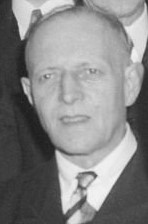
Wildermuth, Hermann-Eberhard, born 23-10-1890, in Stuttgart, 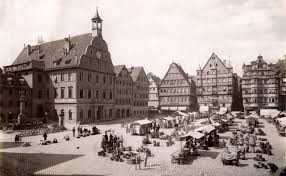 German Empire, to Hermann Wildermuth (1852–1907)
  He was married with Marianne, born Storz, Wildermuth (1887–1974).
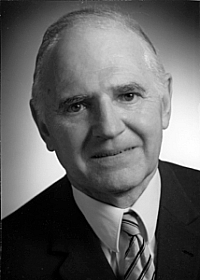
After Wildermuth completed secondary schooling in 1908 he studied law and political sciences in Tübingen, Leipzig and Berlin from 1909 to 1914. In Tübingen, Wildermuth was a member of the South German liberal fraternity “Academic Society Stuttgardia”. Here he met future political associates Reinhold Maier, 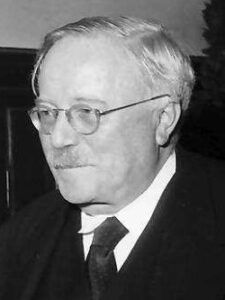 Karl Georg Pfleiderer,
 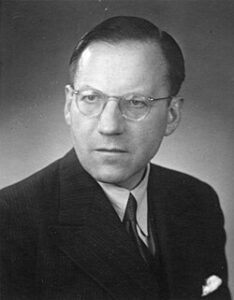 Konrad Wittwer
  and Wolfgang Haussmann.
  After graduation in 1921 Wildermuth worked at the Imperial Institute for Job Placement and Unemployment in Berlin, and later as a senior executive officer eventually worked in the Ministry of Labour. From 1928 Wildermuth was director of Deutsche Bank’s construction operations and in addition from 1930, board member, later president of the German Society for Public Works.
Wildermuth served in 1908/09 as a one-year volunteer in the 1st Württemberg Infantry Regiment. He returned as an officer of this regiment in the First World War, 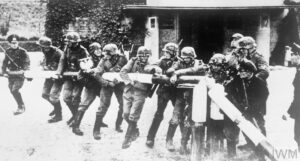 serving from 1914 to 1918 on the Western and Eastern Fronts and in Italy. From 1919 to 1921 he was commander of a battalion composed of students in Tübingen to quell uprisings against the Weimar republic. His main enemies in this period were the (Communist) Spartacus League,
 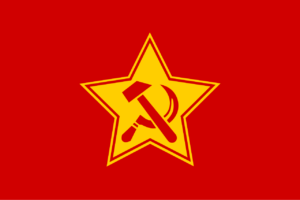 who returned the compliment by putting a price on his head. At the outbreak of the Second World War Wildermuth was drafted as a reserve major and during the Battle of France was commander of the Second Battalion of Infantry Regiment 272. In 1941/42 he served as commander of Infantry Regiment 737 in Serbia, where he was promoted to lieutenant colonel in December 1941. During this period he was ordered to undertake mass shootings in reprisal for partisan activity, but later stated that he never carried out such orders (though officers in nearby zones clearly did). As of 01-05-1942, Wildermuth was commander of Infantry Regiment 371
  at Army Group Center on the Eastern Front and then from May 1943 as commander of Infantry Regiment 578 in Italy.
On 12-08-1944 Wildermuth became “Fortress Commandant” of Le Havre in France. Wildermuth took command of the besieged port city in August 1944 and led its defense during Operation Astonia before surrendering to Allied forces in September
This came as a disappointment; he had hoped for a corps. Before taking his new command, however, he swore the ‘customary oath’ to Adolf Hitler 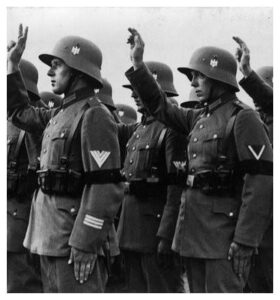 to defend the fortress to the last man, and only to surrender with the authorisation of his superiors. This oath to Hitler was, broadly speaking, respected by Wildermuth. At his interrogation by the British in January 1945, he stated that his aim had been to deny the Allies the use of the port, and to tie down as many Allied troops as possible, and that this had been achieved to his own satisfaction, since two British infantry divisions and about 150 tanks were assigned to the siege of Le Havre for almost fourteen days. Furthermore, while Wildermuth personally surrendered to British troops on 12 September, after being wounded
  in the thigh, he refused to order the surrender of the garrison on the ground that as a prisoner of war he no longer had any authority to do so.
Prior to the early September launch of the British-led Operation Astonia to take the port city Wildermuth had requested that French citizens be evacuated before heavy pre-assault naval and air bombardment commenced. His offer was rebuffed by Lieutenant-General John Crocker, 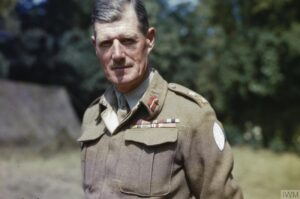 in command of the 1st British Corps which had laid siege to the city. Crocker would later argue that if Wildermuth cared about the civilian population, he could have surrendered the garrison before the bombing began, and that acceding to Wildermuth’s request would have served only the German interest, by gaining time and removing potentially disruptive French civilians from the defended fortress. After retiring, Crocker became vice-chairman of the Imperial War Graves Commission and Lord Lieutenant of Middlesex, a position he held from 1961 until his death on 09-03-1963, at the relatively young age of sixty-seven. He was also a Member of the Royal Patriotic Fund Corporation,
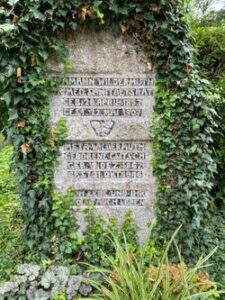
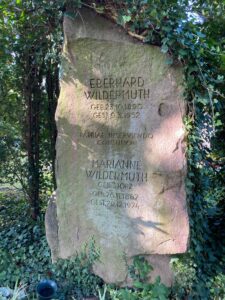
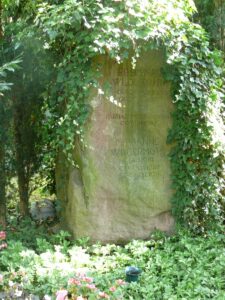
Death and burial ground of Wildermuth, Hermann-Eberhard.
Upon his 12 September surrender Wildermuth was interned in England at the Trent Park senior officers’ prisoner of war camp. 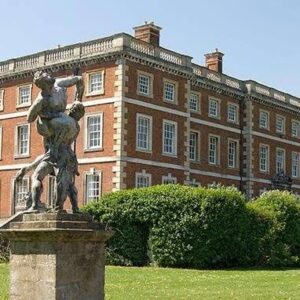
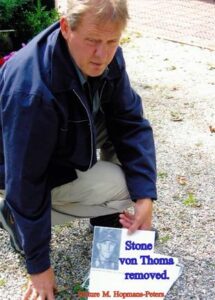
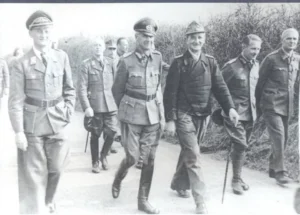 In this camp some famous German Generals were prisoners. Wilhelm Josef Ritter von Thoma,
 Hans Jurgen von Arnim
 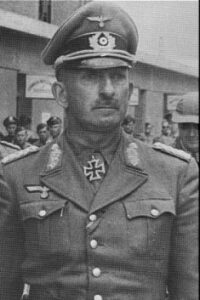 , Dietrich Hugo Hermann von, “Saviour of Paris” Choltitz
  and Ludwig August Arnold Julius Friedrich Crüwell

British intelligence considered Wildermuth a convinced patriot and brave officer but vehemently opposed the Nazi regime. In a wiretapped conversation in Trent Park, General Carl Friedrich Goerdeler  said that Wildermuth had in May 1944 been willing to participate in a coup against Hitler. He may have been influenced in this by the knowledge gained from his brother, a doctor, that the Nazis had murdered at least 100,000 mentally ill patients. In the end, however, he took no part in the plot, and would certainly not have been placed in command of Le Havre had Adolf Hitler suspected him.
Wildermuth, Hermann-Eberhard, died 09-03-1952 (aged 61), in Tübingen, West Germany and is buried at the Stadtfriedhof/cemetery Tübingen, Germany. Gmelinstraße 20, 72076 Tübingen, Germany.


Leave a Reply