

Reuhl, Heinrich Wilhelm, known as Wilhelm, was born on 04-07-1920 in Bischofsheim 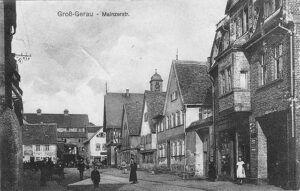 in the district of Hanau as the the eldest of three children of civil engineer Wilhelm Reuhl and his wife Margareta. He had a younger sister and a younger brother.
In his youth, Reuhl developed a keen interest in building model gliders. He subsequently learnt to fly gliders himself. He attended the Oberrealschule in Frankfurt and, after graduating in April 1938, took up a position as a trainee at a machine tool factory. This traineeship was cut short by the outbreak of World War II, and Reuhl was called up into the Wehrmacht  in October 1939.
Given his previous flying experience, his conscription into the Luftwaffe came as no surprise. Reuhl undertook his training from October 1939 at the Weimar-Nohra air base before being sent to the pilot training school at the Brandis-Waldpolenz airfield in Saxony in early 1940. In June 1940, Wilhelm Reuhl was transferred to the theatre of operations in western France. Following the victories over Poland and France, the Wehrmacht sought to gain air supremacy over Britain in order to prepare for an invasion of the island. Consequently, from July 1940 onwards, the Luftwaffe bombed British armaments factories, anti-aircraft positions and Royal Air Force (RAF) bases.  under command of Air Chief Marshal Hugh Caswell Tremenheere “Stuffy” Dowding.
 The air raids, which were extended to include civilian targets from September 1940 onwards, went down in history as ‘The Blitz’.
During this air battle, Wilhelm Reuhl – by then a Lance Corporal – was also involved as an on-board mechanic on reconnaissance flights over England. On 27-09-1940, he took part as an on-board gunner on a Junkers 88 fighter aircraft 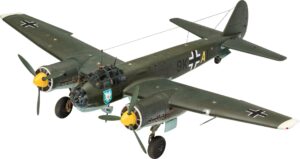 on a reconnaissance flight targeting Manchester. Equipped with high-resolution photographic equipment, the crew led by pilot Helmut ‘Acky’ Ackenhausen
 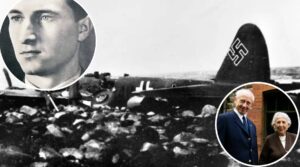 were tasked with taking photographs of the port facilities in Manchester. However, the crew did not get that far – the Ju 88 was intercepted over Bristol by three British Spitfire fighters.
  The climax of the dogfight took place at around 9.30 am over the coastal town of Porlock.
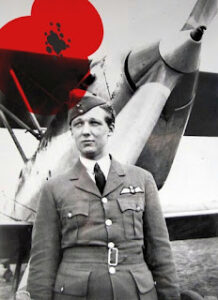
Two bursts of machine-gun fire from Flying Officer Eric Marrs’ 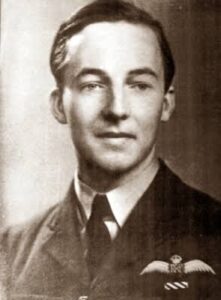
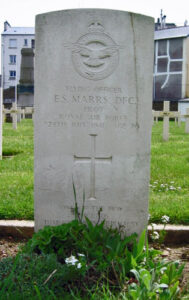 Spitfire struck the German fighter aircraft, forcing Pilot Ackenhausen to make an emergency landing on Porlock beach. Officer Marss, age 20, was killed on 24-07-1941 on a sortie escorting RAF bombers attacking the German battleships Scharnhorst and Gneisenau.
Three of the four-man Ju 88 crew had no choice but to surrender to the British coastguard and police who were rushing to the scene, and were taken into British captivity. Ackenhausen is said to have remarked: “Spitfire, too good”.
Death and burial ground of Reuhl, Heinrich Wilhelm.
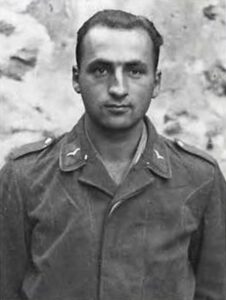
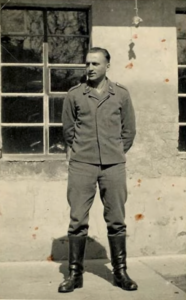
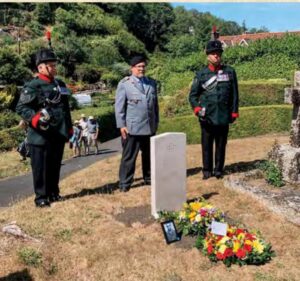
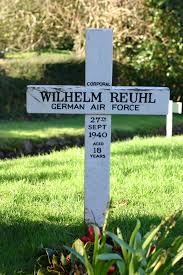
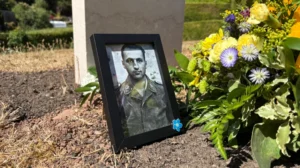
Wilhelm Reuhl, age 20, was the only one who did not survive this air battle on 27-09-1940. He was recovered from the fuselage of the aircraft, already dead. Wilhelm Reuhl was buried with military honours at Hawkcombe Cemetery in Porlock.
At the family’s request, Reuhl was not reinterred at the German war cemetery at Cannock Chase in the 1960s. His grave has always been adorned with flowers by relatives and local residents.
In 2026, on the initiative of the Commonwealth War Graves Commission (CWGC) and the Volksbund Deutsche Kriegsgräberfürsorge e.V., Wilhelm Reuhl will be given a new, standardised gravestone to ensure his memory is permanently honoured in Porlock.




Leave a Reply