

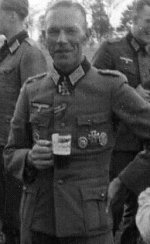
Thoor, Franciscus Adrianus Cornelius “Franz” van, born on 03-04-1922 in my hometown Eindhoven, as the only son of Janus van Thoor and Francisca Roefs..  This is where his father Adrianus “Janus”. F. van Thoor lived, milk liquor store, dairy trader or dairy peddler by trade. His deceased son helped him sell milk. This photo is from 1965. He still lives at home and works as a peddler at his father’s dairy business.
His mother Francisca is a former school teacher, Every day around five, Janus gets up to have the milk cans filled in Son and then put them on the flat cartaround in Eindhoven-Noord. “He was a sinewy, strong little man, but he could not read or write,” says Jan van den Wittenboer  about his grandfather. “So if there are people on the bought milk from him, then he had to remember all those names until he got home and my grandmother could write it down. I’ve always been amazed that he could remember all that, because.he grabbed a drink at every pub he passed,” says Van den Wittenboer with a smile.“ Those horses knew exactly where to stop.”Almost as a matter of course, Frans van Thoor helps out in the family business, he mainly visits the customers who live furthest away. But in the early 1940s, the young Eindhoven resident turned out to be wronghis job to keep another trade: bicycle tires. In times of war, food and stuff are hardly freely available, everything is distributed on the basis of coupons. There is also a need for rubber bicycle tiresscreaming shortage. “At that time, very few people had one car. You went to work by bike, that was your most important means of transport”, says Jan Julia Zurné, political historian at Radboud University Nijmegen. She points to an article in the newspaper. In it, the public prosecutor in Den Bosch sighs that there is a ‘bicycle theft epidemic’ in Eindhoven. Every month 300 two-wheelers are stolen, mainly for the rubber. Zurné: “To counter that, those thieves got very high marksto punish.” Frans van Thoor is only too aware of this he is involved in a lean business. Not that he steals bikes, certainly not. But he buys inner and outer tires from an old classmate. He tells him that those tires were taken by his father at the factory in Hoogeloon. Frans van Thoor does not ask questions. Van den Wittenboer: “He has always maintained that he did not know that the bicycle tires had been stolen.”In the end, his former classmate is caught after he has stolen bicycles on the Wilhelminaplein, at the C&A and on the Vestdijk. The trail also soon leads to Van Thoor, who has successively paid 10, 25 and 22.50 guilders for the sets of rubber tires. The judge does not find it credible that he did not know that the stuff had been stolen. A letter from his father and a good word from the pastor don’t help either. Van Thoor has to go to jail for at least a year.
Frans is remembered as a resistance fighter, but nothing is known about this. It is known that Frans is convicted of buying stolen bicycle tires from an acquaintance. He is sentenced to community service in Germany in the German penal camp Erica  and ends up in the district of Heerte in Salzgitter, where he is employed for the German war industry. Workers, camp prisoners and convicts such as Frans, who were deported to Germany as part of the Arbeitseinsatz, were put to work in the Reichswerke Hermann Wilhelm Göring ,
 a conglomerate of iron ore mines and factories, in this industrial city. Under appalling conditions, the workers work long, hard days in the production of weapons, ammunition and vehicles for the German army. Meanwhile, they suffer severely from the lack of adequate nutrition, hygiene, housing and medical care. In their weakened state, the workers are also at risk of being involved in serious accidents. Due to the enormous importance of Salzgitter as an industrial center for German arms production, the city is also regularly the target of Allied bombing raids.
Erika concentration camp was a Nazi concentration camp during World War II. The camp was situated at the Besthemerberg near Ommen. The camp was designated mostly for Dutchmen convicted of black market trade or resistance to the occupational authorities; only eight Jews were detained here.
The camp was notorious for the brutal behaviour of its personnel, leading Dutch judges to refuse to send convicts there in 1943. The camp was turned into an mostly for those refusing to do forced labour, but in the autumn of 1944 it once again became a penal camp. The camp was liberated on 11-04-1945.
Herbertus Bikker 
 also known as The Butcher of Ommen was a member of the Waffen-SS. In this function he served as a guard at the prison and work camp Erika near Ommen. He received his nickname due to his brutal behaviour at the prison camp.
From 1945 to 1946, the camp was instead used to detain Dutchmen who had collaborated with the German occupiers. Bikker died in 01-11-2008 at the age of 93, but that his death had been kept quiet. The police found Bikker dead in his home, after the door had been forced. The remains probably lingered for a few days in the apartment to which he had finally moved after discovering his identity. Bikker died of natural causes; he was buried anonymously in Haspe.
Death and burial ground of Thoor, Franciscus Adrianus Cornelius “Franz” van.


On 16-12-1942, while working in Heerte, Frans sees that a fellow prisoner is having a hard time and shares some of his food with him. The guards see this and place Frans in a tub of ice cold water as punishment. This is fatal to him; he suffers cardiac arrest and dies on the spot at the age of 20. The only thing Frans van Thoor returned from Germany was a leather wallet containing three coins, half cents. And a stack of letters. “I can still remember that he wrote that he walked to the factory singing every day,” says Jan van den Wittenboer (76) about his uncle. “I think he mostly said that not to worry his mother. Because that German labor camp was, of course, hell.”
Of course, Van den Wittenboer never knew his uncle himself, but he does remember how the body was brought from Germany to Eindhoven a few years after the war. “That was in 1951. The metal coffin was on a flat cart, with a Dutch flag over it. I can still see my grandmother diving on that box. Frenchwas also the third child that my grandfather and grandmother gave up.”Their first son died in the cradle, one of the daughters died shortly after her marriage and with Frans they also lost their youngest child. “We went to the cemetery of Fellenoord in Eindhoven  every week for years. My grandmother was devastated with grief. She left the back door open every night until her death. For French. Because she somehow had the hope that he would return.” In 1993, the body of Frans van Thoor was exhumed and transferred to the honorary cemetery in Loenen, Gelderland. And he gets a street named after him in the Eindhoven church village of Acht in the resistance hero neighborhood.
  Frans finds his final resting place on the National Field of Honor in Loenen. Zurné encountered while sifting through theVan Thoor’s file also contains a striking document, a letter from the secretary-general of the Department of Justice. He responds to a request for clemency and writes that Van Thoor’s prison sentence will be shortened by three months. So instead of March 6, he only has to be detained until December 6. “That was ten days before his death,” says Zurné. “So he wasn’t into that at allhad to be in a labor camp in Germany when he died. That letter never reached him.If you consider the conditions there, I can also imagine that those guards were not concerned with whether someone could go home earlier. Fate has pursued him continuously, he was always in the wrong place at the wrong time. That makes his death so sad.”




Leave a Reply