


Steinbach, Anna Maria “Settela”, born 23-12-1934 in Buchten near Born  (South Limburg) as the daughter of the trader and violinist of the Sinti, Heinrich (Moeselman) Steinbach and Emilia (Toetela) Steinbach.
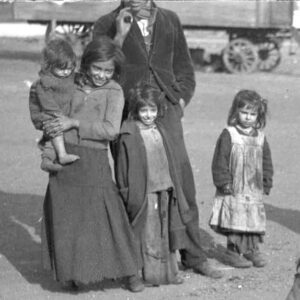
 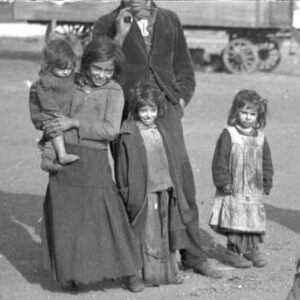 Settela as a toddler in the arms of her sister Elisabeth.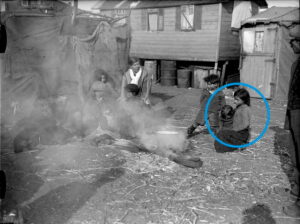
The family traveled thru Limburg playing music and begging. Steinbach family. For a long time, she was an icon of the persecution of Dutch Jews, until it was discovered in 1994 that she was not Jewish, as was assumed, but belonged to the Sinti family of the Roma.
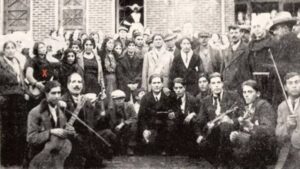
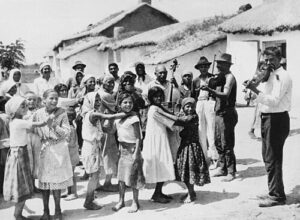
On 16-05-1944, a raid against Roma was held throughout the Netherlands. Settela was arrested in the webmaster’s birthtown Eindhoven. That same day, she arrived at Westerbork camp 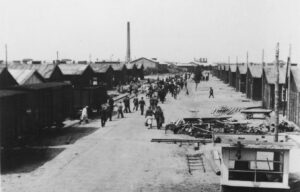 with 577 others. From this group, over 300 people were allowed to leave again quite quickly because, although they were caravan dwellers, they were not Roma. In Westerbork, Settela was shaved bald as a preventive measure against head lice. Because she was ashamed of her bald head, her mother tore off a piece of a sheet that she could wrap around her head.
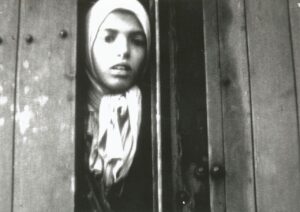
On May 19th, she was deported to Auschwitz-Birkenau by train with 244 other Sinti. 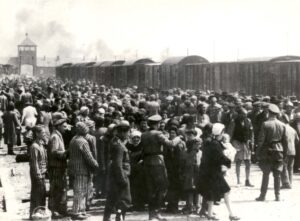 As the doors of the freight car she was to be transported in were closed, she looked out one last time at a dog walking there.
 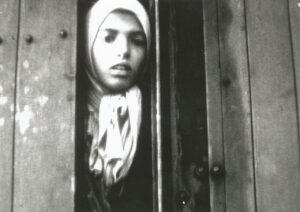 This image was captured by Werner Rudolf Breslauer,
 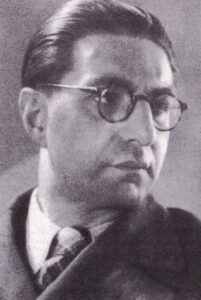 a German Jewish prisoner in Westerbork, who was commissioned by camp commander Albert Konraad Gemmeker
 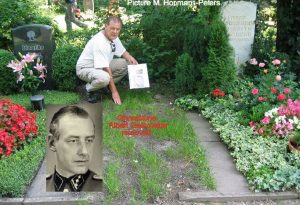 to make the Westerbork film about the camp. Her mother said, “Settela, get away from that door, you might get your head caught in it.” That’s how Crasa Wagner,
  who was behind her in the carriage, heard that her name was Settela.
On May 21, the Dutch Sinti, including Settela, arrived at Auschwitz-Birkenau. They were registered and taken to the Roma section. When half a million Jews from Hungary were deported to Auschwitz-Birkenau in the summer of 1944, the camp ran out of space. A Roma uprising broke out, but it was betrayed and quickly suppressed by the Nazis. Roma still deemed fit to work were transferred to munitions factories in Germany. Between late July and August 3, the remaining three thousand were gassed, including 213 Dutch Sinti. Settela and her mother, two brothers, two sisters, her aunt, two nephews, and a niece also belonged to this group, so the date of her death cannot be determined with certainty.
Of the Steinbach family, only Settela’s father survived the Second World War. Heinrich Steinbach had already been arrested and was sent to work for Philips in Eindhoven. After the war, he tried in vain to find his wife and ten children. A postcard dated 22-05-1945, in which he wrote from Eindhoven to the repatriation service in Maastricht, inquiring about the fate of his family, was rediscovered in 2024 in the archives of the Military Authority at the Limburg Historical Center in Maastricht. The card was answered on 26-07-1945. Heinrich Steinbach died in 1946 at the age of 44 in Maastricht, reportedly of grief, and was buried there.
Fifty-seven thousand people transported from the Netherlands arrived in Auschwitz. Of these, 38,000 were immediately gassed; the remaining 19,000 were first registered as prisoners. Of these 19,000, 900 would survive the war.
After the war, the fragment from Rudolf Breslauer’s 1944 Westerbork film was widely used in documentaries. A still from the film even became an icon for the persecution of the Jews. Because the girl’s name was unknown, she was known as “the girl with the headscarf.” Since Westerbork was primarily a transit camp for Jews, it was initially assumed that the girl was Jewish.
Death and burial ground of Steinbach, Anna Maria “Settela”.
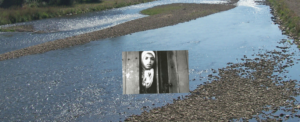
In December 1992, journalist Aad Wagenaar began an investigation into her identity. He discovered that two wagons in the filmed train were carrying Dutch Sinti. On 07-02-1994, at a trailer park in Spijkenisse, Wagenaar learned the girl’s name from Crasa Wagner. Later, it became clear to him that she had been gassed in Auschwitz along with her mother, four siblings, and four other relatives. During the Holocaust, the Sola River, near the Auschwitz-Birkenau concentration camp, was used by the Nazis to dispose of ashes and bone fragments from murdered Jews and other victims, originating from the crematoria, Probably Settela too.


Leave a Reply