


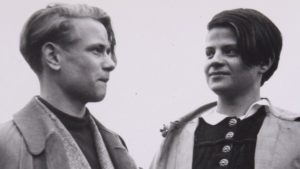
Scholl, Hans Fritz and Sophie Magdalena, born 22-09-1918 in Ingersheim  and 05-09-1921, in Forchterberg, to Robert and Magdalena Scholl, born Müller, were German teenagers in the 1930s. They had three more sisters, Thilde born 1925 died one year old in 1926, Inge, died in 1998 and Elisabeth Scholl, now 93 and one younger brother Werner
 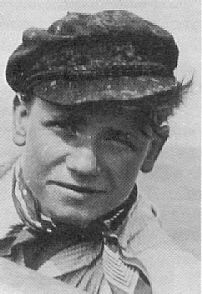 , here with Hans
 , went missing in 1944 (He was a soldier on the eastern front. Mogilev most likely). Although his body was never found it is assumed he was killed. (29) was missed in action in 1944. Like other young Germans, they enthusiastically joined the Hitler Youth (see Adolf Hitler) .
 They believed that Adolf Hitler was leading Germany and the German people back to greatness. Their parents were not so enthusiastic.
 Their father, Robert Scholl, a politician ,
  a strong opponent of Adolf Hitler and was very upset when Werner and Hans joined the Hitler Youth and Sophie Inge and Elisabeth became members of the German League of Girls (BDM) in 1933.
  He argued against Hitler and the Nazi Party and disagreed with his children’s views that he would reduce unemployment: “Have you considered how he’s going to manage it? He’s expanding the armaments industry, and building barracks. Do you know where that’s all going to end… Don’t believe them – they are wolves and deceivers, and they are misusing the German people shamefully”. Scholl was sentenced to 18 months in prison for listening to enemy radio broadcast. Later, in 1942, he would serve time again in a Nazi prison for telling his secretary: “The war! It is already lost. This Hitler is God’s scourge on mankind, and if the war doesn’t end soon the Russians will be sitting in Berlin.” Gradually, Hans and Sophie began realizing that their father was right. They concluded that, in the name of freedom and the greater good of the German nation, Hitler and the Nazis were enslaving and destroying the German people. They also knew that open dissent was impossible in Nazi Germany, especially after the start of World War II. Most Germans took the traditional position, that once war breaks out, it is the duty of the citizen to support the troops by supporting the government. But Hans and Sophie Scholl believed differently. They believed that it was the duty of a citizen, even in times of war, to stand up against an evil regime, especially when it is sending hundreds of thousands of its citizens to their deaths. The Scholl siblings began sharing their feelings with a few of their friends, Christoph Probst,
  Alexander Schmorell,
  Willi Graf,
  as well as with Kurt Huber,
  their psychology and philosophy professor. One day in 1942, copies of a leaflet entitled “The White Rose”
  suddenly appeared at the University of Munich. The leaflet contained an anonymous essay that said that the Nazi system had slowly imprisoned the German people and was now destroying them.
  The Nazi regime had turned evil. It was time, the essay said, for Germans to rise up and resist the tyranny of their own government. At the bottom of the essay, the following request appeared: “Please make as many copies of this leaflet as you can and distribute them.” The leaflet caused a tremendous stir among the student body. It was the first time that internal dissent against the Nazi regime had surfaced in Germany. The essay had been secretly written and distributed by Hans Scholl and his friends. Another leaflet appeared soon afterward. And then another. And another. Ultimately, there were six leaflets published and distributed by Hans and Sophie Scholl and their friends, four under the title “The White Rose” and two under the title “Leaflets of the Resistance.” Their publication took place periodically between 1942 and 1943, interrupted for a few months when Hans and his friends were temporarily sent to the Eastern Front to fight against the Russians. Sophie’s fiancé was Fritz Hartnagel,

 born 1920 and they got four sons, Thomas (* 1947), Jörg (* 1949), Klaus (* 1952) und Martin (* 1956). Fritz died old age 84, on 29-04-2001, in Stuttgart. Elisabeth is now 93 years old. The members of The White Rose, of course, had to act cautiously. The Nazi regime maintained an iron grip over German society. Internal dissent was quickly and efficiently smashed by the Gestapo. Hans and Sophie Scholl and their friends knew what would happen to them if they were caught. People began receiving copies of the leaflets in the mail. Students at the University of Hamburg began copying and distributing them. Copies began turning up in different parts of Germany and Austria. Moreover, as Hans points out, the members of The White Rose did not limit themselves to leaflets. Graffiti began appearing in large letters on streets and buildings all over Munich: “Down with Hitler! . . . Hitler the Mass Murderer!” and “Freiheit! . . . Freiheit! . . . Freedom! . . . Freedom!” The Gestapo was driven into a frenzy. It knew that the authors were having to procure large quantities of paper, envelopes, and postage. It knew that they were using a duplicating machine. But despite the Gestapo’s best efforts, it was unable to catch the perpetrators. One day, 18-02-1943, Hans’ and Sophie’s luck ran out. They were caught by Jakob Schmidt, the school concierge and a member of the Nazi Party in the entrance hall (Lichthof) of Munich University.They had left the bulk of leaflets outside the university lecture halls. Jacobs, later was sentenced to five years imprisoned, he died age 78, on 16-08-1964.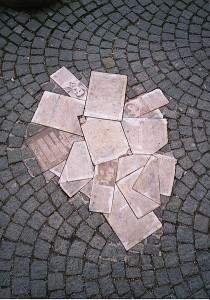

 He
He chief justice of the People’s Court of the Greater German Reich, had been sent from Berlin, Gauleiter Josef Goebbels.


 was in court in his German Army uniform. He managed to get to his brother and sister. “He shook hands with them, tears filling his eyes. Hans was able to reach out and touch him, saying quickly, Stay strong, no compromises.” Hans met with them first, and then Sophie. Hansen writes: His eyes were clear and steady and he showed no sign of dejection or despair. He thanked his parents again for the love and warmth they had given him and he asked them to convey his affection and regard to a number of friends, whom he named. Here, for a moment, tears threatened, and he turned away to spare his parents the pain of seeing them. Facing them again, his shoulders were back and he smiled. Then a woman prison guard brought in Sophie. Her mother tentatively offered her some candy, which Hans had declined. “Gladly,” said Sophie, taking it. “After all, I haven’t had any lunch!” She, too, looked somehow smaller, as if drawn together, but her face was clear and her smile was fresh and unforced, with something in it that her parents read as triumph. “Sophie, Sophie,” her mother murmured, as if to herself. “To think you’ll never be coming through the door again!” Sophie’s smile was gentle. “Ah, Mother,” she said. “Those few little years. . . .” Sophie Scholl looked at her parents and was strong in her pride and certainty. “We took everything upon ourselves,” she said. “What we did will cause waves.” Her mother spoke again: “Sophie,” she said softly, “Remember Jesus.” “Yes,” replied Sophie earnestly, almost commandingly, “but you, too.” She left them, her parents, Robert and Magdalene Scholl, with her face still lit by the smile they loved so well and would never see again. She was perfectly composed as she was led away. Robert Mohr [a Gestapo official], who had come out to the prison on business of his own, saw her in her cell immediately afterwards, and she was crying. It was the first time Robert Mohr had seen her in tears, and she apologized. “I have just said good-bye to my parents,” she said. “You understand . . .” She had not cried before her parents. For them she had smiled. No relatives visited Christoph Probst. His wife, who had just had their third child, was in the hospital. Neither she nor any members of his family even knew that he was on trial or that he had been sentenced to death. While his faith in God had always been deep and unwavering, he had never committed to a certain faith. On the eve of his death, a Catholic priest admitted him into the church in articulo mortis, at the point of death. “Now,” he said, “my death will be easy and joyful.” That afternoon, the prison guards permitted Hans, Sophie, and Christoph to have one last visit together. Sophie was then led to the guillotine. One observer described her as she walked to her death: “Without turning a hair, without flinching.” Christoph Probst was next. Hans Scholl was last; just before he was beheaded, Hans cried out: “Long live freedom!” Unfortunately, they were not the last to die.
 The Gestapo’s investigation was relentless. Later tried and executed were Alex Schmorell (age 25), Willi Graf (age 25), and Kurt Huber (age 49). Students at the University of Hamburg were either executed or sent to concentration camps. Today, every German knows the story of The White Rose. A square at the University of Munich is named after Hans and Sophie Scholl. And there are streets, squares, and schools all over Germany named for the members of The White Rose.
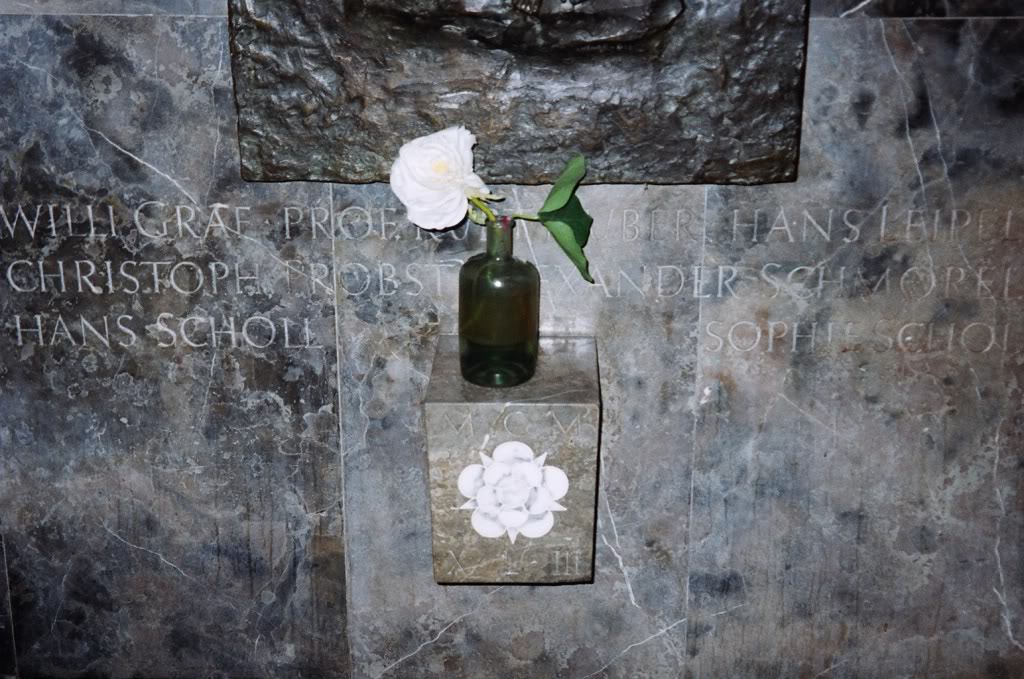
 Their actions made them enduring symbols of the struggle, universal and timeless, for the freedom of the human spirit wherever and whenever it is threatened. Hans and Sophie are buried on the cemetery Perlacher Forst in Munich.

 Father Robert Scholl died old age 82, on 25-10-1973 and mother Magdalena died age 76, on 31-03-1958, both in Ulm.
Message(s), tips or interesting graves for the webmaster: robhopmans@outlook.com


Leave a Reply