


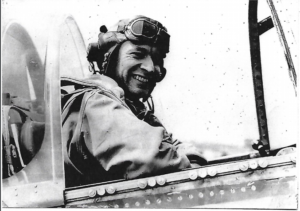
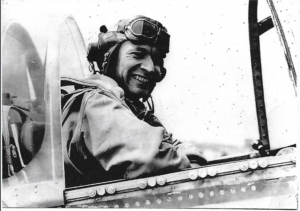
Post, Dean Nelson “Bud” Jr. born 29-11-1920, in Jacksonville, Duval, 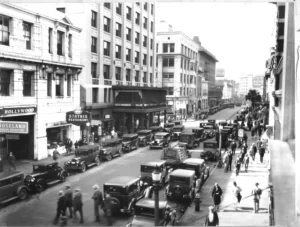 Florida, United States,to his father, Dean Nelson Post, who was 21 and his mother, Catherine, born Huntington Pendleton, who was 19. Dean lived in Hillsborough, Florida, United States in 1935 and Tampa, Hillsborough, Florida, United States in 1940. Dean Post was a clerk for an electrical supply wholesale company. Post Jr. had three younger brothers, Kent, Edward, and Earle, and a younger sister, Peggy. He completed his high school education, but had trouble finding stable employment. According to the 1940 census, Post was living in Tampa, Florida, had recently been laid off and was looking for a job.
Post enlisted in the Air Force  and was assigned to the 357th Fighter Group
 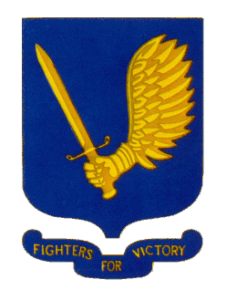 in the “Mighty” 8th Air Division.
  under command of General Major James Harold ” Jimmy Doolittle”,
  Activated on 01-12-1942, the Mighty Eighth trained at Santa Rosa, CA, before deployment overseas. Once in England, this group earned the nickname “the Yoxford boys,” as they were typically described as eager to fly the swiftest P-51 Mustangs.
 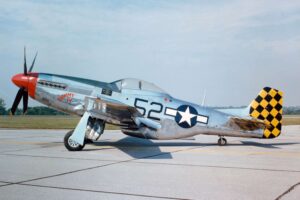 The 357th Group frequently escorted heavy B-17 and B-24 bombers that flew across The Channel to bomb strategic positions on the European mainland. For example, the 357th was involved in the bombing runs of March 4th and 6th, 1944, the second dubbed “Black Monday.”
In part the attacks on the heart of Germany had provoked Hermann Göring,  head of the Luftwaffe, to order Operation Steinbock – the bombing of London -that had begun again seriously in January.
Apart from the casualties in London the main effect of Operation Steinbock was the decimation of Germany’s bomber force in the west. 329 Luftwaffe bombers would be shot down during the early part of 1944 as they faced much improved air defences over Britain, including radar equipped night fighters. There would be few bombers left to attack the Allied forces in Normandy.
The bombing of March 4th marked the first time P-51s escorted a bombing run by the 8th Air Division all the way to Berlin. The following Black Monday bombing run was one of the most impressive feats by the 8th Air Division, as this mission fielded over 800 bombers with escorts such as the P-51s that Dean Post flew. This mission, considered a success, dropped its payload on Berlin while incurring minimal losses, despite intense Luftwaffe  resistance. The 357th Fighter Group began escorting bombing missions from England to continental Europe on 11-02-1944, and continued until the end of the war. Post participated in many of these missions until he was shot down on 27-05-1944.
On 27-05-1944, the 357th Fighter Group left their station in Leiston, England, bound for Ludwigshaven, Germany. The mission report filed by Post’s commanding officer states that it was a classified “ramrod” mission – a short-range bombing run intended to keep the Germans in that area nervous of future attacks. The report also stated that there was fair weather with good visibility, which mostly eliminated weather-related risks.This was 357th Fighter Group’s 65th mission since entering combat. Post was commandeering a single-crew P-51B equipped with dual .50 caliber machine guns. While en route, the squadron encountered German resistance. The 357th shot down several German aces, including a decorated German pilot named Horst Carganico 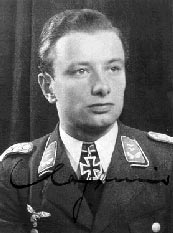
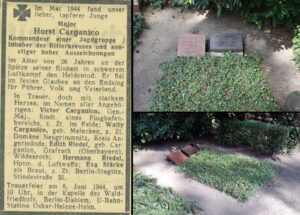 who had received numerous German awards in battle. During the ensuing dogfight, Dean Post, last sighted by Major John Arthur Storch,
 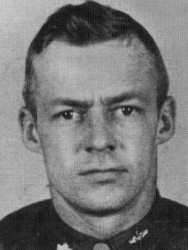 was engaging an enemy fighter and accidentally collided midair with the other plane. It would later be revealed that he had collided with Allied pilot Lieutenant Billie Dowe Harris
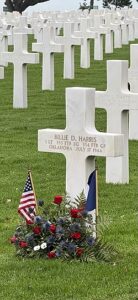 . John Storch survived the war and passed away 18-05-1985, age 68. Billie Harris had managed to avoid crashing his plane into the town area and was able to maneuver to crash the plane into the forest, saving the loss of many lives. He on 17-07-1944 (aged 21) was able to maintain the control of his plane and avoid the village
French citizens observing the fight saw both pilots bail out. Andre Clair, then age 10, witnessed the crash. Clair states that he was playing in a field when he saw Post’s plane catch fire and begin to nosedive after the collision. He also saw Post successfully bail out of the plane. The crash took place roughly eight miles north-east of Gerardmer, France, in the Vosges Mountains, at around 11:45. He was taken under the care of Melle Bailly, who hid him near Le Rudin and treated his wounds; he had sustained extensive burn damage to his hands, arms, and face.
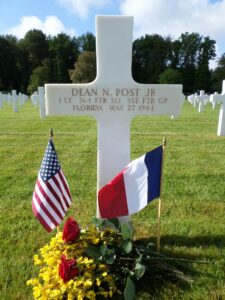
Death and burial ground of Post, Dean Nelson “Bud” Jr.
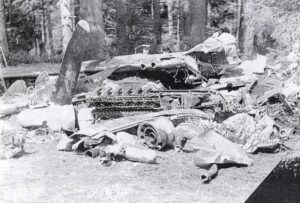
Unfortunately, too many witnesses in this town saw the crash, and eventually, the German Military Police were alerted that an American pilot was being hidden. They located Dean Post and brought him to a German prison. At this prison, German authorities interrogated Post for two days. On 29-05-1944 they brought him, age 21, to the nearby town square, in front of the Kleber Barracks, which had taken the temporary German name Goering-Kasern, to await transportation via ambulance to a prison internment camp. While awaiting this ambulance, at around two in the afternoon, a German officer, identified as Major Hiss, shot Post two times, in either the back or the neck. The subsequent police report written by the German authorities stated that Post was “killed while attempting to escape” but all the Frenchmen who witnessed the event stated that he was shot with both hands up in the universal sign of surrender.
On 08-06-1944, Post’s mother wrote a letter to his brother, Kent, about Post’s disappearance. In the letter, she wrote that Dean was probably in hiding or a prisoner because “Germans don’t shoot the fellows coming down”. She asked Kent to pray for their family, saying “God made this world and controls everything in it but the wills of men. We are told that he knows when a sparrow falls – so he must know when a P-51 goes down”. She went on to say that Bud (a nickname for Post) will be well taken care of by the Germans because officers are treated with better respect. She then told Kent, “Don’t for one minute let yourself feel that he isn’t O.K he has just got to be. You both must get back”. She ended the letter by saying, “I am not going to weep – I am a Marine mother”. This letter was written only eleven days after Lieutenant Post’s death on 29-05-1944.
After his death, the German authorities allowed the French citizens to inter Post’s body at a local cemetery, provided that they did not have a large funeral, as the Germans were nervous it would sparks some form of Resistance. In response, twelve French citizens followed the casket to meet a larger group in an informal ceremony, under intense German scrutiny. In defiance of the Germans’ orders, the locals of the surrounding villages came every night and covered Dean Post’s grave with flowers, which the Germans would then remove the following morning. French citizens replaced these flowers every night for several weeks to show their anger at Post’s execution. 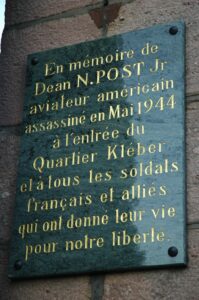 The plaque erected at the entrance of the Kleber Barracks
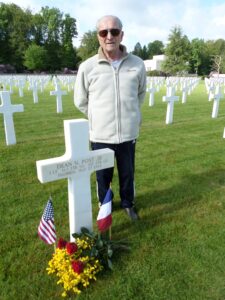
In events following the Allied advancement and liberation of France, German troops shelled the city of Gerardmer on 17-11-1944. The extensive fire damage destroyed most the city. After the war, French citizens demanded Major Hiss be brought before a court for war crimes, but there is no evidence to show that such an event occurred. At some point after the rebuilding of Gerardmer, the town’s inhabitants created a plaque denouncing Post’s assassination and thanking all Allies who were killed for their service, and put it up at the entrance to the Kleber Barracks where Post was killed. After his death, the US government awarded to Lieutenant. Post the Air Medal with two oak leaf clusters and a purple heart. Dean Post is reburied to the The Epinal American Cemetery, 385 Rue de la Rondenolle, 88000 Dinozé, France.
Mr Andre Clair of Gerardmer who at age 10 witnessed the death of Lt Post as he was being marched wounded through the street towards the German Barracks. A German military policman shot him in the back with a pistol.


Leave a Reply