

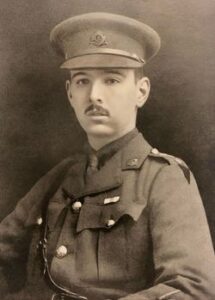
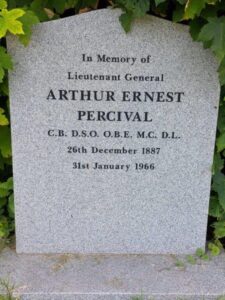
Percival, Arthur Ernest, 26-12-1887 in Aspenden, East Hertfordshire District, 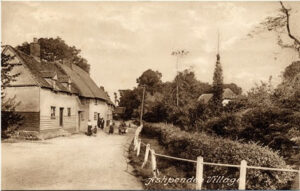 Hertfordshire, Engeland, the second son of Alfred Reginald and Edith Percival, born Miller. His father was the land agent of the Hamel’s Park estate and his mother came from a Lancashire cotton family. By 1891 the family was living in nearby Thundridge at “Sprangewell” on Poles Lane, his father being listed as “Land Agent” in the 1891 census, although it is unclear if this is still for Hamel’s Park, or for E.S. Hanbury’s Poles estate (now “Hanbury Manor”), which is adjacent to Sprangewell..
Arthur on 27-7-1927 was married with Margaret Elizabeth MacGregor “Betty”, 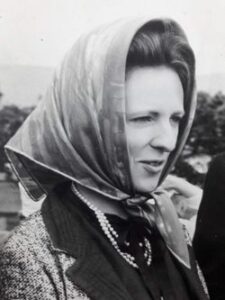 She was the daughter of Thomas MacGregor Greer of Tallylagan Manor, a Protestant linen merchant from County Tyrone in Northern Ireland. They had met during his tour of duty in Ireland but it had taken Percival several years to propose. They had two children. A daughter, Dorinda Margery, (1929–2022) was born in Greenwich and in 1959 married Lieutenant-Colonel Charles Edward Henry John Mulholland,
 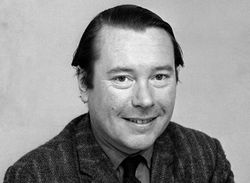 4th Baron Dunleath. Alfred James MacGregor,
 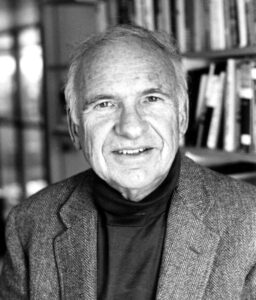 their son, was born in Singapore and served in the British Army.
Percival was initially schooled locally in Bengeo. Then in 1901, he was sent to Rugby with his more academically successful brother, where he was a boarder in School House. A moderate pupil, he studied Greek and Latin but was described by a teacher as “not a good classic”. Percival’s only qualification on leaving in 1906 was a higher school certificate. He was a more successful sportsman, playing cricket and tennis and running cross country. He also rose to colour sergeant 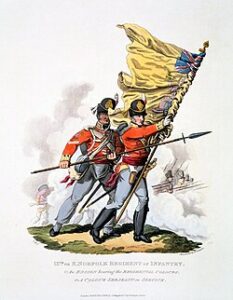 in the school’s Volunteer Rifle Corps. However, his military career began at a comparatively late age: although a member of Youngsbury Rifle Club, he was working as a clerk for the iron ore merchants Naylor, Benzon & Company Limited in London, which he had joined in 1914, when the First World War
 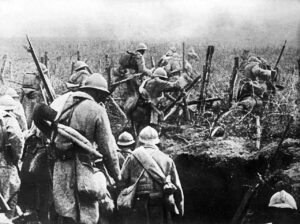 broke out.
Percival enlisted on the first day of the war as a private in the Officer Training Corps of the Inns of Court, at the age of 26, and was promoted after five weeks’ basic training to temporary second lieutenant. He ended the war, which came to an end on 11-11-1918 due to the Armistice with Germany, as a respected soldier, described as “very efficient” and was recommended for the Staff College.
Percival was appointed Brigadier, General Staff, of the I Corps, British Expeditionary Force,  commanded by General John Greer Dill,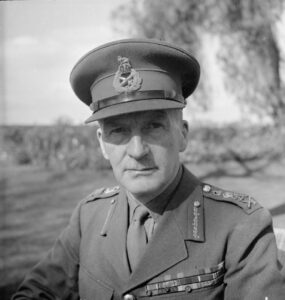
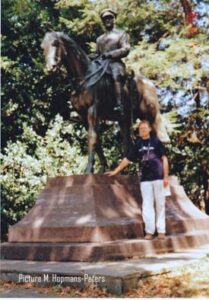 from 1939 to 1940. He was then promoted to acting Major General, and in February 1940 briefly became General Officer Commanding (GOC)
  of the 43rd (Wessex) Infantry Division.
  He was made Assistant Chief of the Imperial General Staff at the War Office in 1940 but asked for a transfer to an active command after the Dunkirk evacuation. Given command of the 44th (Home Counties) Division, he spent 9 months organising the protection of 62 miles (100 km) of the English coast from invasion. He was appointed a Companion of the Order of the Bath (CB) in the 1941 King’s Birthday Honours.
He left Britain in a Sunderland flying boat and embarked on an arduous fortnight-long, multi-stage flight via Gibraltar, Malta, Alexandria (where he was delayed by the Anglo-Iraqi War), Basra, Karachi, and Rangoon, where he was met by an RAF transport. Percival had mixed feelings about his appointment, noting that “In going to Malaya I realised that there was the double danger either of being left in an inactive command for some years if war did not break out in the East or, if it did, of finding myself involved in a pretty sticky business with the inadequate forces which are usually to be found in the distant parts of our Empire in the early stages of a war.”
On arrival, Percival set about training his inexperienced army; his Indian troops were particularly raw, with most of their experienced officers having been withdrawn to support the formation of new units as the Indian army expanded. Relying upon commercial aircraft or the Volunteer air force to overcome the shortage of RAF  planes, he toured the peninsula and encouraged the building of defensive works around Jitra. A training manual approved by Percival, Tactical Notes on Malaya, was distributed to all units.
In July 1941 when the Japanese occupied southern Indochina, Britain, the United States and the Netherlands imposed economic sanctions, freezing Japanese financial assets and cutting Japan from its supplies of oil, tin and rubber. This ABCD Encirclement 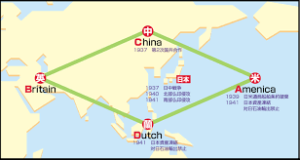 aimed at pressuring Japan to abandon its involvement in China; instead, the Japanese government planned to seize the resources of South-East Asia from the European nations by force. Both the Japanese navy and army were mobilised, but for the moment an uneasy state of cold war persisted. British Commonwealth reinforcements continued to trickle into Malaya. On 2 December, the battleship HMS Prince of Wales
 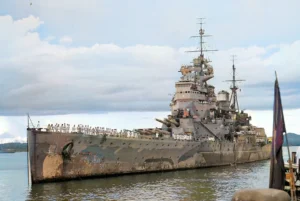 and the battle-cruiser HMS Repulse,
 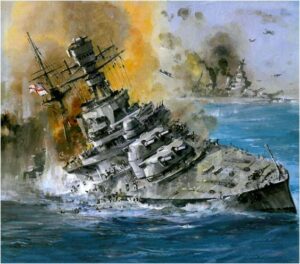 escorted by four destroyers, arrived in Singapore, the first time a battle fleet had been based there. (They were to have been accompanied by the aircraft carrier HMS Indomitable to provide air cover but she had run aground in the Caribbean en route.) The following day Rear-Admiral Ernst John Spooner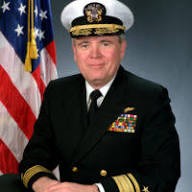
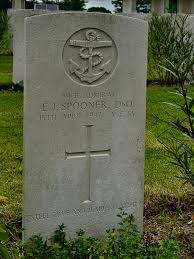 hosted a dinner attended by the newly arrived Commander-in-Chief Eastern Fleet, Admiral Sir Thomas “Tom Thumb” Spencer Vaughan Phillips,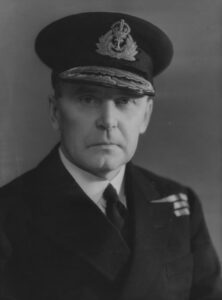
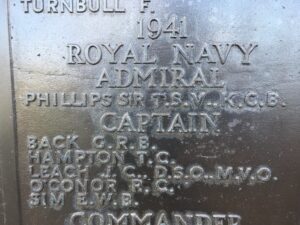 and Percival.
On 08-12-1941 the Japanese 25th Army  under the command of Lieutenant-General Tomoyuki Yamashita
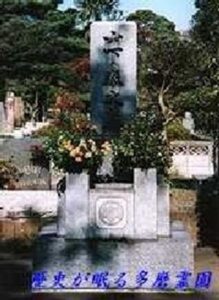 launched an amphibious assault on the Malay Peninsula (one hour before the attack on Pearl Harbor; the difference in date was because the two places lie on opposite sides of the International Date Line). That night the first Japanese invasion force arrived at Kota Bharu on Malaya’s east coast. This was just a diversionary force, and the main landings took place the next day at Singora and Pattani on the south-eastern coast of Thailand, with troops rapidly deploying over the border into northern Malaya.
On 10 December Percival issued a stirring, if ultimately ineffective, Special Order of the Day:
In this hour of trial the General Officer Commanding calls upon all ranks Malaya Command for a determined and sustained effort to safeguard Malaya and the adjoining British territories. The eyes of the Empire are upon us. Our whole position in the Far East is at stake. The struggle may be long and grim but let us all resolve to stand fast come what may and to prove ourselves worthy of the great trust which has been placed in us.
Royal Engineers prepare to blow up a bridge during the retreat.
The Japanese advanced rapidly, and on 27–01-1942 Percival ordered a general retreat across the Johore Strait to the island of Singapore 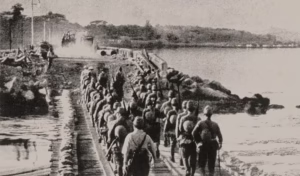 and organised a defence along the length of the island’s 70-mile (110 km) coast line. But the Japanese did not dawdle, and on 8 February Japanese troops landed on the northwest corner of Singapore island. After a week of fighting on the island, Percival held his final command conference at 9 am on 15 February in the Battle Box of Fort Canning. The Japanese had already occupied approximately half of Singapore
  and it was clear that the island would soon fall. Having been told that ammunition and water would both run out by the following day, Percival agreed to surrender. The Japanese at this point were running low on artillery shells, but Percival did not know this.
The Japanese insisted that Percival himself march under a white flag to the Old Ford Motor Factory in Bukit Timah to negotiate the surrender. 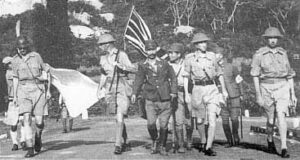 A Japanese officer present noted that he looked “pale, thin and tired”. After a brief disagreement, when Percival insisted that the British keep 1,000 men under arms in Singapore to preserve order, which Yamashita finally conceded, it was agreed at 6:10 pm that all British Commonwealth troops would lay down their arms and cease resistance at 8:30 pm. This was in spite of instructions from Prime Minister Winston Churchill
 for prolonged resistance.
A common view holds that 129,704 Allied personnel surrendered or were killed by fewer than 30,000 Japanese. However, the former figure includes nearly 50,000 troops captured or killed during the Battle of Malaya, and perhaps 15,000 base troops. Many of the other troops were tired and under-equipped following their retreat from the Malayan peninsula. Conversely, the latter number represents only the front-line troops available for the invasion of Singapore. British Commonwealth casualties in battle since 8 December amounted to 7,500 killed and 11,000 wounded. Japanese losses totalled more than 3,507 killed and 6,107 wounded.
In 1918, Percival had been described as “a slim, soft spoken man… with a proven reputation for bravery and organisational powers” but by 1945 this description had been turned on its head with even Percival’s defenders describing him as “something of a damp squib”. The fall of Singapore switched Percival’s reputation to that of an ineffective “staff wallah”, lacking ruthlessness and aggression. Over six feet in height and lanky, with a clipped moustache and two protruding teeth, and unphotogenic, Percival was an easy target for a caricaturist, being described as “tall, bucktoothed and lightly built”. 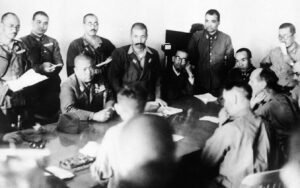 Lieutenant-General Yamashita (seated, centre) and Lieutenant-General Arthur Percival sitting between his officers, his clenched hand to his mouth
There was no doubt his presentation lacked impact as “his manner was low key and he was a poor public speaker with the cusp of a lisp”
Percival himself was briefly held prisoner in Changi Prison, where “the defeated GOC could be seen sitting head in hands, outside the married quarters he now shared with seven brigadiers, a colonel, his ADC and cook-sergeant. He discussed feelings with few, spent hours walking around the extensive compound, ruminating on the reverse and what might have been”. In the belief that it would improve discipline, he reconstituted a Malaya Command, complete with staff appointments, and helped occupy his fellow prisoners with lectures on the Battle of France.
Along with the other senior British captives above the rank of colonel, Percival was removed from Singapore in August 1942. First he was imprisoned in Formosa and then sent on to Manchuria, where he was held with several dozen other VIP captives, including the American General Jonathan Mayhew IV “Skinny” Wainwright, 
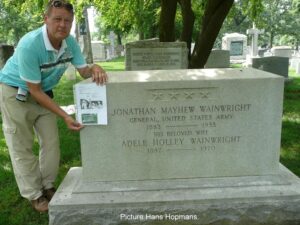 in a prisoner-of-war camp near Hsian, about 100 miles (160 km) to the north east of Mukden.
As the war drew to an end, an OSS/Office of Strategic Services  team removed the prisoners from Hsian. Percival was then taken, along with Wainwright, to stand immediately behind General Douglas MacArthur

 as he confirmed the terms of the Japanese surrender aboard USS Missouri in Tokyo Bay on 02-09-1945.
 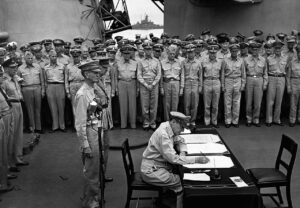 Afterwards, MacArthur gave Percival a pen he had used to sign the treaty.
Percival and Wainwright then returned together to the Philippines to witness the surrender of the Japanese army there, which in a twist of fate was commanded by General Yamashita. Yamashita was momentarily surprised to see his former captive at the ceremony; on this occasion Percival refused to shake Yamashita’s hand, angered by the mistreatment of POWs in Singapore. The flag carried by Percival’s party on the way to Bukit Timah was also a witness to this reversal of fortunes, being flown when the Japanese formally surrendered Singapore back to Lord Louis Francis Albert Victor Nicolas “Dickie” Mountbatten. 
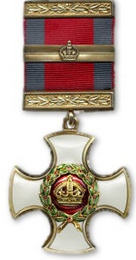
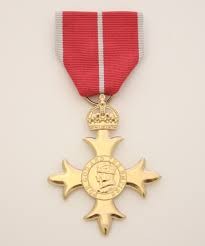
 British Army Lieutenant General. His ultimate surrender was viewed by many as probably the worst disaster and largest capitulation in British military history, with nearly 140,000 Allied personnel either killed or taken prisoner. He survived Japanese captivity for the remainder of the war and upon his release, he was present at the Japanese surrender ceremony aboard the battleship USS Missouri in Tokyo Bay on September 2, 1945. After returning to England, he retired from the British Army in 1946, with 32 years of military service. Among his awards and honors include the Companion of the Order of the Bath,
 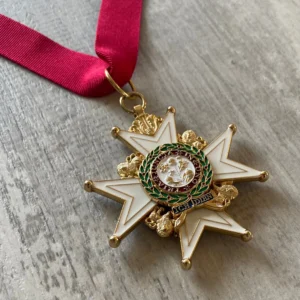 the Distinguished Service Order & Bar,
  the Officer of the Order of the British Empire,
  and the French Croix de guerre
  .
.


Leave a Reply