

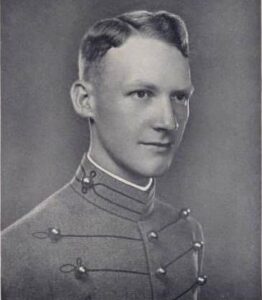
Nininger, Jr Alexander Ramsey “Sandy”, born 20-10-1918 in Gainesville, Georgia, 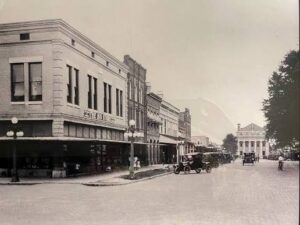 United States, the son of Mr. and Mrs. A. R. Nininger. His father owned two movie theatres. Nicknamed “Sandy” as a youth, Alexander spoke French fluently, loved classical music, and wrote poetry in secret. As a small child he spent some time at his Mother’s old family home in Central Valley, New York. It was there in that little town, just across the hills from West Point,

 that he received the first inspirations which moulded his character and shaped his destiny; the story of God and his ever presence—the story of the Statue of Liberty (which he had viewed with wonder) and all it stood for—the story of his grandfather, Captain Alexander Ramsey Nininger of the old 28th U.S. Infantry,
  who fought the Indians. In the West, back In the ‘70s—the story of his great grand uncle Alexander Ramsey, a pioneer of the West, first Governor of Minnesota, and Secretary of War during the administration of President Rutherford Birchard Hayes
 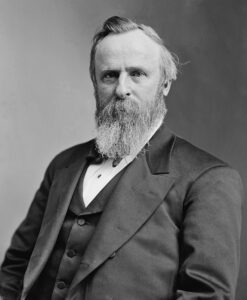 , and known to the Indians as “the great peace maker”. And then—one day a company of cadets from West Point, on a hike, marched past the house. He waved to them and cheered, and watched them out of sight. He wanted to know all about those boys in grey.
Then and there his mind was made up to go to West Point. His family moved to Florida in 1926 and finally established a home in Fort Lauderdale, where he went through grammar school and high school, graduating in June 1937.
His determination to go to West Point had never wavered. He received his appointment from Congressman James Mark Wilcox, 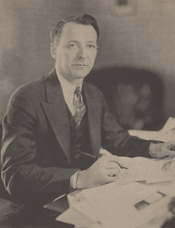 after taking a competitive examination, and entered the United States Military Academy on 01-07-1937.
Sandy was a boy of quiet gentle disposition, deeply interested in his studies, and with a strong natural sense of duty. When an older friend said to him once “Sandy why do you want to be a soldier—you are so gentle—you could not hate and kill people could you?” He replied in his quiet manner, “I would not kill out of hate, but I would kill out of love for my country”.
He loved all the fine beautiful things in life—art, literature, classical music. He was fond of athletics, especially football, baseball and tennis. He played football at high school, and at West Point he played on his company team.
Always showing a great interest in the welfare of his comrades, he was very active in any movement which helped and encouraged them. He was one of the guiding organizers of The Dad’s Club,  at high school—an organization composed of the fathers of the students, for the purpose of aiding the students in athletics, and also to finance the college educations for those who were deserving of such aid, and whose families were unable to bear the expense. This organization is still active and sending boys to college each year. Sandy was also a charter member of the Key Club, composed of school students, and sponsored by the Kiwanis Club
  —their object being to help each other.
During all the time he was at West Point, he kept in touch with these organizations and all his friends.
After being commissioned a 2nd Lieutenant Nininger was sent to the Philippines and was attached to the 57th Infantry Regiment (United States) 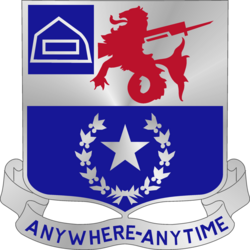 of the Philippine Scouts, under command of General Eugen Siegfried Erich Ritter von Schobert.
 According to journalist Malcolm Gladwell, after entering active service, Nininger “wrote a friend to say that he had no feelings of hate, and did not think he could ever kill anyone out of hatred. He had none of the swagger of the natural warrior. He worked hard and had a strong sense of duty.” Nininger loved to draw pictures. During the first month of the Japanese invasion of the Philippines, Nininger’s unit helped prepare American defenses in Bataan. After the Japanese launched their assault on Bataan, Nininger voluntarily joined another company because his unit was not yet engaged in combat.
Death and burial ground of Nininger, Jr Alexander Ramsey “Sandy”.
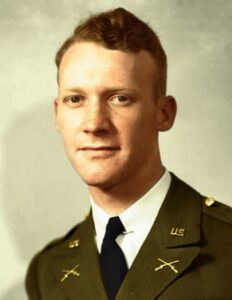
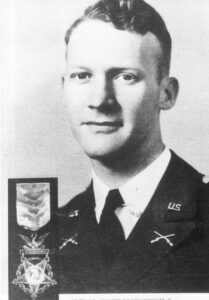
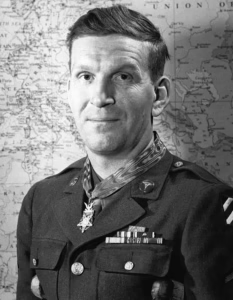
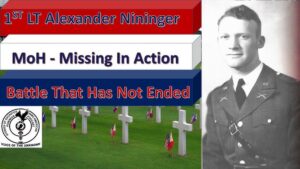
Sandy Nininger was killed in action near Abucay, Bataan, on 12-01-1942, age 23. He was posthumously awarded the Medal of Honor 
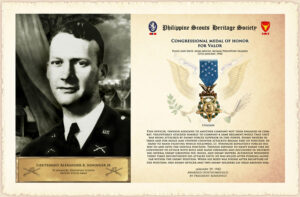 for leading an assault on Japanese positions. He was the first Medal of Honor recipient of World War II after those who were at Pearl Harbor.
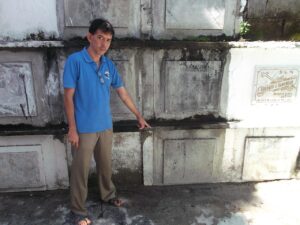
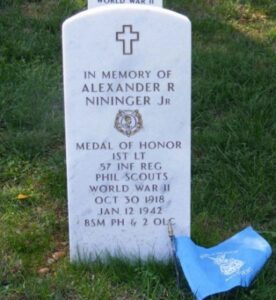
One of four unidentified graves at Santo Domingo Parish Church Cemetery, Abucay, Bataan that is possibly Nininger’s resting place. After the war, Nininger’s name was mistakenly inscribed on the Wall of the Missing at Manila’s ABMC Cemetery. There is also a cenotaph for him at Arlington National Cemetery. Today, the First Division of Cadet Barracks at West Point is named in his honor, and the Alexander R. Nininger Award is presented to West Point graduates who have displayed valor in combat.
One of four unidentified graves at Santo Domingo Parish Church Cemetery, Abucay, Bataan that is possibly Nininger’s resting place.


Leave a Reply