


Kuiper, Abraham Kornelis, “Bram”  born 28-08-1922 in Arnhem and Sape Kuiper,
  born in Arnhem, 03-02-1924 sons of of Taco Kuiper(1894-1945)
  and Helena Florentina “Leni” Talma, born Stheeman (1893) Kuiper.
  From left, Taco, Aleid Antonia, Frits, Bram, Leni and Sape. Taco joined the Communist Party of the Netherlands in 1931. As former students of the 1st Montessori School,
  Bram and Sape are part of the artwork ‘In Memoriam’. This installation of 172 wooden suitcases by artist Willem Volkersz
  commemorates the students of the school who were murdered in the Second World War. Three of the 172 (former) students were not Jewish, including the Kuiper brothers, and were killed in the resistance. Sape Kuiper studied in Delft since 1941 and wanted to become a civil engineer. After a year, he obtained his propaedeutic certificate and joined the student resistance. He went into hiding in May 1943. Like his brother Abraham, he was a member of CS-6, a communist resistance group in Amsterdam. The name probably comes from the address where the group originated: Corellistraat 6 in Amsterdam, directly opposite the 1st Montessori school where Bram and Sape went to school as children.
CS-6 was the name of a left-wing Amsterdam resistance group during World War II. The group was founded in the summer of 1940 by brothers Gideon (“Gi”)

 and Jan Karel (“Janka”) Boissevain.

 After their failed attempt to escape to England in July 1940, they returned to their parental home, where their mother had already begun to take in Jewish refugees. CS-6 collected weapons and initially focused on sabotage, and later also on liquidating traitors.
The brothers Kuiper helped Jewish people in hiding and, together with Leo Herman Frijda

 and Olaf Thingberg Thomsen (1919-1943,
  manufactured detonators. This was used, among other things, to try to set fire to the cinema on Rembrandtplein in Amsterdam
  because German propaganda films were being shown there. The next newcomer to the Nieuwe Suikerhofje, Bram Kuiper, is the youngest of the residents at nineteen. Early in January 1942, a year after the first students, he moves into the small community behind the door at Prinsengracht 385-395. As a first-year student, he is proud to come and live in the courtyard with so many seniors who are doing all sorts of things in the organizing resistance. When he registers at the city hall, the monastery oath is still fresh in his memory. He convinces the civil servant to officially include the name for the courtyard “Prinsenklooster” thought up by the students in his change of address. Bram is so young that he is still in school when the war starts. He finishes the Barlaeus gymnasium in Amsterdam Zuid with gymnasium A and then takes the state exam gymnasium B. In September 1941 he starts his biology studies. In January 1942 he moves from his parental home in the Euterpestraat to the Prinsengracht 395.
 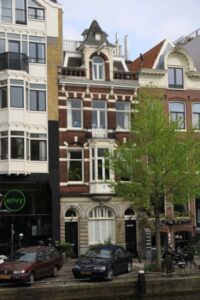 All the residents of the courtyard are already in the resistance. Bram also starts delivering illegal newspapers and looking for identity cards without J for Jewish friends and acquaintances to forge. From the summer of 1942 onwards, various groups of young people, including Bram, his younger brother Sape and their friends from the Barlaeus, increasingly come under the influence of older communists and they switch from care resistance to armed actions, robberies, sabotage and eventually also to shooting NSB members, traitors and collaborators.
For example, on 15-07-1943, Sape, age 19, together with Johan Cornelis Kalshoven,

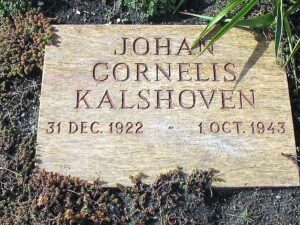 committed an attack on the Dutch police officer Blonk. On 22-07-1943, Kuiper, in collaboration with Hans.Hugo Geul,
  liquidated the dentist H.E.B. de Jonge Cohen, age 51
  in Amsterdam, who passed on addresses of Jewish patients to the Sipo. Sape Kuiper was arrested immediately afterwards, sentenced to death by a Polizeistandgericht at the end of September and executed on 01-10-1943, age 19. After being severely mistreated by the SD during interrogations, Hans Hugo Geul was sentenced to death on 30-09-1943, aged 27, after which he was shot dead the next day together with nineteen others.
Tony IJssennagger. Anthony “Tony” IJssennagger, Bram’s friend and neighbor at the courtyard, does not understand why Bram, whom he calls “very gifted, with a sharp and clear mind”, “lets himself be sent out as an errand boy” for CS6.
Abraham “Bram” Kuiper as the first child of Taco Kuiper (1894), since 1920 a teacher at the municipal grammar school in Arnhem. There are many ministers in the families of both parents. Taco’s brother Frits, like their father, becomes a minister and his sister Hannie (Johanna Engelberta 1896-1956)  studies theology. Taco was born in Friesland but grew up in Amsterdam because his father, Abraham Kornelis, after whom Bram is named, is a Mennonite minister in the Singelkerk. On 18-08-2020, the municipality of Amsterdam decided to name the Johanna Kuiperbrug
  after her. In 1972, she was posthumously awarded the Yad Vashem distinction. She survived the war and died age 53 on 02-03-1956, in Semarang, a city on the north coast of the Indonesian island of Java.
Bram does not seem to have focused directly on sabotage. He is probably also less technical than his younger brother, who studies civil engineering in Delft. According to his mother and his friend Guido van Suchtelen, 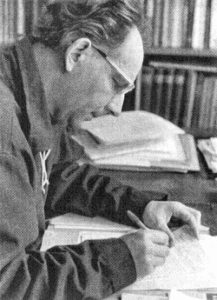 Bram has to maintain contacts between the students and the workers within CS6. Who these workers are and what Bram does exactly is not clear. It is possible that these workers are people like Adrianus Klijzing,
 who is a mechanic. Outside Amsterdam, CS6 has more members who are not students. Antoine Theodore “Toon” Broeckman (1911-1943)
  is a radio technician. Victor Alfred van Swieten (1906-1943)
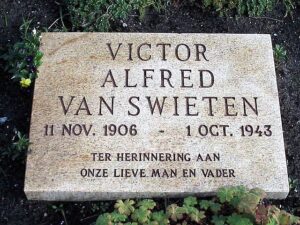 is a car and motorcycle dealer and bicycle repairman. Both live in Eemnes. Petrus Antonius Martinus “Pam” Pooters (1911-1943),
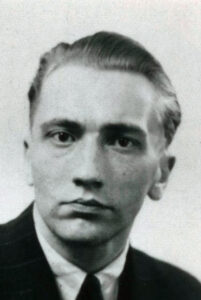
 who worked in the anti-fascist sabotage and espionage group Wollweber before the war and who comes from an Amsterdam working-class family, also works with Bram.
On 29-06-144 Bram is arrested in Brussels and is never released. Abraham was allowed to write a farewell note, just before their execution. Bram Kuiper wrote the following, among other things:
“I myself am not afraid, but I think of you all the time, especially when I heard about [the death of] Sape this morning. I hope you will enjoy Alei and Frits a lot. (…) The last book I read was: A Daudet: ‘Souvenirs d’un homme des lettres’. I always find such books the most beautiful, what a true humanist. I was particularly struck by: ‘Une lecture chez Edmond de Goncourt’, in which he describes how Edmond loses his brother, but still follows his calling and life resumes its course. (…) I hope and am convinced that from now on a similar return to the creative life will take place for you too. (…) Goodbye father, goodbye mother, Alei, Frits.
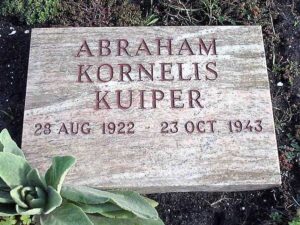
Death and burial ground of Kuiper, brothers, Abraham Kornelis “Bram” and Sape.
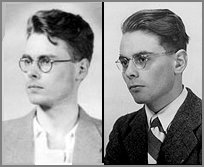
Bram.” Abraham Kuiper was shot by the Germans on 23-10-1944, age 21. He was buried as his brother Sape who was shot on 01-10-1944, age 19, at the the Bloemendaal Cemetery of Honor. CH2H+6C, 2051 EC Bloemendaal, Netherlands.


Leave a Reply