


Kop, Arij, born 28-02-1901, in Vlaardingen 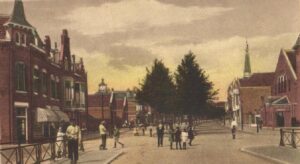 . Netherlands.
Arij Kop had been a mate on the high seas before his marriage, but before the outbreak of the war, he worked as a debt collector, insurance agent, and magazine delivery person. Ary joined the Geuzen group around Bernardus IJzerdraat, who had found a base in the Flardinga walking club, where Kop was secretary.
The Geuzen, or the Geuzen Resistance, were a Dutch resistance group during World War II. The group was formed as early as May 1940 under the leadership of Bernard IJzerdraat 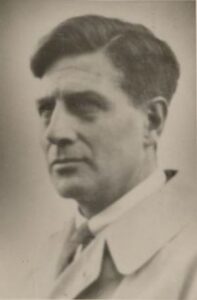
 from Schiedam, assisted by “the doer,” Arij Kop from Vlaardingen.
The group began distributing anti-German pamphlets under the name “Geuzenbrief.” Bernard IJzerdraat wrote his first Geuzen letter, titled “Geuzenactie,” as early as 15-05-1940. Two weeks later, he met his former colleague Jan Kijne. 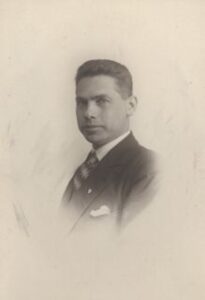
 Jan Kijne (Vlaardingen, 03-01-1895 – executed on the Waalsdorpervlakte, 13-03-1941) was a resistance fighter on behalf of De Geuzen. Jan gathered information about the occupiers and helped distribute the resistance newspaper De Geus from 1940. Kijne was arrested and, after being imprisoned in the Orange Hotel, was executed as one of the so-called 18 dead on the Waalsorpervlakte.
This meeting led to a connection with a group from Vlaardingen, who were also working to organize resistance. This consisted of Ies Korpershoek, Arij Kop, and Jacob ” Sjaak” van der Ende, 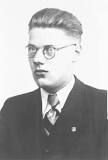
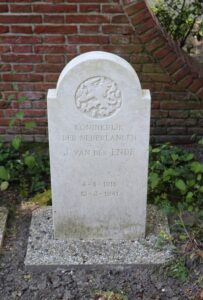 respectively the chairman, secretary, and treasurer of the Flardinga walking club,
 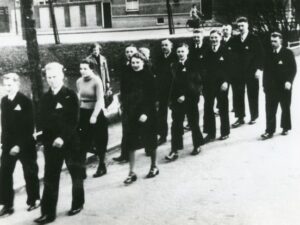 of which Jan Kijne was also a member. However, it didn’t stop at distributing pamphlets. During so-called training marches, the long-distance hikers committed the first acts of sabotage by cutting telephone wires of the German antiaircraft guns in the meadows in the area. Jacob ” Sjaak” van der Ende was arrested on 28-11-1940, and sentenced to death in March 1941 in the Geuzen Trial. Sjaak was one of the 15 Geuzen and 3 February strikers who were executed on 13-03-1941.
De Geuzen’s operations were short-lived due to betrayal and inexperience; in November 1940, member Daniel “Daan” van Striep disclosed details to an NSB 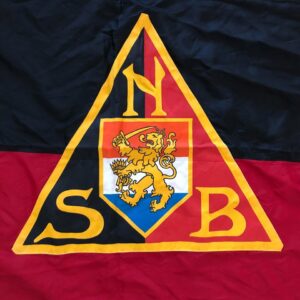 contact, triggering arrests beginning on 19-11-1940. Over 280 members were eventually detained, with many tortured in Scheveningen’s Oranjehotel prison, leading to at least two deaths from abuse before trial.
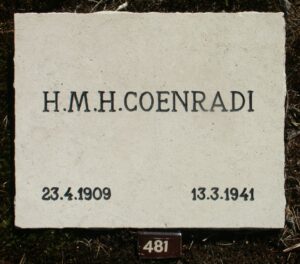
 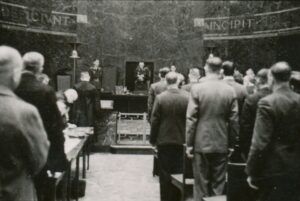 The February 1941 trial at the Supreme Court resulted in death sentences for 18 Geuzen members (three of which were commuted for underage individuals), leading to the execution of 15 Geuzen, including leaders IJzerdraat, Kijne, and Kop, along with three communist resisters, Hermanus Mattheus Hendricus Coenradi,
 Joseph “Joop” Eijl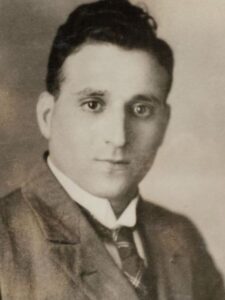
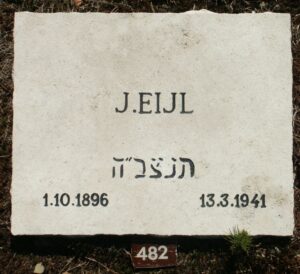 and Eduard Carel Frederik “Ward” Hellendoorn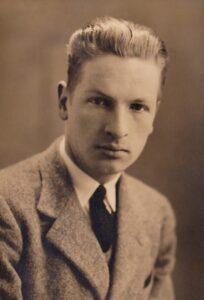
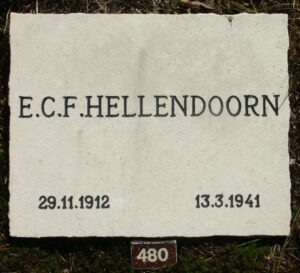 ) by firing squad on 13-03-1941 at Waalsdorpervlakte—the first mass execution of Dutch resisters.
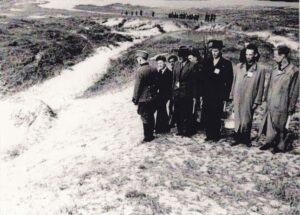
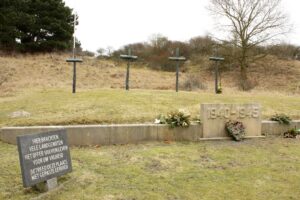 An additional 157 Dutch prisoners, largely Geuzen members, were deported to Buchenwald concentration camp
  in April 1941, of whom 63 perished; survivors faced long-term imprisonment. Post-war, the group’s sacrifices were honored through reburials and memorials, underscoring its role in galvanizing broader Dutch resistance efforts.
Death and burial ground of Kop, Arij.

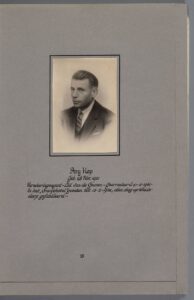
After his arrest on 21-11-1940, until his death, Kop, age 40, was held in the House of Detention in Scheveningen, also known as the Orange Hotel and locked up in cell 552.


 During a raid, the Germans had found Geuzen papers, other illegal publications, weapons, and ammunition. Kop was able to make notes on toilet paper that have been preserved. Despite the abuse during his interrogations, Kop didn’t break down. He was eventually sentenced to death three times. Arij Kop is one of the eighteen people mentioned in the poem “The Song of the Eighteen Dead” by Jan Campert.
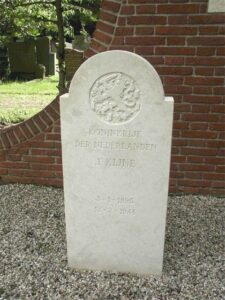
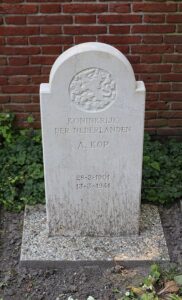
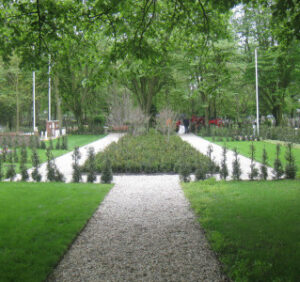
 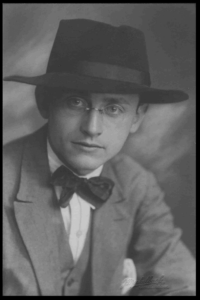 He was executed on March 13th at the Waalsdorpervlakte. Arij Kop was reburied at the Emaus cemetery in Vlaardingen, Emaus 6 3135 Jc Vlaardingen.
  A street is named after him in both Schiedam and Vlaardingen.




Leave a Reply