

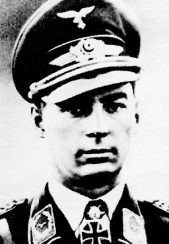
Hitschhold, Hubertus, born 07-07-1912 Kurwien,  joined the Reichhswehr after finishing his study, on 01-03-1930, age 17 and soon, in 1931 he became a pilot. He followed a secret training as a Fighter Pilot in Lipezk, Russia
  and transferred to the 2nd Prussian Regiment on 01-10-1931 and joined the Hermann Goering’s (did you know)
  (see Goering-Fock)
  and (Goering Peter)
  new Luftwaffe in 1935. He was taken up in the 1st Stuka Squadron, 163rd Luftwaffe
joined the Reichhswehr after finishing his study, on 01-03-1930, age 17 and soon, in 1931 he became a pilot. He followed a secret training as a Fighter Pilot in Lipezk, Russia and transferred to the 2nd Prussian Regiment on 01-10-1931 and joined the Hermann Goering’s (did you know) (see Goering-Fock) and (Goering Peter) new Luftwaffe in 1935. He was taken up in the 1st Stuka Squadron, 163rd Luftwaffe and was soon appointed as a Staffelkapitän of the 2nd Immelmann Squadron.
Max Immelmann, the WWI ace, 
 was the first pilot to be awarded the Pour le Mérite, Germany’s highest military honour was the first pilot to be awarded the Pour le Mérite, Germany’s highest military honour in World War I
  . Hitschhold was promoted to Hauptmann during the Poland invasion and assigned as commander of the 1st Group. His leading in the Western Invasion was awarded with the rank of Major, on 19-07-1940 and he received the Iron Cross of the Iron Cross.
 Hitschhold then was involved in the Battle of Britain (see Bomber Harris)
 , the Balkan war and Operation Merkur, landing on Crete, Mai 1941 (see Bruno Bräuer)
 before he was transferred to the East Front for Operation Barbarossa, June 1941. He had to make a forced landing with his Ju 87 behind enemy lines, already on the first day 21-06-1941, hit by anti aircraft fire. Leutnant Freitag, Captain of the 3rd Squadron, landed close by and took Hitschhold and his radioman on board. Hitschhold her with Field Marshal der Luftwaffe, commander 4 Luftflotte Wolfram von Richthofen
 was appointed to commander of the Stuka School in Wertheim, on 16-10-1941 and awarded with the Oak Leaves, on 31-12-1941. He was back on the front again from 18-06-1942 as commander of the 1st Fighter Squadron and his Squadron was refreshed with the new Fighter Bomber Focke Wulf FW 190. He lost his command of the 1st Squadron to Oberstleutnant Alfred Druschel, Druschel crashed age 27, on 01-01-1945, near Aachen, on 10-06-1943 and got the command of the 2nd Air Fleet.
was the first pilot to be awarded the Pour le Mérite, Germany’s highest military honour was the first pilot to be awarded the Pour le Mérite, Germany’s highest military honour in World War I . Hitschhold was promoted to Hauptmann during the Poland invasion and assigned as commander of the 1st Group. His leading in the Western Invasion was awarded with the rank of Major, on 19-07-1940 and he received the Iron Cross of the Iron Cross. Hitschhold then was involved in the Battle of Britain (see Bomber Harris) , the Balkan war and Operation Merkur, landing on Crete, Mai 1941 (see Bruno Bräuer) before he was transferred to the East Front for Operation Barbarossa, June 1941. He had to make a forced landing with his Ju 87 behind enemy lines, already on the first day 21-06-1941, hit by anti aircraft fire. Leutnant Freitag, Captain of the 3rd Squadron, landed close by and took Hitschhold and his radioman on board. Hitschhold her with Field Marshal der Luftwaffe, commander 4 Luftflotte Wolfram von Richthofen was appointed to commander of the Stuka School in Wertheim, on 16-10-1941 and awarded with the Oak Leaves, on 31-12-1941. He was back on the front again from 18-06-1942 as commander of the 1st Fighter Squadron and his Squadron was refreshed with the new Fighter Bomber Focke Wulf FW 190. He lost his command of the 1st Squadron to Oberstleutnant Alfred Druschel, Druschel crashed age 27, on 01-01-1945, near Aachen, on 10-06-1943 and got the command of the 2nd Air Fleet.

Alfred Druschel. Ernst Kupfer.
He on 06-11-1943, now as a General, succeeded the crashed General Ernst Kupfer, Kupfer crashed on 06-11-1943, age 35, during a inspection trip over Greece.
The Kuban was Hitschhold’s last battle in the field. The Kuban Bridgehead was a German position on the Taman Peninsula, Russia, between the Sea of Azov and the Black Sea. In June 1943 he was relieved of command from Schlachtgeschwader 1 on 10 June and promoted to Oberst. Hitschhold was appointed Fliegerführer Sardinien, responsible for the coordination of air units in Sicily. Fliegerführer Luftflotte 2  Fliegerkorps II’s previous headquarters at Viterbo was appropriated by Fliegerführer Luftflotte 2 under Hitschhold. Hitschhold was directly subordinated to Fliegerkorps II. Hitschhold was to assume command of all the bomber, fighter, reconnaissance and ground-attack units in support of the 10th Army under command of Generaloberst Heinrich von Vietinghoff.
  Hitschhold’s command failed to repulse the Allied invasion of Sicily. In September 1943 the Allied invasion of Italy succeeded in gaining a foothold on continental Europe. Naples was captured and only the Air raid on Bari yielded any success. On 01-01-1944 Hitschhold was appointed General der Schlachtflieger, a position he held until 08-05-1945. Hitschhold advocated ending Ju 87 production in favour of the Fw 190. Production ended only in September 1944. On 01-01-1945 Hitschhold was promoted to Generalmajor, a position he held until the German surrender in May 1945.
Fliegerkorps II’s previous headquarters at Viterbo was appropriated by Fliegerführer Luftflotte 2 under Hitschhold. Hitschhold was directly subordinated to Fliegerkorps II. Hitschhold was to assume command of all the bomber, fighter, reconnaissance and ground-attack units in support of the 10th Army under command of Generaloberst Heinrich von Vietinghoff. Hitschhold’s command failed to repulse the Allied invasion of Sicily. In September 1943 the Allied invasion of Italy succeeded in gaining a foothold on continental Europe. Naples was captured and only the Air raid on Bari yielded any success. On 01-01-1944 Hitschhold was appointed General der Schlachtflieger, a position he held until 08-05-1945. Hitschhold advocated ending Ju 87 production in favour of the Fw 190. Production ended only in September 1944. On 01-01-1945 Hitschhold was promoted to Generalmajor, a position he held until the German surrender in May 1945.Death and burial ground of Hitschhold, Hubertus.


 From left: Oberst Gerd von Massow (Higher Commander of the Fighter Pilot and Destroyer Schools), Oberstleutnant Günther Freiherr von Maltzahn (Commodore Jagdgeschwader 53 “Pik-As”)
  and Oberstleutnant Hitschhold (Commodore Battle Wing 1), in early 1943
Hubertus Hitschhold retired in Söcking, near the Starnbergersee, where he at the age of 53 died on 10-03-1966 and he is buried with his wife Liselotte, who died old age 90 in 1996, on the cemetery of Söcking.


Leave a Reply