


Ginder, Philip De Witt, born 19-09-1905 in Plainfield, New Jersey  the son of Grant De Witt.Ginder (1873-1958)
  and Emma Edith, born Troxell Ginder. (1873-1950).
  Philip was raised in Scranton, Pennsylvania, and graduated from Scranton Central High School in 1923. In high school, Ginder was the senior class president, manager of the football team, and president of the school’s athletic association.
Ginder passed a competitive examination for a Congressional appointment to the United States Military Academy West Point 
 offered by Representative Laurence Hawley Watres.
  He began attendance at West Point in 1923, graduated in 1927, and was ranked 171st of 293. Ginder’s graduation was the subject of news headlines because he took his final exams after having undergone an emergency appendectomy just one day prior. At graduation, he received his commission as a second lieutenant of Infantry.
Ginder completed the infantry officer qualification course in 1933, and his early career included postings to: Fort Wadsworth,  New York; Manila, Philippine Islands; Fort Benning, Georgia; Fort Missoula, Montana; and Schofield Barracks, Hawaii.
During World War II, Ginder was the assistant chief of staff for personnel (G-1) for the Fourth United States Army.  under command of General John Lesesne DeWitt
 Appointed to command the 357th Infantry Regiment,
  a unit of the 90th Infantry Division, nicknamed “Tough ‘Ombres” under command of Major General Terry de la Mesa Allen Sr., he was among the first ashore during the Normandy landings on D-Day, June 6, 1944.
  Ginder developed a reputation for subpar performance in combat, with observers and subordinates calling him “obtuse” and “full of boast and posturing.” 357th veteran William Eugene DePuy
 called Ginder “as close to being incompetent as it is possible to be.” Ginder was ultimately relieved of command during combat and escorted to the division command post under armed guard.
Ginder was later appointed commander of the 121st Infantry Regiment,  an 8th Infantry Division
  under command of Major General William Claude McMahon,
  unit. Philip was in command of the regiment when it captured the German town of Hürtgen as part of the Battle of Hürtgen Forest.
  It was for this action that he received the Distinguished Service Cross
  for actions on 28-11-1944, when he personally led his reserve company through the town in bitter house-to-house fighting while armed only with his pistol and a hand grenade. The citation for the DSC reads:
The President of the United States of America, authorized by Act of Congress, 09-07-1918, takes pleasure in presenting the Distinguished Service Cross to Colonel (Infantry) Philip DeWitt Ginder, United States Army, for extraordinary heroism in connection with military operations against an armed enemy while Commanding an Infantry Company of the 121st Infantry Regiment, 8th Infantry Division, in action against enemy forces on 28 November 1944, in Germany. Colonel Ginder personally led his reserve company of his battalion in an attack against a strongly defended town, when other attacking companies were pinned down by intense enemy small arms and mortar fire. With complete disregard for his own personal safety and armed only with his pistol and a hand grenade, Colonel Ginder courageously moved forward leading his men into the town despite the fierce enemy resistance. During the bitter house-to-house fighting that followed, Colonel Ginder through his personal courage and leadership, set an inspiring example which gave added encouragement to his men. Colonel Ginder’s courageous actions, personal bravery and zealous devotion to duty exemplify the highest traditions of the military forces of the United States and reflect great credit upon himself, the 8th Infantry Division, and the United States Army.
Ginder was appointed the commanding officer of the 9th Infantry Regiment in the spring of the 1945. Ginder commanded the regiment until the end of the war, taking part in liberating the western part of Czechoslovakia, and ending the war in the town of Rokycany near Pilsen.
In addition to his DSC, Ginder was also awarded the Silver Star,  “for conspicuous gallantry and intrepidity in connection with military operations against the enemy”, and the Legion of Merit,
  “for exceptionally meritorious conduct in the performance of outstanding services to the Government of the United States” for his service during the war.
From 1946 to 1949, Ginder attended the National War College and served in the Far East on the staff of General Douglas MacArthur.  From 1949 to 1951, he served as senior military attaché in Prague, Czechoslovakia.
Ginder commanded the 6th Infantry Regiment,  Berlin (1951–1952), the 45th Infantry Division, Korea (1953), the 37th Infantry Division, Fort Riley (1954), 10th Mountain Division (1954–1955) and Fifth United States Army (1955). Ginder went to Korea as a Colonel, and advanced to Major General in less than two years, making him the youngest American General to command a combat division in Korea. His service in Korea included nearly 18 months spent north of the 38th parallel. His service there resulted in him being awarded with the Army Distinguished Service Medal,
  the citation for which reads:
After the Korean War, Ginder commanded Fort Polk, Fort Riley, Camp McCoy, the Fifth United States Army, and served in the office of the Chief of Staff of the United States Army as special assistant for Reserve and National Guard Forces.  His final posting was to Governor’s Island as deputy commander of First United States Army. He retired a Major General in 1959.
Death and burial ground of Ginder, Philip De Witt.


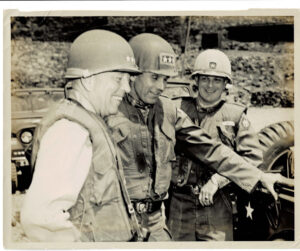 Taylor, General Maxwell Davenport (1901-1987);
  Radford, Admiral Arthur William (1896-1973);
  Ginder, Major-General Philip De Witt (1905-1968).
In his retirement, Philip Ginder was active as a businessman. He was a board member of various companies and president of a Brazilian-American trading company. The twice-married officer died on 07-11-1968, in the Trafalgar Hospital in New York City, after suffering a cerebral hemmorhage and was buried in the cemetery of the military academy at West Point Cemetery, West Point, New York, Section V, Row A, Site 41. His first wife was Marjory Wyson Walker ( 1914-2002)  His second wife was Jean Van Kirk Dalrymple (1902-1998), who he married on 01-11-1951.


Leave a Reply