


Crouch, Ronald Lionel “Ronnie” born 14-07-1916, in Bishopton, 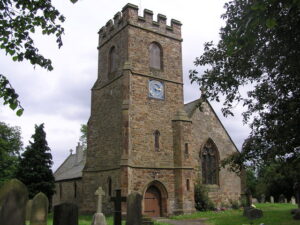 Darlington Unitary Authority, County Durham, United Kingdom, the son of Ernest W. Crouch and Enid Crouch,
 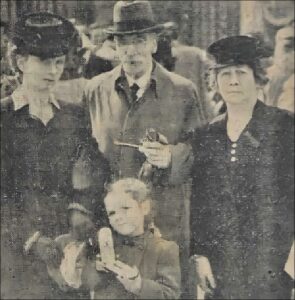 Ronald, nicknamed “Ronnie”, attended St. Brendan’s College in Bristol and went to work for Marks & Spencer Ltd., where he rose to the position of assistant manager of the Castle Street branch.
In June 1940, Ronald married Elizabeth “Betty” Jones. 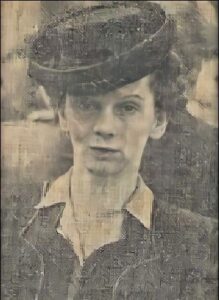 Elizabeth was the daughter of Edwin Jones and his wife, who lived at Backingstone Farm in Bishopston. However, this wasn’t a suburb of Bristol, but the village of Bishopston near Swansea in Wales. Two places with exactly the same name, only 80 miles (130 kilometers) apart. After their wedding, Ronald and Elizabeth settled in Bishopston, Wales. Their only child, Roberta (or Bobbie), was born on 27-10-1940. Ronald was athletic, a passionate rugby player. His wife, Elizabeth, was a community nurse in their hometown.
Ronald’s military career had already been underway for eight years. On 16-08-1932, at the age of 16, he joined the Territorial Army, or Territorials, the active volunteer army of the United Kingdom. In 1939, Ronnie transferred to the British Army.  Crouch served in France in 1940, was wounded there
 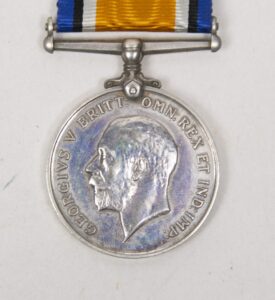 , and was evacuated a week before the thousands of British troops were to be evacuated from the beaches of Dunkirk
 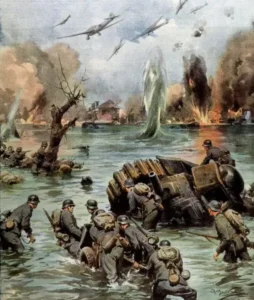 before the advancing Germans. After recovering, Ronald was sent on a military mission to Greece. Heavy fighting forced his evacuation to Crete. There, he was slightly wounded again and managed to escape in a small fishing boat.
Crouch served in Tunisia and fought against the Afrika Korps  of German General Erwin Johannes Eugen Rommel.

 The German Afrika Korps had been sent to Libya in February 1941 to support the demoralized Italian troops in their Libyan colony. The Italians had suffered one defeat after another against the British troops, and Hitler hoped that by deploying the Afrika Korps, the war in North Africa could turn in favor of the Axis powers. The main objective of this campaign was for the Germans to gain control of the Suez Canal in British-controlled Egypt. The Suez Canal, also known as the “windpipe of the British Empire,” could completely change the course of the war.
But the Germans faced problems in the African desert. They were exhausted by the constant fighting and the desert climate. Supply lines from Italy across the Mediterranean Sea were also growing longer. These supply lines were also constantly under attack by the British, both at sea and from the air, from the British air bases on Malta.
The most important factor, however, was the British’s increasing strength in Africa, and the shift in focus of the German high command in Berlin, which was forced to shift increasingly to the hard-fought battle on the Eastern Front, the struggle with the Soviet Union. 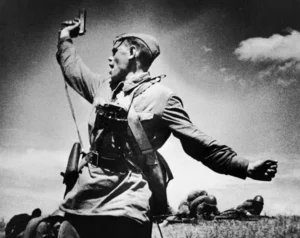
During the African campaign, Ronald distinguished himself through his courage and actions, including the battles around Rewizat Ridge. 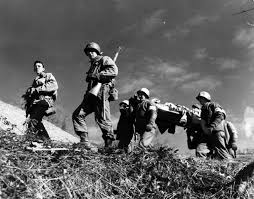 Meanwhile, his military career was progressing rapidly. In February 1942, he was promoted to Captain, but was captured shortly thereafter in Benghazi, a city in the northeast of what was then Italian Libya. Crouch disappeared into a German prison in Benghazi, where many more British prisoners were held. Sitting there waiting for what was to come was completely out of Ronald’s nature. He wanted out! That opportunity came unexpectedly when British bombers attacked the city of Benghazi. In the ensuing confusion, Ronald and 10 other young British officers managed to escape from their prison. It was the beginning of a hellish journey. Over 29 days, the men walked nearly 300 miles across the desert, heading east through enemy lines, on their way to their own British lines.The desert climate was unforgiving and unpredictable. This journey was one of heat and scorching sun, but also of heavy rain and bitter cold. During their journey, the men encounter nomads, spend the night with them, receive bread, and drink goat’s milk, before continuing their journey. During the final days of their journey, they suddenly see a German transport truck approaching. The men remain calm, but when the truck is close enough, the British suddenly jump onto the road, pretending it’s an ambush. The German driver is forced to stop. One of the British officers holds a wrench in his hand like a pistol. This is convincing enough for the German driver, who immediately surrenders. But this truck doesn’t seem to have enough fuel to complete the journey to the British lines. They tie up the German, take his revolver, and wait for a second truck. It arrives quickly, and they also force this truck to stop and capture its driver. With two trucks and the two prisoners, they arrive at their own British lines after a journey through enemy territory. They succeed! The men are then transferred to Cairo, Egypt. Ronald is admitted to hospital there with dysentery and a grenade wound in the arm.
Partly due to his escape action and courage, Ronald was promoted to Major 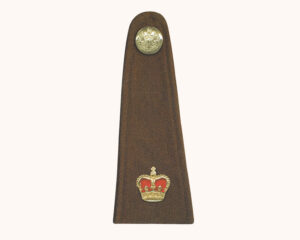 in October 1942, just eight months after being promoted to captain.
On 27-03-1943, at dusk, Ronald pulled off another heroic act. At El Hamma, the rear of the Divisional Artillery Group 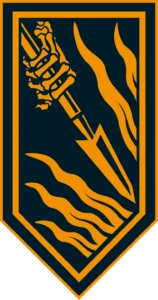 was attacked by tanks and four 88mm guns. Ronald, commander of an anti-tank battery, led the counterattack. Through his control and quick action at close range, he managed to destroy several enemy tanks and all four 88mm guns. The enemy then withdrew, suffering significant damage and casualties. The British lost only two trucks. Ronald, with a great sense of typical British humor, downplayed his actions when he described them as “A little party we did at El Hamma.” For his actions and leadership at El Hamma, Ronald would later be awarded the Military Cross.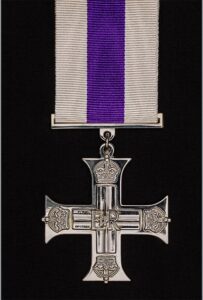
On 13-05-1943, the fighting in Africa ended with the official German surrender in Tunis. The then approximately 230,000 German and Italian troops had already surrendered to British and American forces in the preceding days. Ronald returned home in November 1943 and became a staff officer and anti-aircraft instructor at the School of Artillery in Larkhill, Salisbury. 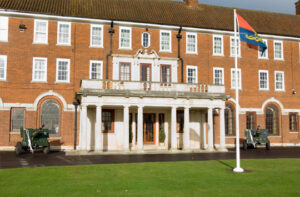
 He held this position until the Allied landings in Normandy in June 1944. From July 1944, he was second in command of the 75th Anti-Tank Regiment (75ATR)
  in the 11th Armoured Division (11AD).
  under command of Lieutenant General Edward Hale “Ted” Brooks
 This division landed in Normandy on June 13 and 14 and subsequently conducted sporadic raids to reach the strategic city of Caen.
On August 7, Adolf Hitler  surrendered Normandy. The Allies gratefully took advantage of this. What followed was a rapid and relatively straightforward Allied advance through northern France towards the northeast. The German-occupied ports along the Channel were ignored. The target of this Allied advance was larger: Antwerp! Specifically, the port of Antwerp, which was to serve as a second port of disembarkation to shorten the increasingly long supply lines from Normandy.
The advance through northern France was dubbed The Great Swan by the British, 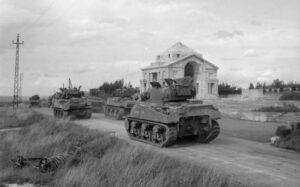 based on the concept of swanning along (meaning “swanning along” or “relatively easy”). Everywhere, the British were cheered and welcomed by the ecstatic French population.
 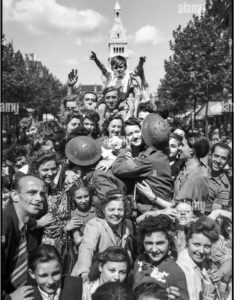 They were presented with fruit and flowers, as well as wine and champagne.
The British are now also passing through the area where many of their fathers and uncles fought or died during the First World War 30 years earlier: places like Arras, Loos, and Lens. 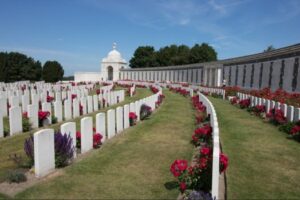 The United Kingdom experienced approximately 886,000 military deaths during World War I. And above all, Ypres. Seeing all those British cemeteries from the First World War makes some passing British troops somewhat emotional. Antwerp is liberated on September 4th by the 11th Army, with the 3rd Regiment of the Royal Navy under the command of Lieutenant Colonel David Arthur Henry Silvertop

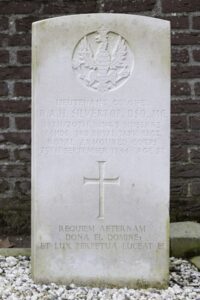 playing a leading role. The port falls into Allied hands almost undamaged. Silvertop on 25-09-1944, age 32, was fatally wounded by bullets fired by fleeing Germans on the corner of Lepelstraat and Perdshemel, in Sint Anthonis, North Brabant, Netherlands.
 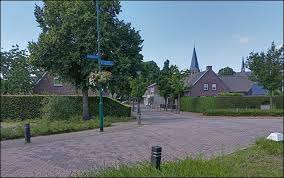 After Sint Anthonis, the Battle of Overloon follows, where the British are deployed in October.In November, as part of Operation Nutcracker, they push deeper towards Venlo to destroy the German bridgehead there. During this period, October 1944–January 1945, they also hold defensive positions in the dangerous Meuse region.
On 23-02-1945, the German border was crossed, and the 11th Infantry Division’s battle continued all the way to the Elbe River, Hamburg, and Kiel. On May 7, a day before the end of the war, Ronald distinguished himself again. Near Liebenau, between Bremen and Hanover, a group of SS  men suddenly fired upon a procession of British vehicles in an ambush. Ronald was at the head of the procession with his driver in a reconnaissance vehicle when his car was suddenly hit with a bazooka shot. Ronald was thrown from the vehicle and landed in a ditch beside the road, whereupon the vehicle exploded. His driver managed to climb out and attempt to assist Ronald, but at that moment, he was mortally wounded by German machine gun fire. Ronald, still dazed from the shock, managed to crawl back to the leading troop vehicle under heavy German small-arms fire, which had been paralyzed by the shelling. Ronald quickly devises a plan, manages to detach a weapon from the troop vehicle, and then leads the attack on the SS, who are wiped out to a single man.
World War II ends in Europe on May 8th with the total, unconditional surrender of Nazi Germany. It is V.E. Day, Victory in Europe Day.  After the liberation, Ronald’s regiment is stationed near Aachen. At that time, Ronald is an acting lieutenant colonel, another step on the way to his next promotion.
Death and burial ground of Crouch, Ronald Lionel “Ronnie”.
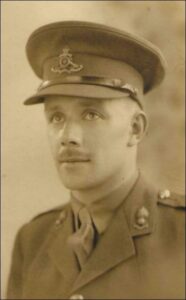
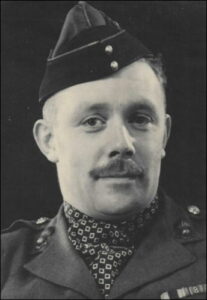
It is around 9:15 p.m. on 26-06-1945, when Ronald returns from Belgium with his Jeep and approaches the Dutch border post Neder-Canne from the Belgian border village of Kanne as Major Ronald Lionel “Ronnie” Crouch died at the age of 28, after being shot by a Dutch sentry while driving a car at a speed of about 50 mph. For a reason only Ronald knows, just before the border post, he suddenly accelerates his Jeep and races across the border at over 60 kilometers per hour! The soldier of the Military Authority immediately fires a warning shot in the air. Ronald doesn’t react and drives on towards Maastricht! The soldier fires a second shot, aimed at the rear tire. The Jeep drives on! The soldier now fires a third shot aimed at the Jeep. But the Jeep disappears from view after the right bend in Cannerweg. Calm returns to the border post. But not for long. Because some time later, it turns out that Ronald’s Jeep has come to a slow, unintentional stop on the right side of the road just after the bend in Cannerweg. The last shot hit Ronald in the head. He died instantly.
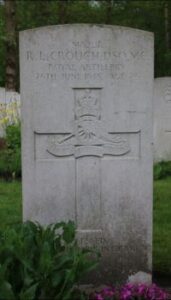
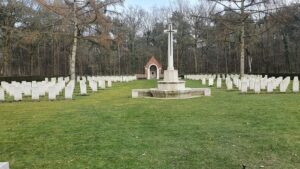
Ronald Lionel “Ronnie” Crouch, was buried first at the Allied Cemetery Margraten, Netherlands and reburied 01-05-1947 to Overloon War Cemetery. Vierlingsbeekseweg 57, 5825 AT Overloon. Section Field IV. A. 8.


Leave a Reply