


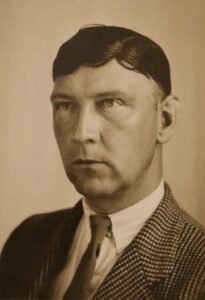
Brune Bert, born Amsterdam, 28-11-1901, 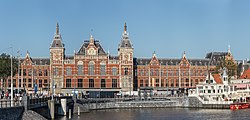 moves from the capital to Waterland in 1933. Previously, he worked as a horse butcher, machinist, and machinist. Together with his wife Antje Boele, he starts a hotel at Beemsterburgwal 8 in Purmerend. The shabby lodging is colloquially referred to as ‘The Louse on a Leash.’
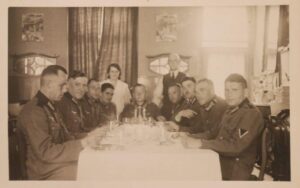 Bert and Annie Brune serve German soldiers during the war in ‘The Louse on a Leash’
Brune lives with his wife in the then small town of Purmerend, which had only seven thousand inhabitants, leading an unremarkable existence. That changes during the occupation, and quickly too.
Shortly after the capitulation of the Dutch armed forces, Bert Brune joins the local Reddingsbrigade/ Lifeguard Brigade.  ‘The louse on the chain’ serves as the meeting point for this organization. The Lifeguard Brigade helps people who end up in the water as a result of the blackout measures.
A few months later, in January 1941, Brune is also at the forefront when the Purmerend branch of the Dutch Union is established. He becomes the propaganda leader of this new political movement, which navigates between the positions of the occupying power and those who are opposed to it. The head of the department will be Aart van Keulen, 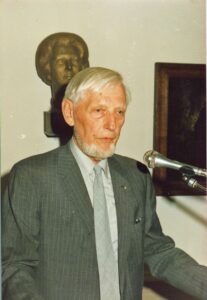
 the village veterinarian. Van Keulen and Brune already know each other from the Lifeguard Brigade. The doctor is also a member of the Ordedienst,
 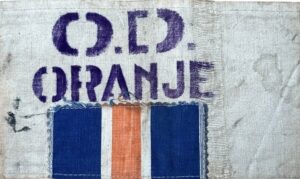 one of the first Dutch underground organizations. Van Keulen brings Brune into the OD. “I said to him, ‘Come on, let’s work together.'” He thot that was wonderful. That man was obviously walking around with a huge inferiority complex in such a community. “A little café for the homeless, where everyone could sleep for a few cents, what was that all about,” Van Keulen tells the authors of the book Verzet verwoord decades later. “Brune took care of the connections.” He received a transmitter and went out into the field in a rowboat. If there was something to report, he was somewhere on the water or in the North Holland Canal broadcasting.”
Brune makes it a habit to disguise himself. 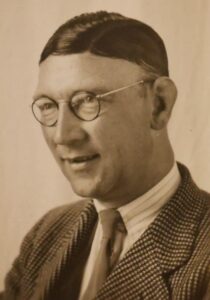
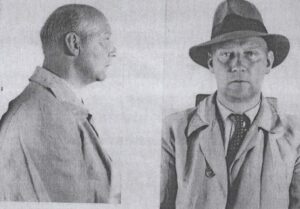 He uses wigs, glasses, and even women’s clothing to mask his identity.
 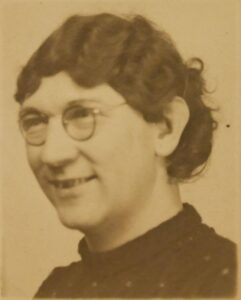 Gradually, the Purmerender is working his way up within the underground. He sees his place of residence less and less; he increasingly ventures to regions further afield in the country to shape the undermining of power there. One of the OD members he works with is the Baron of Aerdenhout, Godert Willem van Dedem.
 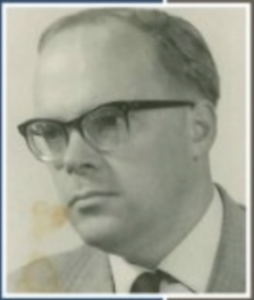 Who in turn has a connection with another resistance fighter, Johannes Mattheus ‘Johnny’ de Droog.
 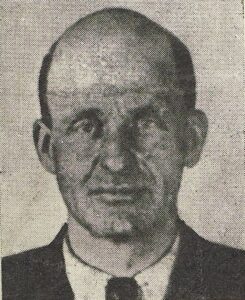 Van Dedem has no idea that this Arnhem resident has since been ‘turned’ and is now working for the Sicherheitsdienst. Johannes Mattheus (Johnny) de Droog (Haarlem, 15–08-1893 – Gorssel, 19-02-1945) was one of the most notorious V-Männer during World War II and, as such, was responsible for the arrest of hundreds of resistance fighters.
The circumstances surrounding Droog’s death are unclear. SD officer Carel Emil Rappard, another Dutch collaborator, stated after the war that he was waiting in front of De Droog’s house. Shortly thereafter, he heard a shot. It was unclear whether he was shot from the outside or if it was suicide. Some assume that De Droog was shot dead by Rappard, on the orders of high-ranking SD officials.
It took De Droog less than two months to infiltrate the Ordedienst. At the end of April or the beginning of May 1942, one of the members invites him for a confidential meeting in Haarlem. De Droog is happy to accept. A towering civil servant, Nicolaas Johannes van Straaten, 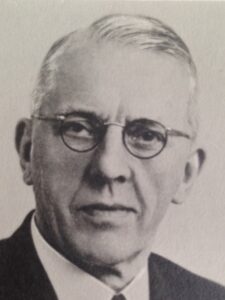 leads him to a sports park in Haarlem. There, several other OD members also arrive, with the most prominent members being Bert Brune and Godert van Dedem.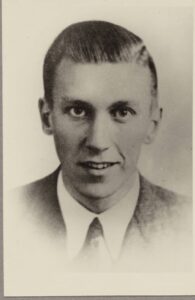
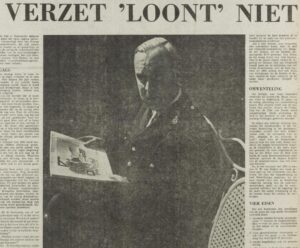 Their guest arrives just in time. The Kennemerlandse OD has come to a dead end. Until May, it could provide the Dutch government in exile with espionage material, thanks to a Nijmegen captain with transmission capabilities. Then, unexpectedly, a hitch occurred. Unbeknownst to them, the Germans closed off this route to Great Britain. They made the OD liaison officer, along with thousands of other soldiers, a prisoner of war and transported him abroad. To secure his overseas transmission, the captain could have handed over his illegal, coded archive to Brune before he left. But no matter how much Van Dedem and Brune puzzled, they failed to crack the secret language used. With that, their contact with London was severed.
During the exchange at the sports park, De Droog mentioned the name of his supervisor, one Jan Willem van Slooten. 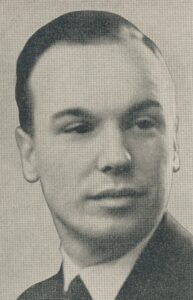 The OD’ers are curious about this secret agent and his – still according to De Droog – indispensable skills and knowledge. That works out well. De Droog is pushing for a meeting between his boss and the regional OD leaders. It is agreed to work out plans and introduce Van Slooten at the home of Nico van Straaten. Thus it is done.
It’s not entirely without danger. Van Straaten’s stately residence is surrounded on all sides by blocks of houses. The chance that the neighbors will ask questions about the sudden appearance of about ten strangers at that one address is not imaginary. To mitigate the risks, OD members keep an eye on things from outside. They do not realize that they, in turn, are being watched by some SD representatives. Van Slooten passed away age 24 in the prison camp of Sachsenhausen, on 03-05-1942.
Unaware that Van Slooten is normally known as Antonie Berends, 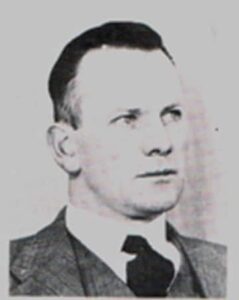 the guests in the crowded living room absorb the revelations he offers them. Behind the closed curtains, the alleged England sailor performs an impressive play. As agreed, he presides over the council. Almost stoically, he recounts having fought in Singapore a few months earlier, where the British unsuccessfully tried to resist the Japanese troops. Afterward, the government decided to send him to the Netherlands as their officer. Berends speaks at length – his eyes calmly focused on his audience, his dark hair slicked back – and his words make an impression. Just like his fellow player before him, he also speaks about assembling sabotage teams. Brune: “These demolition commandos were to be formed by him, as he claimed his order stated, within two months.” This in connection with the upcoming invasion, which was still to come in 1942.”
Antonie Berends was sentenced to life imprisonment in October 1948, in 1958 he was granted clemency and was “put on years.” (The current TBS) Ultimately, he was released in December 1960. In the year 1967, he emigrated with his family to South Africa, where, just like his father in Deventer, he worked as a fruit merchant.He passed away on 27-09-1971, in Randburg (South Africa) from a heart attack. He was 64 years old at the time.
Bert Brune summarizes the intensive activity since the meeting at Nico van Straaten’s in one sentence: “After that time, Van Dedem and I, together and alone, traveled all over the country with Johnny de Droog and sometimes with Van Slooten.” Among others, in Deventer at Ravenhorst, in Assen at Boiten, in Purmerend at Van Keulen, in Alkmaar at Zandbergen (picked up the transmitter), in The Hague at Smalt from Wassenaar.”
On 14-02-1942, the four set out again, this time to pick up illegal transmitters in North Holland. Van Dedem, Berends, Brune, and De Droog take the train to Alkmaar. Upon arrival, Brune – who has difficulty walking due to his leg wound – and Berends look for a spot on a café terrace opposite the station. De Droog and Van Dedem continue their journey on foot. Their destination is nearby. In the center, on the Canal Quay, Gerrit Zandbergen 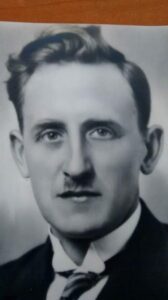
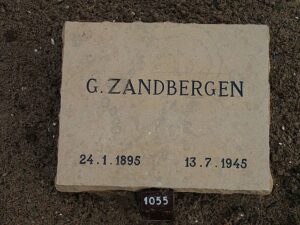 deals not only in vegetables and fruit but also in weapons, maps, and transmitters. Van Dedem and the one introduced as the ‘old general,’ De Droog, receive a suitcase from Zandbergen. It is needed to transport the transmitter hidden elsewhere. The three of them cycle with the suitcase on a rear rack to Uitenboschstraat. After picking up the necessary equipment there, they ride back to the terrace.
On 20-01-1944, Brune walks with his girlfriend to the local station after a resistance meeting in Dieren. Twilight has set in, moisture hangs in the air. The last stretch they have to run. The train is already next to the platform and can leave at any moment. Gasping, they search for a spot in an overcrowded carriage, relieved that they don’t have to wait for the next train. They don’t get very far. In the aisle, a loud voice crackles: “Got you now, hands up!” While his girlfriend manages to retreat unnoticed, Brune indeed has no choice but to raise his hands in the air. He realizes that the man in front of him will not hesitate to pull the trigger. “When De Droog pointed his gun at me, he said to me: ‘Now my wife can at least sleep peacefully again, you wanted to shoot me dead in Vorden!'”
De Droog forces Brune to leave the train. The departing passengers can see and hear that the handcuffed detainee on the platform is being subjected to a verbal tirade. What they miss is how his escort kicks and punches him all the way to the police station. Upon arrival at the destination, he yanks off Brune’s disguise, a blonde wig. A police officer reports that De Droog “went berserk.” He raged, cursed, and insulted Brune with every foul word imaginable. He also deliberately kicked him several times. De Droog said, among other things: “You have already betrayed seventeen (or seven) people before to save your filthy neck, and within two hours, you betrayed five more people,” and: “You still remember the village of Vorden, right? But I’ll kick your ass if you dare mention that name here.” He also said: “Stabbing people in the back, that’s what you dare!” From everything, it was clear that De Droog knew Brune well and had a deep hatred for him.
De Droog shows no mercy for Bert Brune. He is merciless against ‘that faggot’. Both at the police station in Dieren and later at the Arnhem SD headquarters, Utrechtsestraat 55, 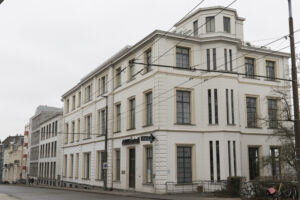 he assisted by several other interrogators, brutally mistreats his capture to the point of bloodshed. “Johnny de Droog hit me on the chest with the butt of his revolver and also kicked me.” Johnny also hit me on my neck. I was also hit on my fingers with a short stick. Later, I had to strip completely naked and they hit me on various parts of my body.
De Droog tells Brune that his mother is also in custody. She will be beaten to death in front of his eyes if he remains silent, he threatens, knowing that the old lady is nowhere to be found. SD officer Piet Wamelink – not exactly the gentlest either – sees that the prisoner ‘was severely beaten by De Droog, to the extent that colleague SD officer August Ahlbrecht 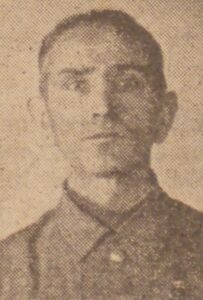 told De Droog to stop, since Brune still had something to say.’ It hardly helps. Brune’s incitements to kill him make De Droog bent on revenge.
To still come across as credible to the Sicherheitsdienst,  he needs—his own words—a ‘stunt.’ He delivers this by handing resistance man Koen Rozendaal
 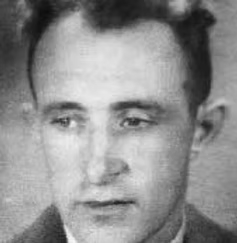 over to the Nazis. He knows the gardener’s apprentice who rose to become the leader of the Waterlandse Knokploeg from his own illegal period in Purmerend and Beemster. In July 1944, he arranges a meeting with Rozendaal in an Amsterdam establishment. The alerted SD can then easily arrest him. Two weeks later, Rozendaal, age 33, is shot in the dunes near Overveen. Remarkably, Brune continues with illegal work until the liberation.
It doesn’t stop with this sacrifice. Brune also reveals the location of the Identity Card Center in Amsterdam. The loot this time consists of thirty detainees. Remarkably, Brune continues with illegal work alongside his traitorous activities until the liberation. He recruits hundreds of people for the Order Service and becomes the contact officer for the OS in the northern provinces.
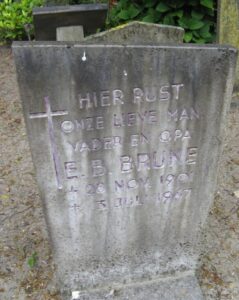
Death and burial ground of Bert Brune.
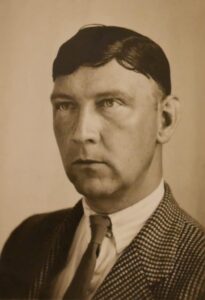
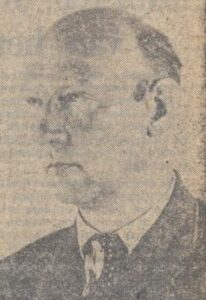
It takes until June 1946 for Bert Brune to be arrested again, this time by the post-war authorities. During his trial, two years later, several former resistance colleagues speak up for him. However, there is too much incriminating evidence. The Special Court therefore sentences him to ten years in prison. He serves four of them. Brune finds a job again after his release thanks to his wartime contacts and lives the rest of his life just as inconspicuously as before the war. On 03-07-1967, Brune dies at the age of 65, in Purmerend. He is laid to rest in the Roman Catholic cemetery in the municipality where he began his double life, Purmerend.




Leave a Reply