


Faktor, Leland Dale, born 17-05-1921, in Plymouth, Iowa, 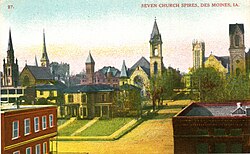 United States, on a farm one and a half miles northwest of Plymouth, in Worth County, a county separated by a single road from Cerro Gordo County, Iowa. Leland was the second son of Louis Faktor and his wife Rose Faktor. Leland had two brothers, Marvin Leroy and LaVerne Ray, and one sister, Juantia.
His grandparents Frances Michalek (born 14-05-1859 in Chochol) and Frank Faktor (born November 1856 in Bohemia) came from the rural heart of Bohemia, then part of Austria-Hungary. They grew up in an agrarian world defined by hard labor, tight-knit communities, and limited prospects under the Habsburg crown.  The House of Habsburg … also known as the House of Austria, was one of the most powerful dynasties in the history of Western civilization.
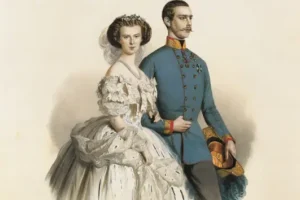 Dynasty, power, myth: The Habsburgs shaped Austria for centuries. To this day, palaces, museums, and public squares tell the story.
Like many Bohemian families of their generation, they ultimately chose to leave Europe behind. Seeking land, stability, and a future shaped by their own hands, Frances and Frank emigrated to the United States, settling in Iowa. There, on the open plains of the American Midwest, they rebuilt their lives within a growing Czech immigrant community. Their journey marked a decisive break with the old world and laid the foundation for the life of their son, Leland Faktor—a man rooted in Bohemian heritage, yet formed by the promise and realities of America.
His childhood unfolded amid farm work and the wide, open countryside. As a small boy, he played and fished in the creek that ran through his father’s land. When he was old enough to work, his father bought him a bicycle so he would have transportation to help neighboring farmers in the area.
From an early age, Leland developed a pronounced fascination with flying and airplanes. A friend who owned a Waco aircraft 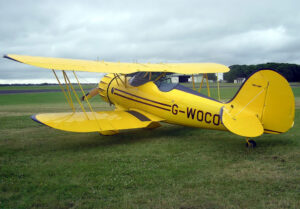 regularly took him up into the air, and especially on Sundays he experienced the freedom and thrill of flight—sensations that made a lasting impression and helped shape his future ambitions. He attended Plymouth High School and graduated in 1940. “He was a quiet boy and some said shy; but he was not quiet or shy when it came to airplanes,” recalled his brother LaVerne in the 1995 book “A Potpourri of Plymouth’s Past.
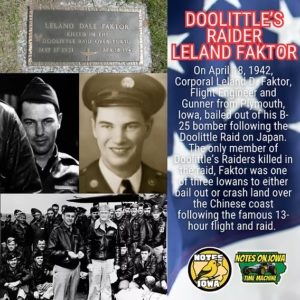
Determined to become a pilot himself, Faktor enlisted in the Army Air Corps  on 08-08-1940 at Fort Des Moines
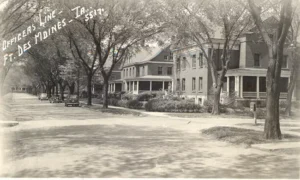 with the explicit intention of learning to fly. He was stationed at Chanute Field, Illinois, when Pearl Harbor
 was attacked. In the weeks that followed, the commanders of the 17th Bombardment Group
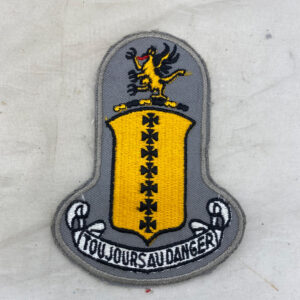 Lieutenant Cololonel William Courtney Mills
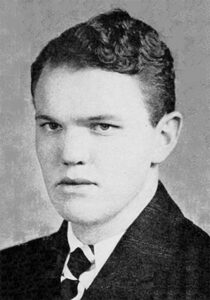 and the 80th Reconnaissance Squadron were ordered to recruit volunteers for an exceptionally dangerous and secret mission “The Doolittle Raid”. Faktor volunteered without hesitation—a decision that would irrevocably shape his fate.
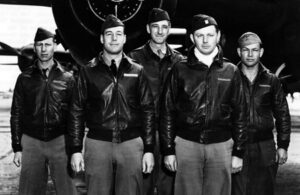
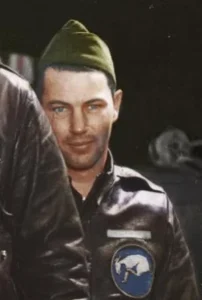
On 18-04-1942, he took part in the Doolittle Raid, the first American air attack on the Japanese home islands. Faktor was aboard the B-25 Whiskey Pete, the aircraft of Crew 3, Faktor on the right, 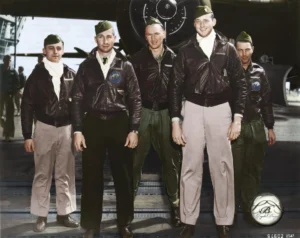 and was positioned in the aft section of the plane. What happened to him after the aircraft reached China remains one of the most disputed episodes of the entire operation.
According to the official American account, Faktor bailed out of the aircraft, but his parachute only partially deployed. It is further suggested that he subsequently fell from a cliff in Suichang County, sustaining fatal injuries. Other official explanations state that although he parachuted successfully, he later died after a secondary fall in steep, rocky terrain.
However, the exact circumstances of his death remain unknown.
Chinese sources present a markedly different version. According to villagers from Beiyang Village, who discovered the wreckage, Faktor did not parachute at all. They reported finding his body inside the wreckage of the aircraft, suggesting that he either could not bail out or never attempted to do so. The villagers transported his body to the village, laid it on a wooden board, and erected a small shed to guard it.
After two days and two nights, his body was transferred to the temporary headquarters of the Thirteenth Air Terminal in Wangcun. 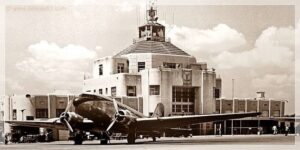 These Chinese accounts are supported by the diary of Richard Ewing Miller of Crew 2,
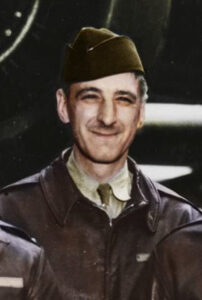
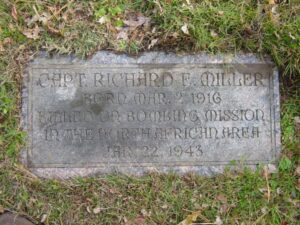
 which explicitly states that Faktor failed to parachute. This diary is held in private possession and is expected to be partially published in the near future.
The Chinese version stands in direct contradiction to the post-mission report of pilot Robert Manning Gray, 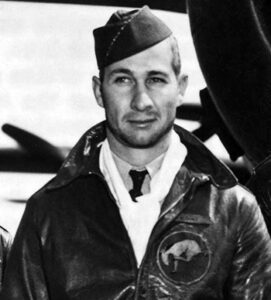
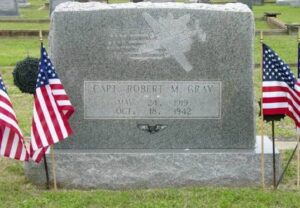
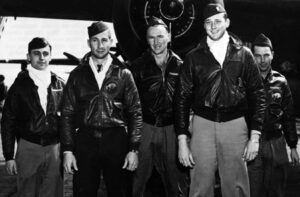 who stated that Faktor did bail out of the aircraft. As a result, Faktor’s death remains one of the enduring mysteries of the Doolittle Raid, comparable to the unresolved cases of William John “Billy Jack” Dieter
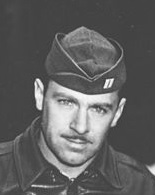
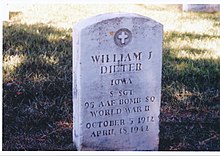 and Donald E. Fitzmaurice

 of Crew 6.
In May 1942, in Chongqing, James Harold “Jimmy” Doolittle 
 allocated $2,000 to the American missionary John Morrison Birch
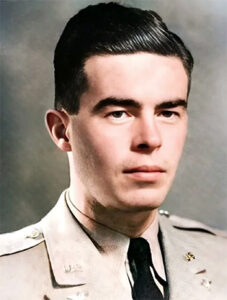
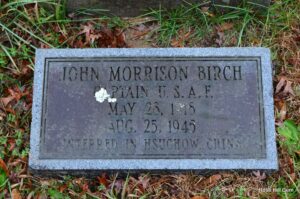 to arrange a dignified burial for Faktor. The Chinese Army provided land near Wan Tsuen, close to Quzhou and a nearby Chinese air force base, for a burial lease of one hundred years. Faktor’s grave was deliberately concealed during the Japanese occupation to prevent desecration.
According to Chinese sources, local villagers recovered his body near the crash site and protected it before it was transferred to Wangcun, near Quzhou. On 19–05-1942, Faktor was given a formal military burial with full honors by the Chinese Air Force near Wan Tsuen.  (Thanks to the Doolittle Raid Rescue Memorial, Quzhou, China).
During the Japanese occupation, his grave was deliberately concealed to prevent desecration. Although his remains were later repatriated to the United States, this site remains a place of remembrance for a young airman who gave his life during World War II.
Death and burial ground of Faktor, Leland Dale.
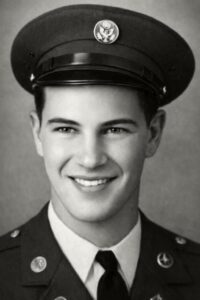
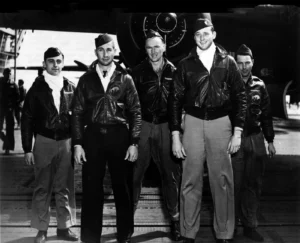
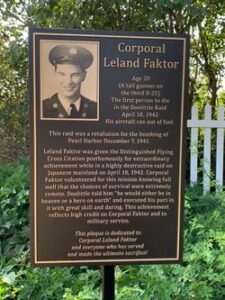
After the war, Faktor’s grave was rediscovered in 1947, and his remains were positively identified through a gold ring and bracelet bearing his name. His remains were repatriated to the United States under the Graves Registration Service. Contemporary news reports stated that “the last of the Doolittles had returned home.
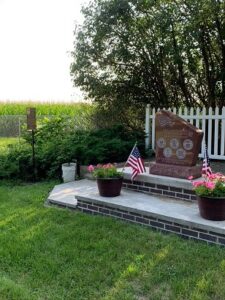
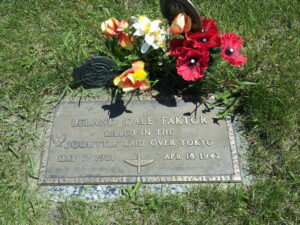
Faktor was reburied with full honors at Bohemian Cemetery, his hometown, becoming the last Doolittle Raider to return to American soil. He was also one of the youngest participants in the mission. Some records note a final reburial date of 27-04-1949 following administrative procedures.


Leave a Reply