

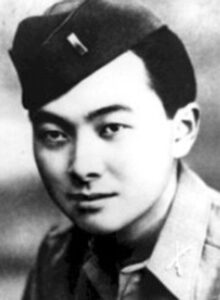
Inouye, Daniel Ken, born 07-09-1924, in Honolulu, 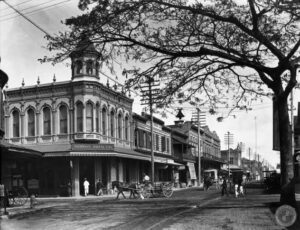 Honolulu, Hawaii, United States, to Hyotaro Inouye (1895–1974)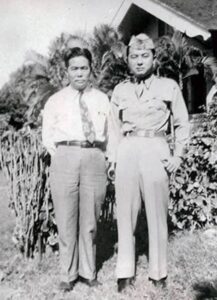
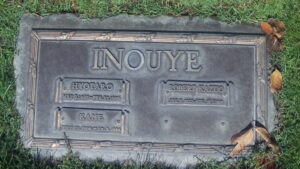 and his wife Kame, born Imanaga Inouye (1902–1986)
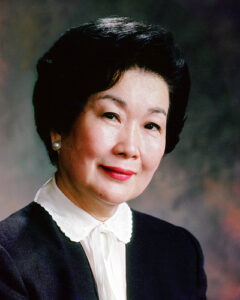
 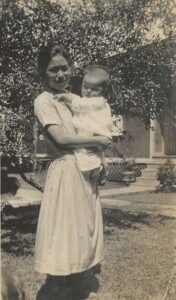 .Daniel had one sister and two brothers, Masako Inouye, Tomita (1929–2014), John Toshio Inouye (1930–2018) and Robert Kazuo Inouye (1932–2009), Daniel was married twice, in 1948 with Margaret Shinobu “Maggie”, born Awamura Inouye (1924–2006)
  and in 2008 with Irene Hirano, born Yasutake Inouye (1948–2020).
 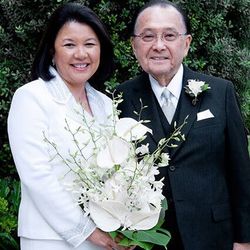 The couples had no children.
His parents had emigrated from Japan to settle in Hawaii’s Bingham Tract which was a Chinese-American enclave in Honolulu. Coming of age as tension grew with Imperial Japan was hard enough, but graduating from high school in Hawaii as a Japanese American immediately following the surprise attack of Pearl Harbor 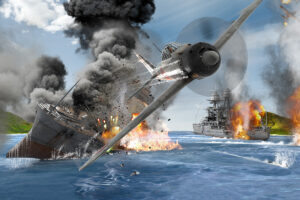 leading to the death of over 1,000 Americans prove especially difficult for Inouye. Curfews were enforced for Japanese Americans in Hawaii. There was an attempt to ship them to internment camps but the local economy for the islands relied heavily on Japanese American businesses. He attempted to enlist in the military but was turned away. He spent a year enduring insults and being questioned about his patriotism. In 1943, when the U.S. Army
  dropped its enlistment ban on Japanese Americans, Inouye curtailed his premedical studies at the University of Hawaii and enlisted in the Army.
Daniel volunteered to be part of the segregated all- Nisei-442nd Regimental Combat Team. 
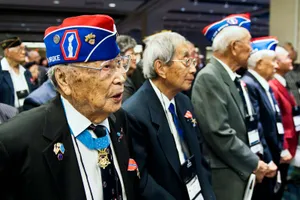 The 442nd Regimental Combat Team was activated on 01-02-1943 at Camp Shelby Mississippi. The Team was composed of Japanese American volunteers from the internment camps, Hawaii, states outside of the west coast exclusion zone, and Japanese American soldiers who were already serving in the U.S. Army when the war broke out. Inouye was promoted to sergeant within his first year, and he was assigned as a platoon sergeant. He served in Italy in 1944 during the Rome-Arno before his regiment was transferred to the Vosges Mountains region of France.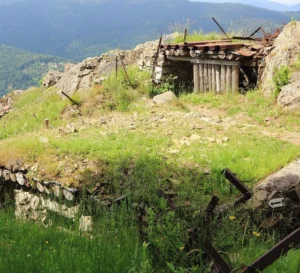
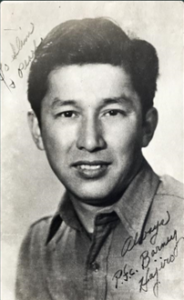
Inouye and the 442nd proved their unbridled valor in the Vosges Mountains when they were ordered to find and rescue a lost battalion of 400 U.S. infantry cut off and surrounded by German forces. In five days of battle in the fall of 1944, the 442nd broke through German defenses and rescued 211 men. I Company went in with 185 men; eight walked out unhurt. K Company began with 186 men; 17 walked out. As a result of his courage Sergeant Inouye with given a battlefield commission to second lieutenant. At one point while he was leading an attack, a German round struck him in the chest directly above his heart, but the bullet was stopped by the some silver dollars he happened to have stacked in his shirt pocket. 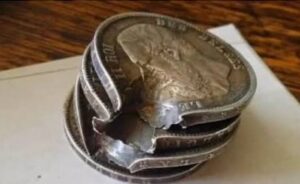 He continued to carry the coins throughout the war in his shirt pocket as good luck charms. Three members of the 442nd, Barney Hajiro,
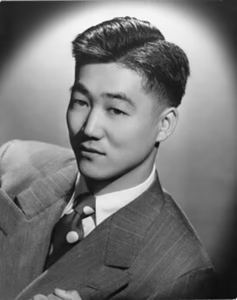
  James Kazuo Okubo,
  and George Taro Sakato
 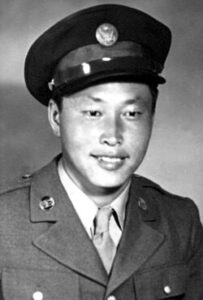 were awarded the Medal of Honor for their participation on the rescue, although due to discrimination at the time, they did not receive their medals until 2000.
In early 1945 Lieutenant Inouye and the 442nd redeployed to the Gothic Line. For nine months in 1944 German Field Marshal Albert Kesselring “Smiling Albert” 
 directed the construction of the Gothic Line along the top of the Apennines in the mountains joining Italy and France. This included the Fritz Todt Organization
 known for its fortifications at Monte Cassino. It was impossible terrain and the worst possible scenario for the American forces attacking uphill against well-fortified and dug in German infantry and artillery.
On 21-04-1945 Lieutenant Inouye was leading a flanking attack on a heavily-defended ridge near San Terenzo in Tuscany, Italy. The American platoon was in turn flanked in a surprise ambush by three MG-43 machine guns 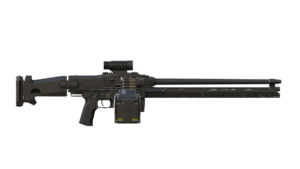 at relatively close range. Inouye’s platoon of 30 men was being cut to pieces. He stood up to look for the best avenue for cover when he was shot in the stomach.
Ignoring his wound, he proceeded to attack and destroy the first machine gun nest with hand grenades and his Thompson submachine gun. When informed of the severity of his wound,  he refused treatment and rallied his men for an attack on the second machine gun position, which he successfully destroyed before collapsing from blood loss. As his squad distracted the third machine gunner, Inouye crawled toward the final bunker, coming within 10 yards. As he raised himself up and cocked his arm to throw his last grenade, a German soldier inside the bunker fired a rifle grenade, which struck his right elbow, nearly severing most of his arm and leaving his primed grenade reflexively “clenched in a fist that suddenly didn’t belong to me anymore”. Inouye’s horrified soldiers moved to his aid, but he shouted for them to keep back out of fear his severed fist would involuntarily relax and drop the grenade. While the German inside the bunker reloaded his rifle, Inouye pried the live grenade from his useless right hand and transferred it to his left. As the enemy soldier aimed his rifle at him, Inouye tossed the grenade into the bunker and destroyed it. He stumbled to his feet and continued forward, silencing the last German resistance with a one-handed burst from his Thompson before being wounded in the leg and tumbling unconscious to the bottom of the ridge. He awoke to see the worried men of his platoon hovering over him. His only comment before being carried away was to order them back to their positions, saying “nobody called off the war!”
The remainder of Inouye’s mutilated right arm was later amputated at a field hospital and without proper anesthesia, as he had been given too much morphine at an aid station and it was feared any more would lower his blood pressure enough to kill him. He had to endure his arm being sawn off without anesthesia. He ceased carrying around his lucky silver dollars in his breast pocket.
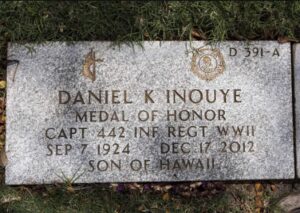
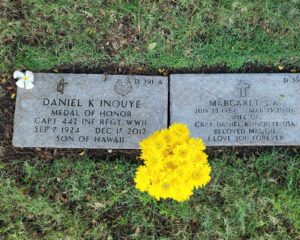
Death and burial ground of Inouye, Daniel Ken.
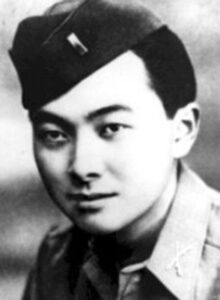
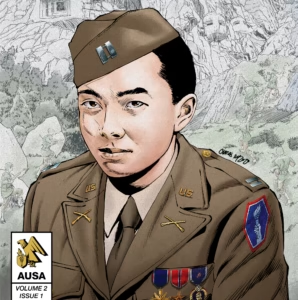
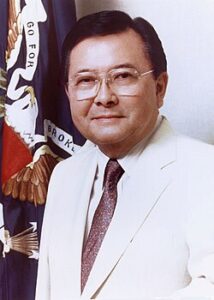
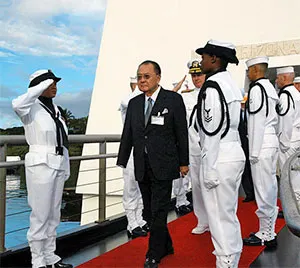
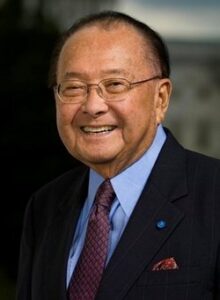
Although Inouye had lost his right arm, he remained in the military until 1947 and was honorably discharged with the rank of captain. At the time of his leaving the Army, he was a recipient of the Bronze Star medal 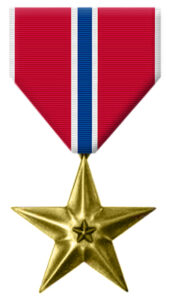 and Purple Heart.
  Inouye was initially awarded the Distinguished Service Cross
  for his bravery in this action, with the award later being upgraded to the Medal of Honor
  by President Bill Clinton
 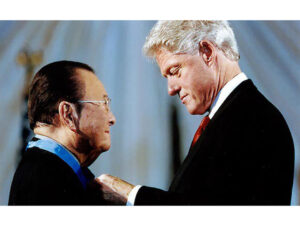 (alongside 19 other Nisei servicemen who served in the 442nd). While recovering at Percy Jones Army Hospital in Battle Creek, Michigan; he met and became friends with another recovering severely wounded young officer – Bob Dole.
 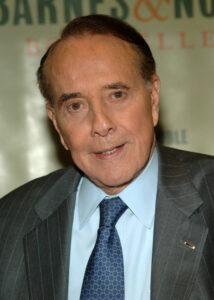 The two became friends that lasted through their terms in the United States Senate and up to Inouye’s death on 17-12-2012 (age 88) in Bethesda, Montgomery, Maryland, United States.. The Percy Jones complex of federal buildings, no longer a hospital, is now named Hart-Dole-Inouye Federal Center in honor of three patients who became United States Senators.
Daniel Ken Inouye is buried at the National Memorial Cemetery of the Pacific Honolulu, Honolulu, Hawaii, Section D, Site 391-A.


Leave a Reply