


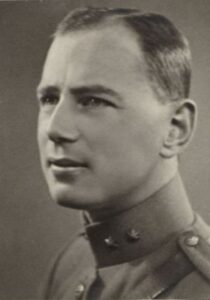
Galen, Graf Clemens August von, ‘the Lion of Münster.’ born on 16-03-1878, in Dinklage, Vechta, 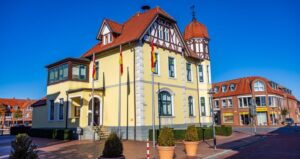 Oldenburg, his father, Graf Ferdinand Heribert Ludwig Maximilian Hubert Anton Maria von Galen, was 46
 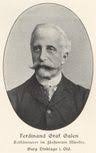 and his mother, Reichsgräfin Elisabeth Friederike Sophie Auguste Maria Huberta Von Spee, was 35.
Clemens August von Galen belonged to one of the oldest noble families of Westphalia. The seventeenth-century bishop and military leader Bernhard von Galen (1606-1678), nicknamed Bommen Berend, was a brother of his distant ancestor Johann Heinrich von Galen and a former predecessor in his bishopric. Clemens August was born in the Catholic southern part of the Grand Duchy of Oldenburg, in Dinklage in the present-day state of Lower Saxony. The name “von Galen” had long been associated with the region: the von Galens had been living there since 1667. Clemens August was a son of Count Ferdinand Heribert von Galen, a member of the Imperial German Diet for the Catholic Center Party, and Elisabeth von Spee, as the eleventh of thirteen children.
Until 1890, Clemens August and his brother Franz 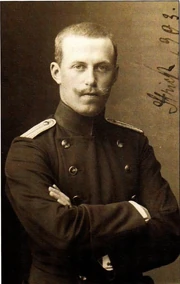 received homeschooling. After that, he went to the Jesuit college Stella Matutina in Vorarlberg, Austria,
 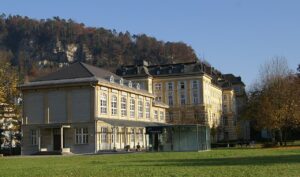 where only Latin was allowed to be spoken. Jesuits were not allowed in Münster at that time, as evidence of the lasting impact of the Kulturkampf, so Clemens and his family had to leave the state of Prussia to receive this education. He was not an easy student to teach. His Jesuit superior wrote to his parents: “Infallibility is the biggest problem with Clemens, who in no way can admit that he might be wrong.” It is always his teachers and educators who are wrong.” Because Prussia did not recognize the Stella Matutina academy, Clemens spent the final years of his education close to home. In 1894, he returned home and attended a public school in Vechta, and in 1896, both Clemens and Franz passed the exam that allowed them to enter university. After graduating, his classmates wrote in his yearbook: “Clemens does not like to engage in love or go drinking, he does not like worldly deception.” In 1896, he went to Switzerland to study at the Catholic University of Freiburg,
 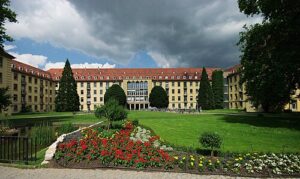 which had been founded by the Dominicans in 1886, where he came into contact with the writings of Thomas Aquinas.
 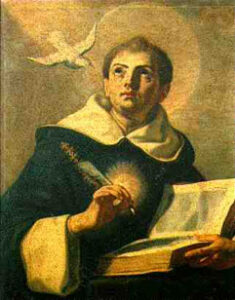 In 1897, he began various courses, including literature, history, and philosophy. After the first winter semester in Freiburg, Clemens and Franz went to Rome for an extensive three-month visit. At the end of the visit, he told Franz that he had decided to become a priest, although he was not sure whether he wanted to be a contemplative Benedictine or a Jesuit. In 1899, he met Pope Leo XIII
 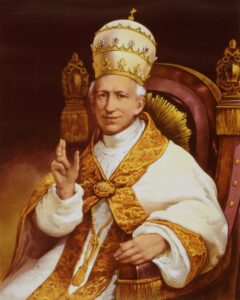 in a private audience. He studied at the Theological Faculty in Innsbruck, founded in 1669 by the Jesuits, where scholastic philosophy was emphasized and new concepts and ideas were avoided. In 1903, von Galen left Innsbruck to go to the seminary in Münster, and he was ordained as a priest on 28-05-1904. Initially, he worked for a relative, the auxiliary bishop of Münster, as a chaplain. However, he quickly moved to Berlin, where he worked as a pastor at St. Matthias.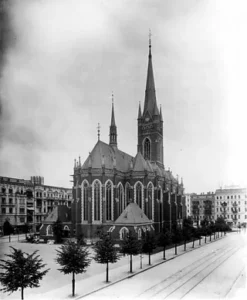
Von Galen was an outspoken anti-communist. He was also openly against the Nazis  because of their so-called euthanasia policy, which resulted in the deaths of thousands of homeless people, mentally ill individuals, and disabled persons. As early as 1936 and 1937, he supported protest actions against the Nazi education policy, including the removal of crucifixes from German schools.
In 1941, he delivered three sermons against the Nazis, who at that time had already killed 100,000 disabled people. 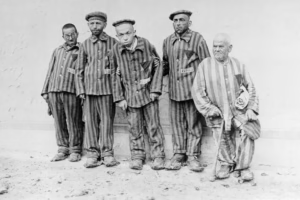 The text of his homily from August 3 of that year at the Lambertikirche in Münster was later dropped over Germany by British planes.
 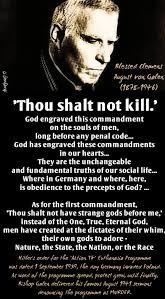 In response, the Gestapo
  placed him under strict house arrest, which lasted until the arrival of the British army in April 1945. Alfred Ernst Rosenberg
 and Martin Ludwig Bormann
 wanted to publicly hang the rebellious Bishop of Münster in the market square of Münster after a possible final victory of the Nazis at the Eastern Front.
After the Allies captured the bombed-out Münster, English and American journalists all wanted to interview the bishop who had defied the Nazi state terror and publicly spoken out against Hitler. However, Von Galen was busy coordinating aid for refugees and the reconstruction of orphanages and churches in the city center. A British military officer working for MI5 described Von Galen as a “hardened German nationalist” (but anti-Nazi) who had the character “of an oak.” Just as von Galen had attacked Nazi crimes, he now also criticized the treatment of German citizens by the Allies (including Soviets and Poles). He accused the Allies (not only the Soviet Russians but also the Poles and the English) of the already initiated systematic expulsion of German citizens from Silesia, East Prussia, Danzig, and also accused the Polish region of Pomerania (around Danzig) of pursuing deliberate ethnic cleansing. He attributes the catastrophic food supply in the western occupation zones to the “Anglo-Americans,” who he claims want to break the German population thru famine.
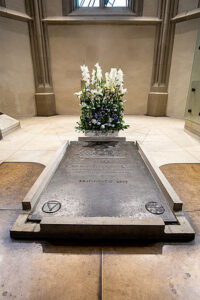
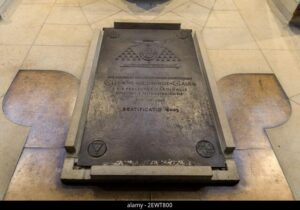
Death and burial ground of Galen, Graf Clemens August von. “the Lion of Münster.”.
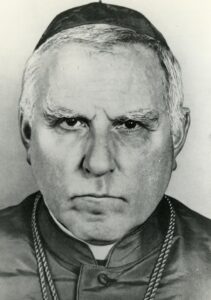
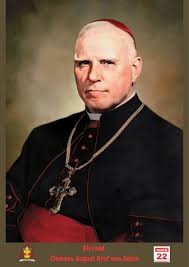
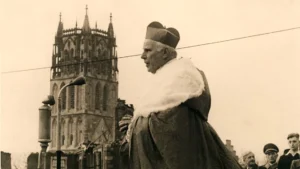
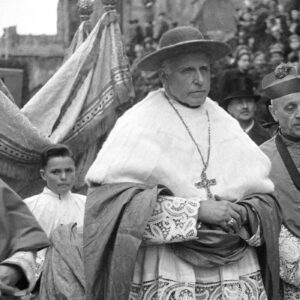
At the beginning of 1946, he traveled to Rome to be created a cardinal 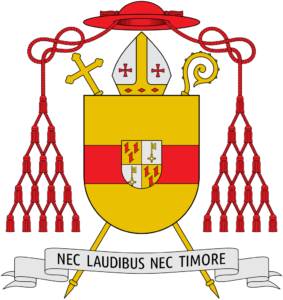 by Pope Pius XII.
 He received San Bernardo alle Terme
 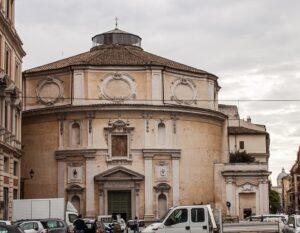 as his titular church. Upon his return from Rome, he was welcomed as a hero in Münster, as many Germans saw this appointment as the beginning of a regained national self-respect. Less than a week after his return, however, he passed away at the age of barely 68—just six days after his birthday on 22-03-1946—due to the consequences of a neglected appendicitis. Galen, Graf Clemens August von. ‘the Lion of Münster.’.is buried in the St. Paulus-Dom in Münster, Domplatz 28, 48143 Münster, North Rhine-Westphalia, Germany.




Leave a Reply