

Wellum, Geoffrey Harris Augustus, born on 04-08-1921, an only child, in Walthamstow, Essex,  the only child of Percy Harris Wellum and Edith J, born Freeman, who were married in Windsor Q4 1918to. In Q3 1943 in Westminster Wellum married Dorothy G C Neil, born Q4 1922 in Romford. They had two daughters and a son. He and his wife were divorced in 1975.
Geoffrey’s father, who had served at Gallipoli during WW1, ran an off-licence. Wellum was educated at Forest School, Snaresbrook,  where he captained the school cricket team.
Aged eighteen, Wellum signed up on a short-service commission with the Royal Air Force  in August 1939. The first aircraft he flew was the Tiger Moth
  at Desford airfield in Leicestershire. Wellum’s first solo flight was on 01-09-1939. Two days later Britain declared war on Germany. After successfully completing the course he then went on to fly the North American Harvard at RAF Little Rissington with 6FTS.
In May 1940, before his flight training was complete, Wellum was posted to 92 Squadron,  which was a combat squadron flying Spitfires.
 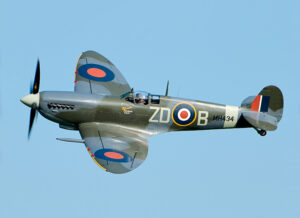 It was at 92 Squadron that he first encountered a Spitfire, and flew the aircraft for the first time. Later, in First Light, he wrote of the experience: “I experienced an exhilaration that I cannot recall ever having felt before. It was like one of those wonderful dreams, a Peter Pan sort of dream”.
Wellum’s first commanding officer was Roger Joyce Bushell, 
 (later immortalised in The Great Escape). Bushell was shot down and captured almost immediately after Wellum’s arrival, and was later executed by the Gestapo in the aftermath of the “Great Escape”.
Much later, in an unpublished interview with The Times, Wellum recalled: “After I joined the squadron they went to Dunkirk and by the end of that day we’d lost five people, four of whom I’d met the night before in the officers’ mess. I thought, ‘Hold on a minute, this is bloody dangerous!’ ”
Soon after Dunkirk, 92 Squadron was transferred from RAF Duxford in Cambridgeshire to RAF Pembrey in Carmarthenshire, Wales. It was there that Wellum began his combat career, “chasing isolated German aircraft all over the south-west”.
Wellum saw extensive action during the Battle of Britain.  Although just 18, he was not the youngest pilot to fight in the battle, an honour which is currently held by Martyn Aurel King,
 born 15-10-1921 – despite being nicknamed “Boy” by his colleagues. Boy was shot down on 16-08-1940, age 18.
On 09-09-1940, 92 Squadron was posted to RAF Biggin Hill in Kent,  in the centre of the fighting. Of the numerous Bf 109 fighters which escorted the German bombers, Wellum wrote “God, is there no end to them? The sun glints on their wings and bellies as they roll like trout in a stream streaking over smooth round pebbles. Trout streams, water meadows, waders, fast-flowing water, the pretty barmaid at the inn. Dear Jesus why this?”.
Wellum’s close colleagues included Brian Kingcome,.left

 Officers and guests celebrating the first anniversary of the arrival of No. 92 Squadron RAF at RAF Biggin Hill, September 1941.Front row, (left to right): Wg Cdr John A. Kent (Kentowski), Flt Lt Anthony Bartley, Mrs Wade, Flt Lt Robert Holland, Plt Off Trevor Wade and two unidentified ladies. In the back – Plt Off Sebastian Maitland-Thompson, Fg Off Tom Wiesse (Intelligence Officer) and Fg Off Geoffrey Wellum.
Wellum claimed a Heinkel He 111  shot down on 11-09-1940, and a quarter share in a Junkers Ju 88
  downed on 27-09-1940. Two (and one shared) Messerschmitt Bf 109s
  were claimed “damaged” during November 1940.
In the summer of 1941 Wellum participated in more than 50 “sweeps” over occupied France (also known as Circus offensives) flying escort for Blenheim and Stirling bomber formations, taking the war to the enemy. He claimed a Bf 109 shot down on 09-07-1941 over France, and in August 1941, Wellum was awarded the Distinguished Flying Cross. 
By this time most of Wellum’s original colleagues at 92 squadron had been killed or captured; he survived owing to a combination of luck and skill. Later, Wellum recalled: “You make yourself a difficult target. Never stay still, never fly straight and level, chuck it around. Quite often you’d find yourself surrounded by aeroplanes and then the sky would be empty. ‘Where’s everybody gone?’ It was then that you were in danger. It was the German you didn’t see who shot you down.”
In the summer of 1941 Wellum was taken off active duty, and assigned to a training squadron: No 52 Operational Training Unit  at Aston Down, flying Hawker Hurricanes. Disappointed to be leaving frontline service, Wellum initially found the experience to be “almost unbearable”. Eventually, Wellum relaxed: “I found a new peace and…gradually I seemed to unwind. I even began to enjoy [teaching] pupils”.
In February 1942, he was reassigned to combat duties, being transferred to 65 Squadron  based at Debden, where he was appointed a Flight Commander in March 1942. By now, the Luftwaffe was flying a new fighter aircraft, the Focke-Wulf Fw 190,
  superior in all but turn radius to the Spitfire V, and the squadron took heavy losses. “Quite simply, the Fw 190 outclasses our Spitfire 5Bs. It is 40mph faster, has very good armament and a very high rate of roll”. In air combat over France, Wellum’s number two, Freddie Haskett, was killed by a Fw 190, and Wellum himself survived only by “throwing the Spit all over the sky without really looking round”. At this time he began to develop severe headaches, “a splitting headache pain across my eyes”.
In July 1942, Wellum was sent to Glasgow, where he participated in Operation Pedestal, a convoy mission to carry supplies for the relief of the besieged garrison at Malta. Wellum led a flight of eight Spitfires to be carried on aircraft carrier HMS Furious,  sailing from the Clyde to the Mediterranean, and then land them on the island. On 11-08-1942, Wellum led his flight of eight Spitfires, flying without ammunition to save weight (the .303 cartridges were replaced with cigarettes), and landed at Luqa airfield on Malta, joining 145 Squadron
  on air defence duties. Their commander was the American Wing Commander Lance Cleo “Wildcat” Wade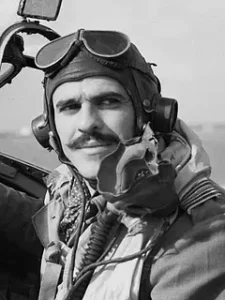
 DSO, DFC & Two Bars.
The convoy was heavily damaged by German and Italian forces, and many ships were sunk. Wellum witnessed the arrival at Valletta Harbour of the few remaining ships, including, last of all, the desperately-needed oil tanker SS Ohio,  barely afloat, escorted by two destroyers. “As the three ships come through the harbour entrance, just about maintaining steerage way, the cheering of the Maltese who have to welcome her in slowly subsides until there is absolute silence. Some of them men, mostly elderly, take off their hats and the womenfolk in their black hoods and cloaks cross themselves. From the fort a bugle sounds the “Still” and not a soul moves”.
On Malta, Wellum was diagnosed with severe sinusitis and battle fatigue, after three years of intensive frontline flying. After surgery, he returned from Malta to Britain via Gibraltar, and later became a test pilot for new aircraft, such as the new Hawker Typhoon fighter-bomber,  based at Gloster Aircraft.
After his return to England, Wellum did not return to combat duties, instead finishing the war as a gunnery instructor In 1943, he married Grace Neil,  his wartime girlfriend, with whom he had three children. The family settled in Epping, Essex.
Life for Wellum at the end of his career as a fighter pilot was never quite the same. “I am certain that my time came with my three years as an operational fighter pilot in our nation’s finest hour. My only regret is that it had to happen so early in life”.
After the war, Wellum stayed with the RAF, achieving Squadron Leader rank. Geoffrey served first as a staff officer in the Second Tactical Air Force in West Germany, where he flew jet aircraft such as the Gloster Meteor, the de Havilland Vampire  and the English Electric Canberra.e was also stationed at RAF Gaydon, and in East Anglia. This was followed by a four-year tour with 192 Squadron. Wellum left the Royal Air Force in 1960 and took over the family haulage business. Later he became a commodities broker.
His birth was registered in West Ham, London, in Q3 1921, the only child of Percy Harris Wellum and Edith J Freeman, who were married in Windsor Q4 1918. In Q3 1943 in Westminster Wellum married Dorothy G C Neil, born Q4 1922 in Romford. They had two daughters and a son. He and his wife were divorced in 1975.
Geoffrey retired from the RAF in 1961 to take up a position with a firm of commodity brokers in the City of London until his retirement to Cornwall where he still lived when ‘First Light’ was published in 2002.
In the mid-1980s, with the family business in liquidation and his divorce pending, Wellum retired, as he had promised himself in his youth, to The Lizard peninsula, Cornwall,settling in Mullion. He joined the local choir, and became deputy harbourmaster.
To prove to himself that he had actually done something with his life, Wellum took his wartime notebooks and wrote a longhand memoir of his time as a Spitfire pilot, that he never intended for publication. He was a member of the Royal Air Force Club.  He was awarded the Freedom of the City of London.
Wellum has contributed to various television documentaries on the Battle of Britain, including Spitfire Ace produced by RDF Media/Channel 4 (2004), Dangerous Adventures for Boys produced by Channel 5 (2008), and The Spitfire: Britain’s Flying Past produced by the BBC (September 2011).
To mark the 70th anniversary of the Battle of Britain, the BBC commissioned a one-off drama for TV called First Light, based on Wellum’s book of the same name. The film was first shown by the BBC on 14-09-2010 with Wellum himself narrating and the young Wellum played by Sam Heughan. 
Wellum also appeared in the documentary “Greatest Events of World War II in colour,” being interviewed on his experience at the Battle of Britain. The series aired on Netflix in 2019, after his death, and the episode “Battle of Britain” is dedicated in his memory.
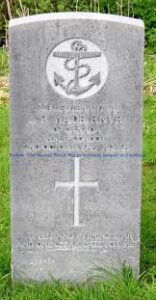
Death and burial ground of Wellum, Geoffrey Harris Augustus.


Geoffrey passed away on 8-07-2018 (aged 96) in Mullion, England and is buried at Mullion Cemetry; Cornwal, United Kingdom. Lender Ln, Mullion, Helston TR12 7AJ, UK.




Leave a Reply