


Tumbrink, Otto Frank, born 04-06-1924 in Bork, Unna,  Nordrhein-Westfalen, Germany.
Otto was serving in April 1944 with the German army of occupation in the Netherlands and his fiancé of Freeke Scheeres, had just informed him of a newborn daughter, named Elfriede.
On 18-01-1944, Meindert Hollander, a 15-year-old lad from Delfzijl, was playing with a ball, when it bounced over a fence. It ended up in a field, filled with land mines. While attempting to retrieve his ball, Meindert was severely injured by an exploding mine. Resting on the Delfzijl General Cemetery Delfzijl, Delfzijl, Groningen
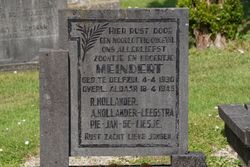
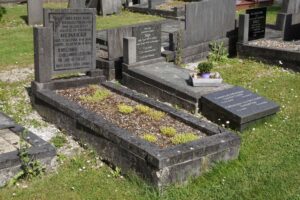 The detonation was heard by Otto Tumbrink, who attempted to come to Mendert’s aid. He also encountered a landmine, which detonated, injuring him as well. Otto, who had just become a father and the young Meindert both succumbed to their injuries and were buried in the Delfzijl General Cemetery. Otto’s remains were reburied in the German War Cemetery in Ysselsteyn on 23-07-1958.
Two days after the liberation of Groningen, the ruins of the medieval houses and shops in the city center—shattered by gunfire and fire—were still smoldering. During the fighting, which lasted four days, 43 Canadian soldiers were killed and 110 civilians lost their lives. A large part of the city center was destroyed. News of the provincial capital’s liberation is also reaching other parts of the province that remain under occupation. Mr. S. Ritsema from Appingedam writes in his account of the final days of the war in April and May 1945: ‘Wednesday, April 18. Another very quiet night. The morning will likely be quiet, too. In Ten Boer, Hotel Klinkhamer has burned down; haven’t seen a “Tommy” (Allied soldier – Ed.) yet. There are, however, fighter planes in the sky now and then. No one is allowed in or out of Appingedam, except for those who absolutely must leave, such as farmers and the like; they are issued a pass (*Ausweis*). Women can also leave if they hand over their identity cards. People from Groningen occasionally arrive in town with incredible stories—claims that Groningen’s city center has been completely destroyed, and so on. The “Tommies” are in Loppersum.’
On that same day, children are kicking a ball around near the German anti-aircraft guns on the dike at Delfzijl. Young soldier Otto Tumbrink 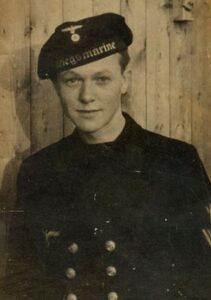 watches on. He is attached to *Batterie Delfzijl*, an anti-aircraft unit forming part of the Atlantic Wall—the 5,000-kilometer-long defensive line along the coasts of German-occupied territories—tasked with protecting targets such as Emden from Allied bombers. The 21-year-old Tumbrink was born in the small town of Selm in North Rhine-Westphalia. He worked in the mining industry, but upon the outbreak of war, he enlisted in the *Kriegsmarine*

 at the age of seventeen, undergoing training with *Marine Flak Abteilung 236*.
 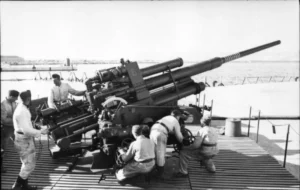 This unit operated anti-aircraft batteries around Emden; however, from 1940 onwards, guns were also stationed in Delfzijl and Groningen, and a year later, the village of Termunten was likewise equipped with *Flak* (anti-aircraft artillery). Otto arrived in Delfzijl on 29-08-1941. After just over a year, he was transferred to *Batterie Nansum*, located a few kilometers north of the port city. Yet by April 1945, holding the rank of *Obergefreiter*,
 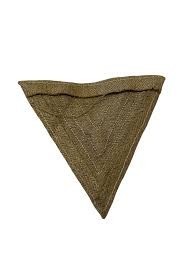 he was once again manning the guns in Delfzijl.
On 08-02-1945, Otto writes a letter to his girlfriend Freeke Scheeres. They have been engaged since 14-05-1944. Otto has just become a father to a daughter, but he hasn’t heard from his fiancée in a while. Does she still like him? Or did she have enough with their daughter? He ends the letter with: ‘Denn einmal kommt der Tag, dass wir uns wiedersehen.’ “For once, the day will come when we see each other again”. The warm regards from afar are sent to you by my dear wife, your ever-thoughtful, loving, and eternally faithful treasure. Otto.
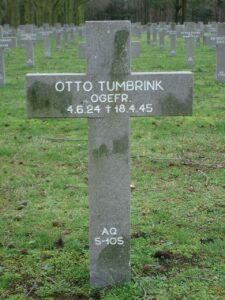
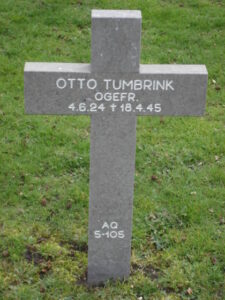
Death and burial ground of Tumbrink, Otto Frank.
On April 18 1945 children are playing soccer right next to the antiaircraft artillery. The area around the antiaircraft battery is fenced off with barbed wire and landmines. The fifteen-year-old Meindert Hollander accidentally kicks the ball into the minefield. The boy climbs over the barbed wire and tries to grab the ball. But he steps on a mine. The explosion echoes over the Harbor City. Meindert lies severely injured in the field. Otto doesn’t hesitate and tries to reach him. But he also steps on a mine. Both Meindert and Otto die from their injuries. They are buried in the cemetery in Delfzijl. Otto’s body is reburied on July 23, 1958, at the German cemetery in Ysselsteyn in Limburg. Timmermannsweg 75, 5813 AM Ysselsteyn.


Leave a Reply