

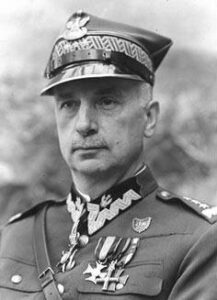
Sosnkowski, Kazimierz, born 19-11-1885, in Warsaw, 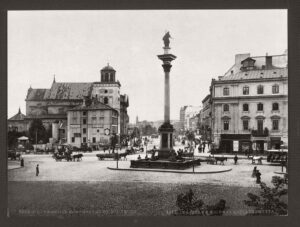 the son of Józef Bogdan Sosnkowski, a chemical engineer, and Zofia, born Drabińska, Sosnkowski. Kazimierz studied architecture at universities in Warsaw and Lviv. In 1906, as commander of the Warsaw district of the PPS combat organization,
  he led the “action against the Moscow occupiers,” known as Bloody Wednesday. Bloody Wednesday refers to the events of 15-08-1906 in the (Congress) Kingdom of Poland, where the Combat Organization of the Polish Socialist Party (OB PPS) carried out a series of attacks on Russians, primarily police officers and informants. This took place in the context of the Revolution in the Kingdom of Poland (1905–1907), and represented one of the biggest actions in the history of OB PPS.
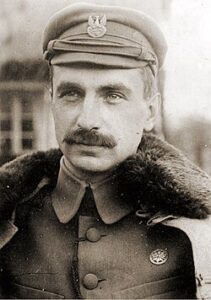
The PPS militant organization was founded in October 1904 on the initiative of Józef Klemens Piłsudski.
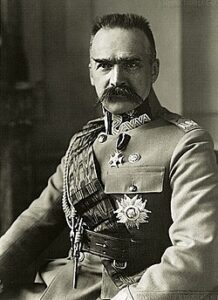
 Polish statesman who served as the Chief of State (1918–1922) and first Marshal of Poland (from 1920).
This was the result of his decision to launch an armed struggle against the tsarist regime. The organization’s mission was to protect PPS demonstrations, neutralize police officers, instill fear among representatives of the Tsarist police apparatus, and attack bridges, rail lines, and expropriations to finance the PPS. Historians emphasize that many future politicians and founders of the Second Polish Republic, including Sosnkowski, were members of the organization.
On the night of July 21–22, 1917, German gendarmes arrested Brigadier Piłsudski and imprisoned him in Gdańsk (now the detention center at 12 Kurkowa Street). Colonel Kazimierz Sosnkowski was also imprisoned. The German courts operated under martial law and punished acts of resistance with the death penalty.
The German authorities were informed that the Poles were planning to free the detainees. A Polish military interpreter, Alojzy Rapior, 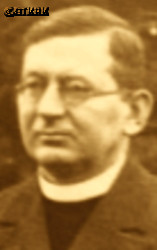 assisted the detainees. On 29-07-1917, Piłsudski and Sosnkowski were led out of their cells one by one and escorted by gendarmes to the station.
Sosnkowski was regarded as a skilled organizer. As undersecretary of military affairs, he established the Polish Army. 
In September 1939, Sosnkowski commanded the southern front in the battles against the Germans near Lviv. Historians emphasize that Sosnkowski enjoyed immense authority among the soldiers. In the final battles of September 1939, he and his subordinates fought directly on the front lines.
He was one of the few high-ranking commanders of the Second Polish Republic to achieve success on the front. On September 15 and 16, his units defeated the SS Germania motorized regiment near Jaworów and Sądowa Wisznia (now Ukraine).
In exile, he served as the successor to the President of the Republic of Poland, Minister of the Interior, and Commander of the Union of Armed Struggle.
“Sosnkowski was a thorn in the side of virtually everyone: part of the government-in-exile, the Soviets, and the Anglo-American Allies. He was convinced that no agreements could be made with the Soviets because they were treacherous and untrustworthy. He knew Russia and its imperialism well from the Tsarist era, regardless of the political system,” said Dr. Jerzy Kirszak, military historian and author of the monograph “General Kazimierz Sosnkowski 1885–1969.” On 08-07-1943, General Sosnkowski was appointed commander-in-chief.
On 30-09-1944, following intervention by the British authorities, President Władysław Raczkiewicz relieved Sosnkowski of his duties as commander-in-chief. “I am well aware that I am committing a highly immoral act,” he explained to the General.
“General Sosnkowski proved himself as commander-in-chief. He was the guardian of the Republic’s honor. He believed that Poland should not exhaust itself in unnecessary uprisings. However, he realized that the Poles had become inconvenient allies for London and Washington. After the Katyn massacre was revealed, there was a fear that Poland would break away from the Allies, and Josef “Koba” Vissarionovich Stalin  exploited this to his advantage,” Kirszak emphasized.
The historian noted that, despite many setbacks, the general succeeded in “building a strong and modern Polish army, which took part in the land battles in early 1944.” When General Sosnkowski was commander of the Polish forces in the West, Polish soldiers fought at Monte Cassino, Ancona, and the Falaise Pocket 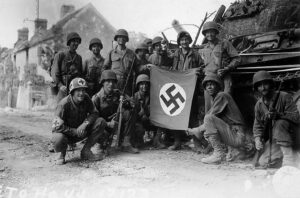 (France), among other places. Polish RAF pilots and naval personnel also took part in the fighting.
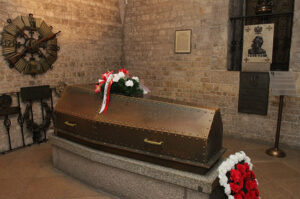
Death and burial ground of Sosnkowski, Kazimierz.
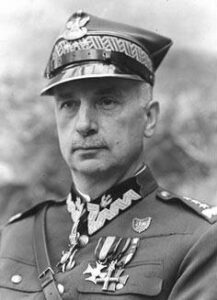
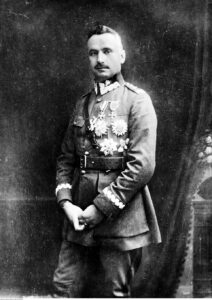
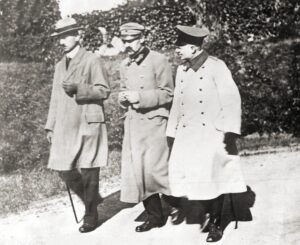
After his retirement, the General moved to Canada, where he devoted himself to political journalism and writing his memoirs, and served as the “spiritual leader of the Polish independence emigration community in America.” Until 1949, he was denied visas to Great Britain and the United States, whereupon he decided to settle permanently in Canada. He and his family settled on a 10-hectare farm in Arundel, Quebec. Sosnkowski died there on 11-10-1969, age 83. In the foreground are Edward Śmigły-Rydz 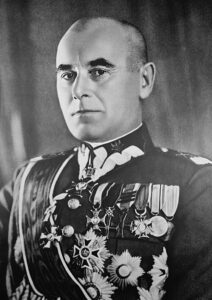
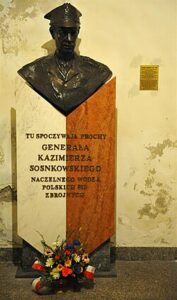
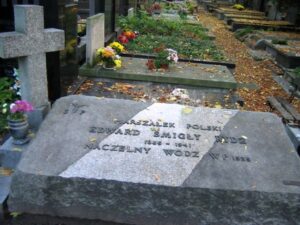 and Kazimierz Sosnkowski On 12-11-1992, an urn containing his ashes was placed in the crypt of the Archbasilica of St. John the Baptist in Warsaw. The grave of Jadwiga Sosnkowska—widow of General Kazimierz Sosnkowski—at Stary Powązki Cemetery in Warsaw, on the right.
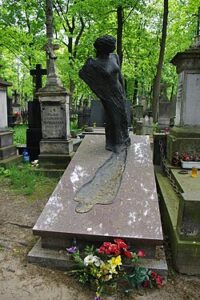
Message(s), tips or interesting graves for the webmaster: robhopmans@outlook.com


Leave a Reply