



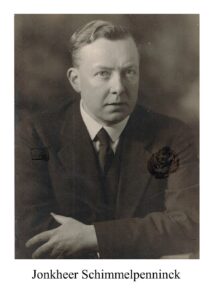
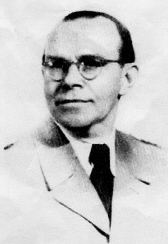
Schimmelpenninck, Johan, alias “Uncle Alexander,” born 30-09-1887, in Rhenen, Netherlands, a descendant of the untitled noble branch of the Schimmelpenninck family and the son of Baron Gerrit Johan Anne Schimmelpenninck (1854–1929), 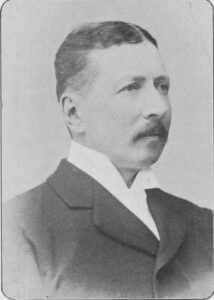 mayor of Rhenen and member of the House of Representatives, and Baroness Cécile Marie Steengracht (1855–1929), a descendant of the branch of the Steengracht
  family that resided at the Beerschoten Estate. Gustav Adolf Steengracht von Moyland ,
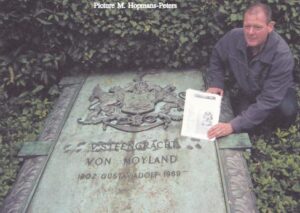 States Secretary under foreign minister Joachim von Ribbentrop,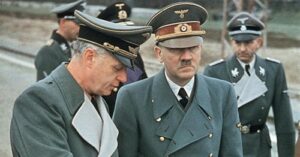
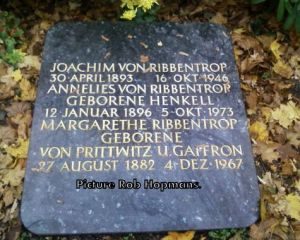 lived here.
He had an older brother, Gerrit (1886–1933), who was the director of a car dealership and died at the age of 37; the eldest brother, Ernest (1883–1963), served as a managing director of that business. He also had a younger sister. He was unmarried. The youngest son of his eldest brother, who was married to a Belgian Viscountess de Bissy, was killed in action in the Dutch East Indies in 1949 at the age of 26.
In the summer of 1940, following the Dutch surrender, Jhr. J. Schimmelpenninck, alias “Uncle Alexander,” took the initiative to establish a resistance organization. Members of the organization were recruited from among naval cadets and military cadets. This led to the formation of an intelligence group that included Gerard Dogger, 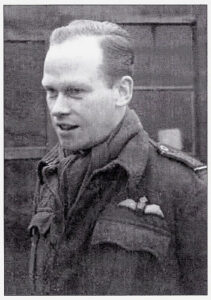 Peter Tazelaar,
 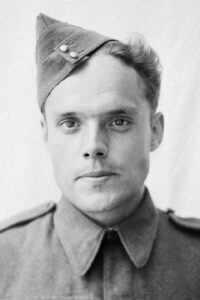 Anton Wilhelm Marie Abbenbroek,
  and Johan Birnie,
 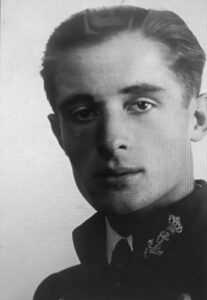 among others. This group would later merge into the Ordedienst.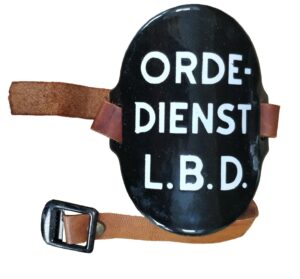
This movement had two objectives. First, it believed that the occupation would not last long. At the time of liberation, the Allies would need to be supported, and the resulting power vacuum would need to be temporarily filled to prevent chaos. The second objective was to gather military intelligence for the benefit of the Allies. The intelligence was to be sent to England, to Queen Wilhelmina. 
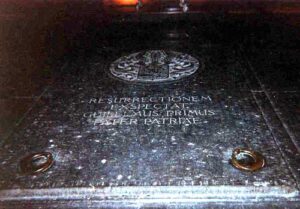
Before the war, Schimmelpenninck had maintained close contact with François van ‘t Sant, 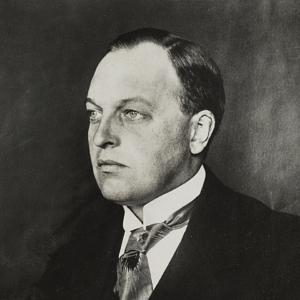 Queen Wilhelmina’s private secretary.
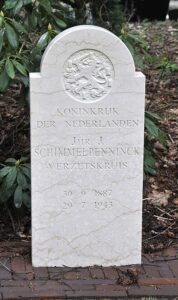
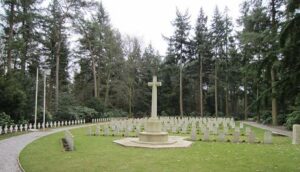
Death and burial ground of Schimmelpenninck, Johan, alias “Uncle Alexander,”
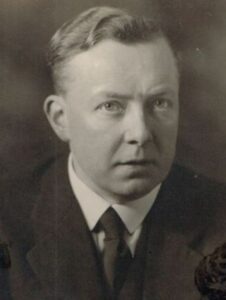
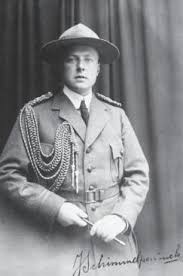
Schimmelpenninck was arrested at his home on 13-11-1941. He was imprisoned in the Scheveningen Oranje Hotel prison.  During his interrogations by the Sicherheitsdienst (SD),
  which involved the “regulated” use of physical violence, Schimmelpenninck did not utter a single word. On 06-11-1942, he was transported to Camp Amersfoort. On 18-01-1943, due to the evacuation of Camp Amersfoort, he was transferred to Camp Vught.
  He was registered as Schutzhäftling 1988. Due to the Second OD Trial, he was transferred to Camp Haaren on 11-03-1943. On 27-04-1943, he was sentenced to death by the Wehrmacht judiciary. He was executed by firing squad, age 55, on 29-07-1943, at Leusderheide, along with sixteen of his fellow resistance fighters.
In addition to Schimmelpenninck, the group consisted of the following resistance fighters: Anton Abbenbroek, Lex Althoff, 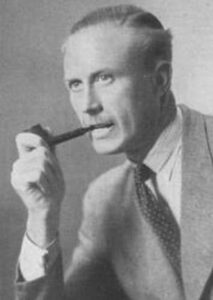 Christiaan Frederik van den Berg,
  Pim van Doorn,
 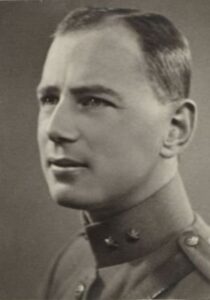 Fritjof Dudok van Heel,
 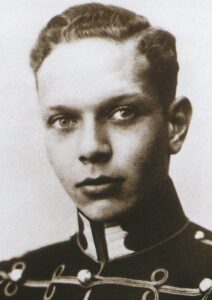 Pieter Hartogs,
  Willem Hendrik Hertly, Johan Frederick Henri de Jonge Melly,
 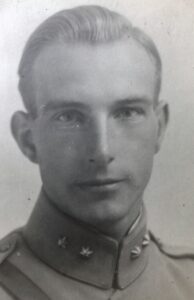 Eduard Alexander Latuperisa,
  Adriën Moonen,
 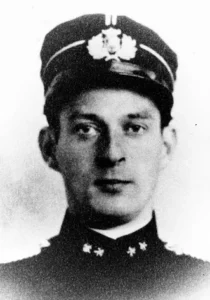 Willem Mulder,
 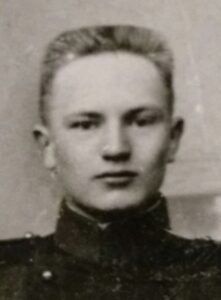 Anton Cornelis Theodorus van Rijn, Jan van Straelen,
 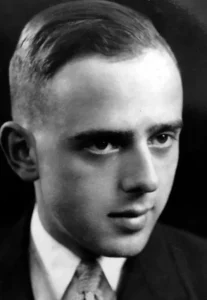 Sieg Vaz Dias,
 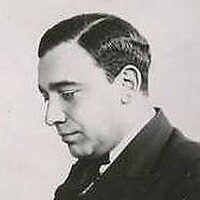 Gerardus “Gerhard” Vinkesteijn,
 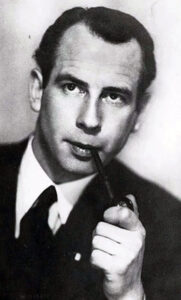 and Abraham “Bob” Wijnberg
  .
.
On 22-06-1945, detectives from the Political Investigation Department for the province of Utrecht, led by Gerrit Kleinveld, 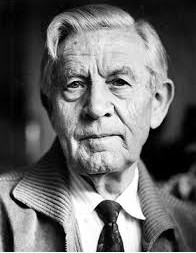 uncovered the mass grave in which Schimmelpenninck was buried. His body was identified based on his physical description and the objects found at the site.
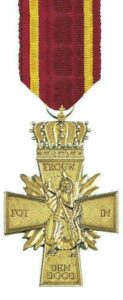
Johan Schimmelpenninck was reburied at the Rusthof municipal cemetery in Amersfoort, Section 12, Row C, Plot 141. He was posthumously awarded the Resistance Cross in 1952. His name is listed on the Roll of Honor for the Fallen 1940–1945.




Leave a Reply