

Schilling, Claus Carl, born 05-07-1871, in Munich, 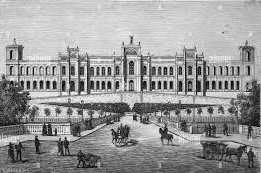 Stadtkreis München, Bavaria, Germany. Schilling studied medicine in his native city, receiving a doctor’s degree there in 1895. He was a professor of parasitology at the University of Berlin and a member of Malaria Commission of the League of Nations.
  Within a few years, Schilling was practicing in the German colonial possessions in Africa. Recognized for his contributions in the field of tropical medicine, he was appointed the first-ever director of the tropical medicine division of the Robert Koch
 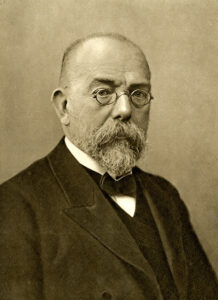 Institute
 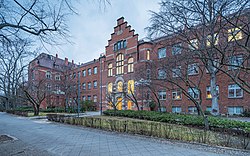 in 1905, where he would remain for the subsequent three decades.Upon retirement from the Robert Koch Institute in 1936, Schilling moved to Benito Mussolini’s

 Fascist Italy, where he was given the opportunity to conduct immunization experiments on inmates of the psychiatric asylums of Volterra and San Niccolò di Siena. (The Italian authorities were concerned that troops faced malaria outbreaks in the course of the Italo-Ethiopian War.) As Schilling stressed the significance of the research for German interests, the Nazi government of Germany also supported him with a financial grant for his Italian experimentation.
Though never a member of the Nazi Party  and a recognized researcher at the Robert Koch Institute before the war, Schilling participated in unethical and inhumane experiments on captive human subjects under both Fascist Italy and Nazi Germany. From 1942 to 1945, Schilling’s research on malaria and attempts at fighting it using synthetic drugs culminated in human experimentation on over a thousand camp prisoners at Dachau, of whom hundreds died.
Schilling returned to Germany after a meeting with Leonardo Conti, 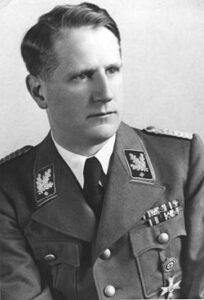
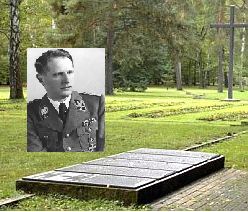 the Nazis’ Health Chief, in 1941 and an SS-Obergruppenführer in Nazi Germany. He was involved in the planning and execution of Action T4 that murdered hundreds of thousands of adults and children with severe mental and physical handicaps. On 19 May 1945, after Germany’s surrender, Conti was imprisoned and in October hanged himself to avoid trial.
By early 1942 Schilling was provided with a special malaria research station at Dachau’s concentration camp by Heinrich Himmler,  the leader of the SS. Despite negative assessments from colleagues, Schilling would remain in charge of the malaria station for the duration of the war.
Although Schilling stressed that the research could be done in a harmless manner, test subjects in Dachau 
 were subject to sadistic treatment. They included confining their hands and arms in cages filled with malaria mosquitoes. Afterwards, they were treated with synthetic drugs, at doses ranging from high to lethal. Of the more than 1,000 prisoners used in the malaria experiments at Dachau
 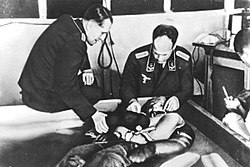 during the war, between 300 and 400 died as a result; among survivors, a substantial number remained permanently injured. A number of priests imprisoned by the Nazis were killed during the experiments.
In the course of the Dachau Trials following the liberation of the camp at the close of the war, Schilling was tried by a U.S. General Military Court, appointed at 02-11-1945, in the case of The United States versus Martin Gottfried Weiss, SS-Obersturmbannführer and the commandant of the Dachau concentration camp 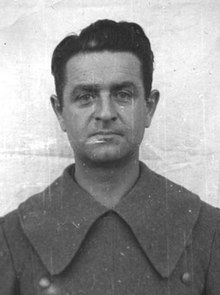
 and SS-Obersturmführer Friedrich Wilhelm Ruppert,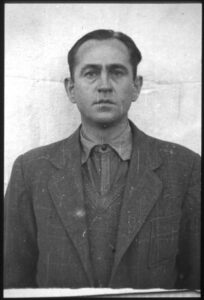
 et al. The defendants, 40 doctors and staff, were charged and convicted of offenses of the violations of laws and usages of war in that they acted in pursuance of a common design, did encourage, aid, abet, and participate in the subjection of Allied nationals and prisoners of war to cruelties and mistreatments at Dachau Concentration Camp and its subcamps. According to the testimony of August H. Vieweg, the patients used in the malaria experiments were Poles, Russians, and Yugoslavs. At that time, there was no formal code of ethics in medical research to which the judges could hold the accused Nazi doctors accountable. The “scientific experiments” exposed during the trials led to the Nuremberg Code, developed in 1949 as a ten-point code of human experimentation ethics.
During his trial, Schilling made a plea in English. Breaking down in tears at the end, he pleaded with the court to let him finish his research, albeit in a less destructive manner:
Czech priest, Friedrich Hoffman, 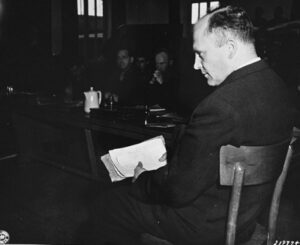 testifies at the trial of former camp personnel and prisoners from Dachau concentration camp. In his hand he holds records showing that hundreds of priests died at the camp after being exposed to malaria during Nazi medical experiments.
“I have worked out this great labor. It would be really a terrible loss if I could not finish this work. I don’t ask you as a court, I ask you personally to do what you can; to do what you can to help me that I may finish this report. I need only a table and a chair and a typewriter. It would be an enormous help for science, for my colleagues, and a good part to rehabilitate myself.”
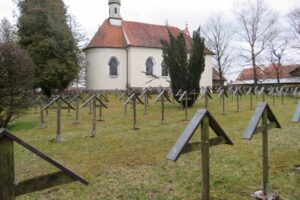
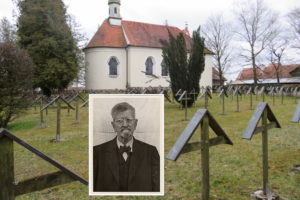
Death and burial ground of Schilling, Claus Carl.
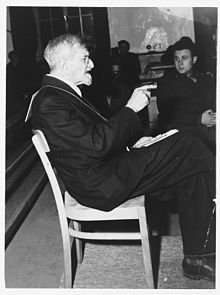

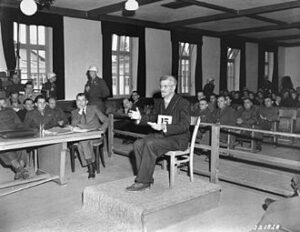
The tribunal sentenced Schilling to death by hanging on 13-12-1945, age 74. After his conviction, Schilling asked his lawyer not to appeal on his behalf, saying he would rather die than stay in prison. However, many in the German medical community protested on his behalf, calling him an honest and humane scientist. Nevertheless, Schilling’s sentence was confirmed, and his execution took place at Landsberg Prison in Landsberg am Lech 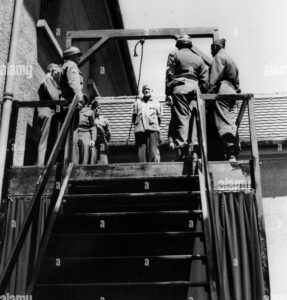
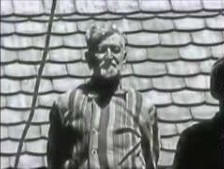 on 28-05-1946. The execution was filmed by military personnel, who recorded Schilling’s ascending the gallows and his hanging, along with a coffin marked “Dr Schilling, Claus.”
When asked if he wanted to make a final statement, Schilling said “I am not guilty. Please get it over with.”




Leave a Reply