

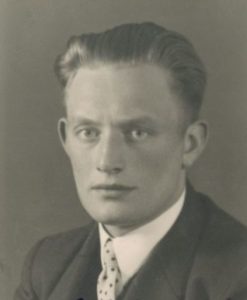
Scheepstra, Liepke,”Bob”, born 01-11-1918, in Lioessens 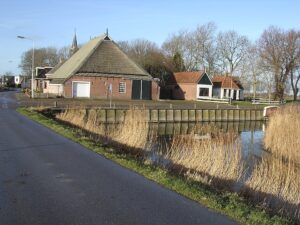 Netherlands, in the then municipality of Oost-Dongeradeel) and spent his youth on Schiermonnikoog. Liepke joined the Police Corps on 03-08-1938, where he was promoted to corporal on 04-01-1939. During the five-day battle against the Germans in May 1940, he was involved in combat operations as a military policeman. After the capitulation, he was transferred to the National Constabulary Corps as part of a police reorganization introduced by the Germans. Because he did not recognize the occupier as the legitimate authority, he resigned in 1941. He moved to Westervoort (near Arnhem) and became a security officer at the Algemene Kunstzijde Unie Arnhem (AKU) there. In January 1942, he married Frouwke Elizabet Dijk (1917-2002).
After the April-May strikes in 1943, he went into hiding with his wife and child because he, as a former soldier, refused to report for military service. Since he had served as a soldier during the war days, he had to report in 1943 after the April-May strikes to go into captivity. Scheepstra did not comply and went into hiding in Arnhem.
Even before going into hiding, Scheepstra was in contact with several employes of the National Organization for Assistance to People in Hiding. He was a co-founder of the affiliated National Assault Groups. Despite his age (24), he took on a leading role in it, partly because, thanks to his military training, he knew how to handle weapons and could instruct others about them.
By the National Organization for Assistance to Refugees (LO), he was appointed as the leader of the National Assault Teams (LKP) 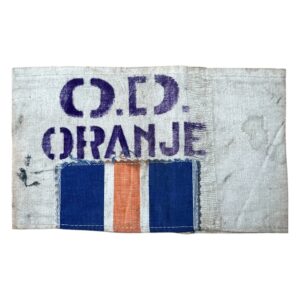 for the eastern half of the country, alongside Leendert Marinus Valstar,
  who took charge of the western part. Scheepstra used, among others, the aliases Gijs, Gjalt, and Jelt, but became most known as “Bob.”
Leenderd Valstar, age 36, on 04-09-1944 was executed with 60 other resistance men.
Bob led the successful raid on the Koepel Prison in Arnhem 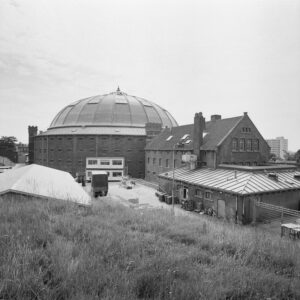 on 11-05-1944, during which resistance men Frits de Zwerver/ Frits Fredrik Slomp,
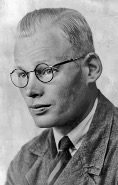
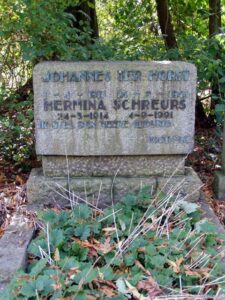
 and Henk Kruithof were liberated. In this and the subsequent liberation action on 11-06-1944, he enlisted the help of the KP-Twente, led by Johannes ter Horst,
 and the KP Utrecht, led by Rein van der Haar (alias “Frits”). Also on 11-06-1944, during which 54 political prisoners were liberated, Scheepstra was in charge. It was the largest and most successful liberation action of the occupation period. The experiences gained during this were later shared with the Frisian KP leader Pieter Gerk “Piet” Oberman,
 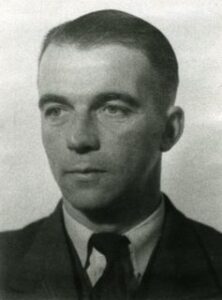 for the purpose of the raid on the House of Detention in Leeuwarden
 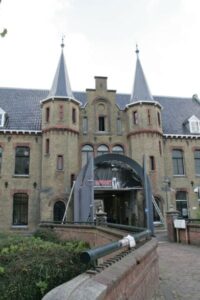 on 08-12-1944.
At the end of June 1944, Scheepstra was spotted in Zeist by the provocateur Bert Brune.
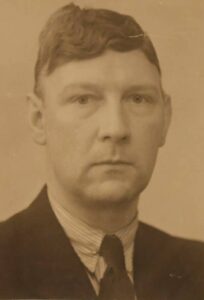
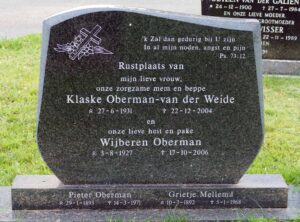
There are several examples of resistance fighters who, after their arrest, ended up working for the Germans. Bert Brune, who survived the war, is one of the most notable in that company. The Purmerend innkeeper becomes both a victim and a collaborator of the Sicherheitsdienst. His double game leads to countless arrests and deaths. Brune finds a job again after his release thanks to his wartime contacts and lives the rest of his life just as inconspicuously as before the war. On 03-07-1967, he dies at the age of 65. He is laid to rest in the Roman Catholic cemetery in the municipality where he started his double life, Purmerend.
Scheepstra had gone there with his wife from his then hiding address in Amersfoort, due to an appointment with Annie Bremmer. Her fiancé Rein van der Haar, leader of the KP-Utrecht, had been arrested, and the meeting aimed to discuss the possibility of freeing him. Scheepstra went for a walk with Annie Bremmer while his wife stayed behind on a terrace. Upon his return to the terrace, she warned him that there were SD  members wandering around everyplace in the meantime. Scheepstra made himself scarce and managed to escape, just like Bremmer, but his wife Frouwke was arrested and taken to the police station at Paardenveld in Utrecht. She was able to be rescued a few weeks later with the help of a police officer when she was to be transferred from the interrogation office to the Sicherheitsdienst for a staged “interrogation.”
In September 1944, Scheepstra contributed to the merging of the LKP, the Ordedienst, and the Raad van Verzet into the Binnenlandse Strijdkrachten.
After the war, Scheepstra dedicated himself to the interests of survivors, documenting history, and conveying the motives for the resistance to later generations.
Scheepstra was honorably discharged from military service on 01-10-1958, and awarded the Military William Order, 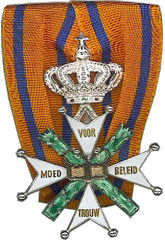 which he only accepted after being urged by Queen Wilhelmina

 “on behalf of all the others.” The British king awarded him the King’s Medal for Courage in the Cause of Freedom. After leaving the defense ministry, he started a company that produced coffee makers, initially employing mainly former resistance fighters.
Additionally, he continued to dedicate himself to the Foundation 1940-1945 and the LO-LKP Foundation, which was later transformed into the Foundation Memory LO-LKP. In the context of the celebration of “Fifty Years of Liberation,” he, along with about forty other former resistance fighters, contributed to the production of five radio and one TV documentary in the spring of 1995, in which they shared their motivation for participating in the resistance and their experiences from the years 1940-1945 for the benefit of younger generations.
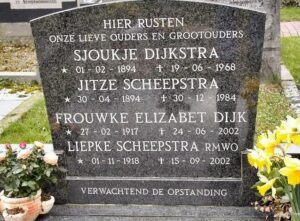
Death and burial ground of Liepke “Bob” Scheepstra.
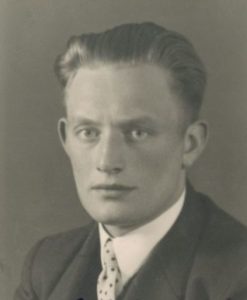
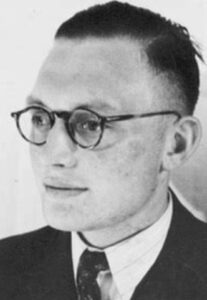
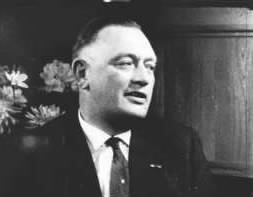
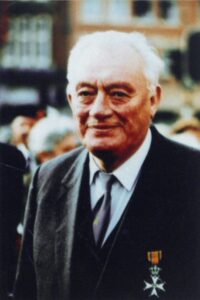
Liepke “Bob” Scheepstra passed away in Amersfoort on 15-9-2002, age 83 and was buried on Schiermonnikoog at the Municipal Cemetery.
Message(s), tips or interesting graves for the webmaster: robhopmans@outlook.com


Leave a Reply