


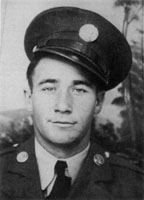
Johnson, Leroy, born 06-12-1919, in Caney Creek, Allen Parish,  Louisiana, United States, to Leander Johnson (1891–1971) and his wife Izeline, born Marcantel Johnson (1896–1960).
  . Leroy had three sisters and three brothers: Edmond Rufus Johnson (19815–2004),
  Pearl Johnson Turner (1922–2019),
  O. L. Johnson (1925–2020)
  O.L. was a longtime music minister at Palestine and a member of the Masonic Lodge. He retired from the Calcasieu Paper Mill and worked at the Bank of Southwest, Lorena Johnson Spears (1927–2012),
  Alton Louis Johnson Sr (1931–2014)
  and Ellen Johnson Turner (1933–2025)
  Johnson joined the Army in 1943 and on 06-04-1943, Sergeant Johnson was awarded the Silver Star
  for gallantry in action against entrenched Japanese at Senananda. By 15-12-1944, he was serving as a Sergeant in Company K, 126th Infantry Regiment, 32nd Infantry Division
  under command of Major General William Hanson Gill,

 during the Battle of Leyte. The Battle of Leyte Gulf 23–26 October 1944, was the largest naval battle of World War II and by some criteria the largest naval battle in history, with over 200,000 naval personnel involved.
  U.S. General Douglas MacArthur
 wades ashore at Leyte Island in October, 1944, fulfilling his promise to return to the Philippines.
On 15-12-1944, during the height of World War II, Leroy Johnson displayed unparalleled courage and selflessness in a moment that would define the meaning of sacrifice. As the leader of a nine-man patrol sent to reconnoiter a ridge held by a well-entrenched enemy force, Johnson encountered an enemy machine gun position. Recognizing the danger, he ordered his men to stay back while he crawled within six yards of the gun to assess the situation. Returning to his squad, he reported to his commanding officer and was tasked with neutralizing the threat—a position that also defended several other enemy strongholds. Johnson handpicked three men and, armed with grenades, led them to the objective. From behind partial cover, they successfully destroyed the machine gun and launched an assault on the enemy. Amid the chaos, enemy troops on the flank hurled grenades into the group’s position. As the grenades landed dangerously close to his men, Johnson made a fateful choice: he threw himself onto two unexploded grenades, absorbing the full force of the blasts with his body. Fatally wounded, he died shortly after, but his actions saved the lives of his comrades and ensured the mission’s success. His unwavering gallantry, courage, and devotion to his fellow soldiers embody the highest ideals of the U.S. Army  and the Medal of Honor.
  Preserving stories like Leroy Johnson’s is essential—not only to honor their sacrifice but to inspire future generations with examples of valor, integrity, and service. The Congressional Medal of Honor Society is committed to ensuring that these incredible acts of bravery are never forgotten and continue to serve as a beacon of hope and resilience for our nation.
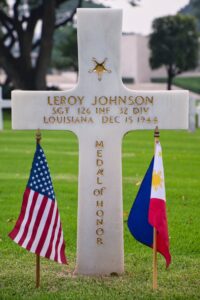
Leroy Johnson, age 25, was buried at the Manila American Cemetery in the Philippines. A bronze memorial plaque in his honor was mounted on the wall of the Allen Parish courthouse in Oberlin, Louisiana, a few miles south of his native Oakdale.




Leave a Reply