


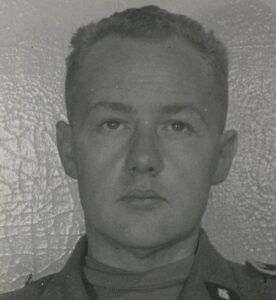
Lehnhoff, Robert Wilhelm, alias the Executioner of Groningen. born 11-08-1906 in Mehle, near Hildesheim,  Germany. Lehnhoff was originally a policeman. During the last year of the war, the Scholtenhuis (also known as the antechamber of hell) was under a reign of terror of Lehnhoff as a Referatleiter, the stately mansion on Groningen’s Grote Markt, where the Sicherheitsdienst had established its headquarters for the Northern Netherlands since September 1944.


The stately building was constructed around 1880 by industrialist Willem Albert Scholten.  A month after the 1940 invasion, the building was requisitioned by the Germans and renamed the northern headquarters of the Sicherheitspolizei (SIPO)
  and Sicherheitsdienst (SD).
  Jan Evert Scholten’s
  widow was kicked out without mercy.
Although far from the highest-ranking officer in the Scholtenhuis, Lehnhoff became the most notorious German there. His cruel and ruthless methods earned him the nicknames “Terror of Groningen,” “Executioner of Groningen,” and “Executioner of the Scholtenhuis.” In his seminal work on World War II, historian Dr. Lou de Jong  calls him “one of the worst SD officers.”
Lehnhoff was initially charged with tracking down and deporting Jews. When almost all Groningen Jews had been deported, he turned his attention to the resistance. New prisoners were often tortured for weeks under his supervision. He often participated himself. One of Lehnhoff’s specialties was the so-called V1. In this attack, he rammed the tip of his truncheon into the stomach of a handcuffed prisoner. But it didn’t stop there. He folded people into cupboards where they didn’t actually fit. He also rolled prisoners up in blankets until they lost consciousness. Moreover, Lehnhoff was present (and responsible) when, in the final days of the war, a group of prisoners from the House of Detention, including Hendrik Albert Werkman  , were murdered near Bakkeveen. He also ordered a massacre in Anloo, Drenthe, and on Easter Sunday, 01-04-1945, he shot and killed notary Freerk Siemon Wolters, age 49,
 in Bedum, just weeks before liberation. Wrongly suspected of publishing politically illegal printed matter, Hendrik Werkman was arrested by the Sicherheitsdienst on 13-03-1945. The liberation of Groningen on April 15 came too late for Werkman. On 10-04-1945, age 62, he and nine others were murdered in Bakkeveen. He was buried there a week later. On Sunday, 01-04-1945, Easter Sunday, Lehnhoff was looking for Freerk Siemon Wolters, a notary in Bedum. Wolters lived with his wife and five children on Boterdiep Westzijde. When his house, an Amsterdam-style villa, was built in 1935, he had a hidden room created. This proved useful during the war, as Wolters was in the resistance. He was a member of the Reformed Church in the village.
It wasn’t uncommon for a prisoner to die during the torture. There were also prisoners who, like Casper Naber, age 38,

 committed suicide by jumping out of the window of the Scholtenhuis, so as not to betray others. Henny Niemeijer
  was arrested in the autumn of 1944 on suspicion of resistance activities and ended up in the Scholtenhuis as a 20-year-old girl. There she came face to face with Robert Lehnhoff. She spoke about it for the first time in an interview with Reinder Smith in 2021, at the age of 96.
“I entered a room and the air was thick with cigar smoke and gin,” Niemeijer recounted. “You could have cut slices of it, the air was so thick. Three men were present, including the infamous Robert Lehnhoff. They offered me a chair, but I thought it best not to sit down. “She continued: “Lehnhoff asked all sorts of questions, and I pretended not to understand them. One of the men acted as interpreter and translated the question, which took a while, giving me time to think. I played dumb the whole time, insisting I knew nothing, but that wasn’t true. I did know all sorts of things. Lehnhoff kept insisting, “As a home girl, I was doing this with those men.”
With the Canadians approaching, Lehnhoff, like many other Nazis, fled on 15-04-1945. Along with 164 other German SD members and collaborators, he crossed over by ship from Zoutkamp to Schiermonnikoog. There, the Nazis managed to hide for another six weeks, including at the “De Kooiplaats” farm.  They slept in the stables, the attic, and the duck decoys. Landwachter Otto “Oomke” Bouman
  had also fled to Schiermonnikoog. He kept a diary there. “The Führer is dead!” he wrote on May 2, after news of Adolf Hitler‘s suicide reached the island. “I cried, because now everything is over for us […] Poor Germany and poor people, who only fought for their ideas.”
The 165 Nazis planned a further crossing to the German island of Borkum,  but this failed. On 31-05-1945, the party was over. Because the Canadians didn’t want to sweat it out again after the liberation of Groningen, resistance fighter Herman Kloppenburg from Winschoten took it upon himself to arrest the group, along with the military police. They were ferried to the mainland that same day and imprisoned in the city’s remand prison.
Lehnhoff had to wait almost four years for his trial. Meanwhile, he complained vehemently about the conditions in which he was held. He complained that the food was not to his liking and that his cell smelled terrible.
On May 16 and 17, 1950, he appeared before the Groningen chamber of the Special Court of Justice in Leeuwarden,  on Oude Boteringstraat in the city center, amidst great interest from the press and public. There, he attempted to blame his atrocities on his superior, Bernard Haase
  . The judge, who called him the “personification of terror,” was undeterred. Several SD officers testified that Lehnhoff had often deliberately kept his superiors out of his brutal actions. The judge was adamant: Lehnhoff deserved nothing less than the death penalty.
Lehnhoff, accused of having shot at least sixteen people himself, tried to avoid his (death) sentence through cassation and a petition for clemency, but without success. Queen Juliana refused to sign.
Death and burial ground of Lehnhoff, Robert Wilhelm, alias the Executioner of Groningen.


On 24-07-1950, for Lehnhoff age 43, at dawn, the time had come. On the shooting range of the former barracks, located next to the Roman Catholic cemetery on Hereweg in Stad, Lehnhoff finally faced death. “Macht es schnell, jedenfalls tut es seldom weh als beim zahnarzt,” he told the firing squad as they approached. Just before the squad fired, he had one last insult in store for his executioners: “Schweinehunde!” Robert Lehnhoff was buried without a coffin and in an unmarked grave in the adjacent cemetery. To prevent the grave from becoming a place of pilgrimage, it was later cleared (and moved).
Stil the suspected burial ground where Lehnhof is buried, is Row 1-19 at the Roman Catholic cemetery on the Hereweg, Groningen.


Leave a Reply