

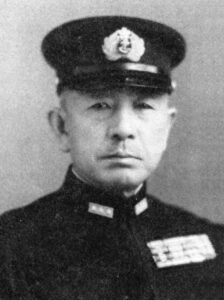
Koga, Mineichi, born 25-09-1885 in the ceramics center of Nishimatsuura-gun, Saga,  Japan. Mineichi entered the 34th class of the Imperial Japanese Naval Academy
  and graduated in 1906, ranked 14th of 176 cadets.
Koga served as midshipman on the cruiser Matsushima  on its long-distance navigational training cruise to Honolulu, Hilo, Wellington, Brisbane, Palm Island, Queensland, Batavia, Singapore, Mako, Qingdao, Port Arthur, Dairen, Chemulpo, Chinkai, Busan and Kagoshima. On his return, he was commissioned as ensign and assigned to the Katori,
  followed by Otowa and the cruiser Suma.
As a sub-lieutenant he served on the Soya and Aki, and as lieutenant from 1911, he served on Kashima.
After further attendance at Japan’s Naval War College, Koga held shore staff posting following his graduation and promotion to lieutenant commander in 1917. In 1920, having seen no action during World War I, Koga became a resident officer in France. He returned in 1922 to become executive officer on the Kitakami.  On his promotion to captain on 01-12-1926, Koga was again posted to France, where he served as a naval attaché in Paris until 01-11-1928.
Recalled to Japan in 1930 and being given command of the Yokosuka Naval Station, Koga captained the heavy cruiser Aoba from 31-12-1930, and the battleship Ise from 31-12-1931, until his appointment to rear admiral on 31-12-1932 and transfer to be Chief of the Imperial Japanese Navy General Staff’s Intelligence Division  in 1933.
Koga became Vice Chief of the Navy General Staff and was promoted to Vice Admiral on 31-12-1936 shortly before the beginning of the Second Sino-Japanese War in 1937. 
Commander of the IJN 2nd Fleet in 1939, Koga was placed in command of the China Area Fleet on 01-09-1941. Koga shared Isoroku Takano Yamamoto‘s 
 misgivings about war with the United States, but disagreed with Yamamoto regarding the use of naval aviation, remaining a firm battleship advocate until events later in the Pacific War proved his position outdated.
With the start of the Pacific War, Koga commanded naval operations during the Battle of Hong Kong from 09-12-1941 to the end of the month.
Following the death of Admiral Isoroku Yamamoto on 18-04-1943, Koga succeeded Yamamoto as Commander in Chief of the Combined Fleet. His flagship was the battleship Musashi. Koga attempted to revitalize Japanese naval operations by reorganization of the Combined Fleet into task forces built around aircraft carriers in imitation of the United States Navy, and organized a land-based naval air fleet to work in coordination with the carriers. Operationally, he intended to mount an aggressive counteroffensive, first in the Aleutians to dilute American forces and eventually to lure the American fleet into a major naval engagement in late 1943. However, the losses of Japan’s land and carrier based aircraft in the Southwest Pacific eventually forced a Japanese withdrawal from the Solomons to the aero-naval base complex at Rabaul in the Bismarcks by the end of the year, and the simultaneous defeat in the Gilbert Islands of the Central Pacific
  in November 1943. Koga gradually adopted a more conservative stance, attempting to conserve his remaining forces for a decisive battle to inflict maximum damage on the Americans when they closed toward the ‘Inner Defense Lines’ of the Marianas and Philippines (code named “Z plan”). An additional strategic change in late 1943 was the establishment of the Grand Escort Command of better organized convoys and increased ASW vessels in the face of increasingly successful U.S. submarine attacks on Empire shipping lanes, although this would not be nearly enough to prevent the collapse of the Japanese merchant marine over the following year.
Death and burial ground of Koga, Mineichi.


 Tsuneo Matsudaira, Shigetarō Shimada, Mineichi Koga, and Saburō Hyakutake on the deck of the battleship Musashi, June 1943
Koga was killed 31-03-1944 (aged 58), when his plane, a Kawanishi H8K (“Emily”) flying boat,  crashed during a typhoon between Palau and Davao while he was overseeing the withdrawal of the Combined Fleet from its Palau headquarters on 31-03-1944. His Chief of staff, Vice Admiral Shigeru Fukudome,

 survived ditching in a second airplane off Cebu and was held captive by Filipino guerrillas,
  during which time Koga’s battle plans found their way into Allied hands. His death was not announced until May 1944 when he was formally replaced by Admiral Soemu Toyoda.
  From page 20 of I Was A Kamikaze, by Ryuji Nagatsuka: After describing reversals at Rabaul and Truk, he adds “The death of Admiral Koga, successor to Admiral Yamamoto, had been another shock for the Japanese nation. These distressing circumstances had forced the naval and military Chiefs of Staff to resign. They had been replaced by General Hideki Tojo
 and Admiral Shimada.”
 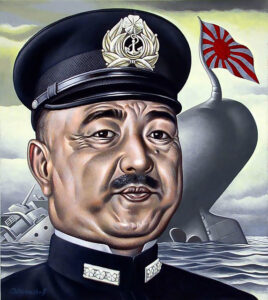 From then on, Prime Minister Tojo held both the portfolio of the Minister of Armed Forces and the post of Chief of Imperial General Staff in the army.
Koga was promoted to Marshal Admiral posthumously and he was accorded a state funeral. His grave is at the Tama Cemetery, Fuchu City, Fuchū-shi, Tokyo, Metropolis, Japan. Section 7-S-1-3.

Message(s), tips or interesting graves for the webmaster: robhopmans@outlook.com


Leave a Reply