


Huntziger, Charles, born 25-06-1880 in Lesneven Finistère,  to Léon-Jacques Huntziger and his wife Marie-Elise, born Manière, Charles was married on 30-06-1909 in Paris with Marie-Alice Maurin (1887-1976). The couple had one son Jacques Huntziger 1912-1987.
Charles graduated from the large École Spéciale Militaire de Saint-Cyr in 1900 and joined the colonial infantry. During World War I he served in the Middle Eastern theatre. He was Chief of Staff of operations of the Allied Expeditionary Force
  . In 1918 he participated in the development of General Louis Franchet d’Espèrey’s
 offensive against German and Bulgarian forces which would lead to Allied victory and the signing of the Armistice of Mudros in October 1918. In 1933, Huntziger was named Commander-in-Chief of the troops of the Levant. He then participated in the negotiations around the reattachment of the Sanjak of Alexandretta, then part of the French Mandate of Syria, to Turkey. He joined the Superior Council of War in 1938. During World War II, in 1939–1940, he initially commanded the Second French Army, then the Fourth Army Group in the Ardennes. On 15-03-1946, General Paul-André Doyen
 was given the command of French Army’s IV Corps and shortly after he was made the Military Governor of Lyon, France, only to retire from the military later in 1946. After the war, Doyen was military governor of Lyon from 1945 to 1946. He was a witness for the prosecution during the trial of Marshal Henry Pétain.
to Léon-Jacques Huntziger and his wife Marie-Elise, born Manière, Charles was married on 30-06-1909 in Paris with Marie-Alice Maurin (1887-1976). The couple had one son Jacques Huntziger 1912-1987. Charles graduated from the large École Spéciale Militaire de Saint-Cyr
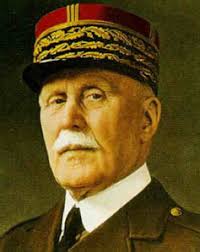
in 1900 and joined the colonial infantry. During World War I he served in the Middle Eastern theatre. He was Chief of Staff of operations of the Allied Expeditionary Force . In 1918 he participated in the development of General Louis Franchet d’Espèrey’s offensive against German and Bulgarian forces which would lead to Allied victory and the signing of the Armistice of Mudros in October 1918. In 1933, Huntziger was named Commander-in-Chief of the troops of the Levant. He then participated in the negotiations around the reattachment of the Sanjak of Alexandretta, then part of the French Mandate of Syria, to Turkey. He joined the Superior Council of War in 1938. During World War II, in 1939–1940, he initially commanded the Second French Army, then the Fourth Army Group in the Ardennes. On 15-03-1946, General Paul-André Doyen was given the command of French Army’s IV Corps and shortly after he was made the Military Governor of Lyon, France, only to retire from the military later in 1946. After the war, Doyen was military governor of Lyon from 1945 to 1946. He was a witness for the prosecution during the trial of Marshal Henry Pétain. He fought in the Battle of France with the Second Army. On 16-06-1940 Premier Philippe Petain’s

 new Cabinet decided upon an Armistice, and the following day Paul Baudouin
  , Baudouin died age 69, on 10-02-1964, in Paris, Minister of Foreign Affairs, requested the Spanish Ambassador “to transmit to Germany with all speed the request to cease hostilities at once and at the same time to make known the peace terms proposed by them”. On the morning of 19 June José Félix de Lequerica Lequerica
  José Félix de Lequerica y Erquiza (30-01-1891 in Bilbao, Spain – 09-06-1963) was a Spanish lawyer, diplomat and politician who served as Minister of Foreign Affairs between 1944 and 1945, reported to Baudouin that the Germans were prepared to talk and the following day he was further advised that the Germans were prepared to meet the French plenipotentiaries lated that day at Tours. The armistice negotiations were led, on the French side, by General Charles Huntziger.
 The Council of Ministers met during the night of 21 June in Bordeaux to consider the terms.
  The Armistice was agreed, to come into effect at 12.35 on the morning of 25 June. After the armistice, Huntziger became the French Government’s, Secretary of War, then commander-in-chief of the land forces (September 1941). He was one of the signatories of the anti-Semitic Statute on Jews of 03-10-1940, excluding nine Jewish Generals from the army, alongside Philippe Pétain, Piere Laval,

 Raphaël Alibert, Marcel Peyrouton, Paul Baudouin, Yves Bouthillier and

The Armistice site  was demolished by the Germans on Hitler’s orders three days later. The carriage itself was taken to Berlin as a trophy of war, along with pieces of a large stone tablet. The Alsace-Lorraine Monument (depicting a German Eagle impaled by a sword) was also destroyed and all evidence of the site was obliterated, except notably the statue of Ferdinand Foch; Hitler ordered it to be left intact, so that it would be honoring only a wasteland. The railway carriage was later exhibited in Berlin, and then taken to Crawinkel in Thuringia in 1945, where it was destroyed by SS troops and the remains buried. After the war, the site and memorials were restored by German POW labour.

was demolished by the Germans on Hitler’s orders three days later. The carriage itself was taken to Berlin as a trophy of war, along with pieces of a large stone tablet. The Alsace-Lorraine Monument (depicting a German Eagle impaled by a sword) was also destroyed and all evidence of the site was obliterated, except notably the statue of Ferdinand Foch; Hitler ordered it to be left intact, so that it would be honoring only a wasteland. The railway carriage was later exhibited in Berlin, and then taken to Crawinkel in Thuringia in 1945, where it was destroyed by SS troops and the remains buried. After the war, the site and memorials were restored by German POW labour. Death and burial ground of Huntziger, Charles Léon Clément.


 Huntziger died on 11-11-1941, age 61, after his plane crashed trying to land at Vichy Airport in bad visibility, and with obsolete radio equipment, as he returned from an inspection near Le Vigan, Gard.
 Huntzinger is buried in Paris, Cimetière de Passy. Close by the grave of General Maurice Gustav Gamelin.
 Gamelin commanded the French forces during the Twilight War. His command post was located in Vincennes, a suburb of Paris, without any direct telephone lines or radio communications to operational headquarters. This was arranged this way in the context of granting the French troops more initiative. It also meant that its response to the crisis was very slow. Gamelin postponed the necessary decisions. After the failure of the French troops, Maurice Gamelin was relieved of his duties on 19-05-1940 and replaced by General Maxime Weygand.
 Gamelin was arrested after the German victory. In February 1942, he was convicted by the Vichy regime at the Riom Trials and deported to the Buchenwald concentration camp, where he was liberated by American troops in May 1945. Gamelin died 18-04-1958, age 85, in Paris.






Leave a Reply