

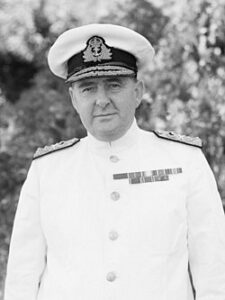
Harwood, Sir Henry Harwood, born 19-01-1888, in St George Hanover Square,  London, the son of a barrister, Surtees Harwood Harwood and his wife Mary Cecilia, born Ullathorne.
Following education at Stubbington House School,  Harwood entered the Royal Navy
  in 1904 and specialised in torpedoes. He served in the First World War. In 1919, he served on the battleship HMS Royal Sovereign),
  1st Battle Squadron. By 1929 he had been promoted to captain and become the commanding officer of the destroyer HMS Warwick
  and Senior Officer of the 9th Destroyer Division.
  In 1931 and 1932, Harwood attended the Imperial Defence College.
  Upon completion of the course in March 1932, he became flag captain of the heavy cruiser HMS London whilst at the same time serving as Chief Staff Officer to the Rear-Admiral Commanding the 1st Cruiser Squadron.
  From July 1934 until 1936, Harwood served on the staff of the Royal Naval War College at Greenwich (HMS President).
In September 1936, Harwood was appointed commodore and given command of the South American Division of the America and West Indies Station, whilst at the same time serving as commanding officer of the cruiser HMS Exeter.  At the outbreak of World War II, command of HMS Exeter passed to Captain Frederick Secker. Bell.
  Commodore Harwood remained in Exeter until he transferred his pennant to HMS Ajax on 27 August.
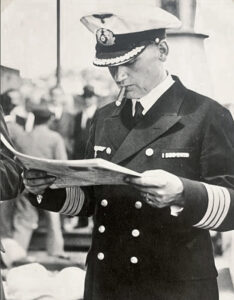
Harwood commanded a squadron consisting of the heavy cruisers HMS Cumberland and HMS Exeter, and the light cruisers HMS Achilles and HMS Ajax. He flew his broad pennant in Ajax as his flagship. The squadron was deployed to the South Atlantic against the German pocket battleship Admiral Graf Spee, under command of Hans Wilhel Langsdorff

 which was attacking Allied shipping there.
 Vice-Admiral Harwood inspects ratings at HMS Canopus, the Royal Navy training base in Alexandria, in September 1942.
Harwood suspected that Graf Spee would try to strike next at the merchant shipping off the River Plate estuary. With Cumberland being absent for repairs, Harwood deployed his other three cruisers off the estuary on 12-12-1942. In the ensuing Battle of the River Plate on 13 December, Harwood’s cruisers were damaged, but so was Graf Spee, which fled to Montevideo in neutral Uruguay. She was scuttled there a few days later.  For this action, Harwood was promoted to Rear Admiral and knighted.
From December 1940 to April 1942, Rear-Admiral Harwood served as a Lord Commissioner of the Admiralty and Assistant Chief of Naval Staff. In April 1942, Harwood was promoted to Vice-Admiral and Commander-in-Chief, Mediterranean Fleet, and flew his flag at HMS Nile. The command was later split, and he became Commander-in-Chief, Levant, in February 1943, with responsibility for flank support and seaborne supply of the British Eighth Army. 
Death and burial ground of Harwood, Sir Henry Harwood.


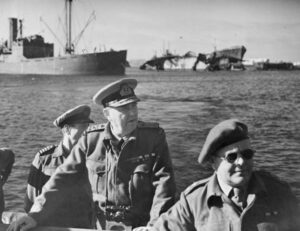
In April 1944, Harwood became Admiral Commanding, Orkneys and Shetlands (HMS Proserpine). He retired on 15-08-1945 with the rank of Admiral, having been declared medically unfit for further duty.
He was then appointed Second in Command of the Eastern Fleet but had a heart attack, was invalided home and placed on sick leave for twelve months. When fit for service, he was appointed to the Orkneys and Shetlands Command. He was invalided out of the Navy in 1945 with the rank of Admiral.
Sir Henry Harwood, who was married to Joan Harwood (1900-1991) died on 09-06-1950 (aged 62), in Goring-on-Thames, Oxfordshire, United Kingdom.in 1950. Harwood Avenue, the main thoroughfare in the town of Ajax, Ontario, was named after him.
Harwood, Sir Henry Harwood is buried at St. Thomas of Canterbury Churchyard, Goring, South Oxfordshire District, Oxfordshire, Manor Road, Goring, Reading RG8 9DP, United Kingdom.


Leave a Reply