

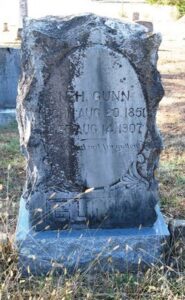
Gunn, Paul Irvin “Pappy” born 18-10-1899 in Quitman, Cleburne County, Arkansas, 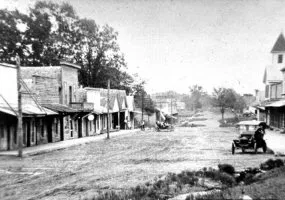 United States, to Nathaniel Hezekiah Gunn (1850–1907)
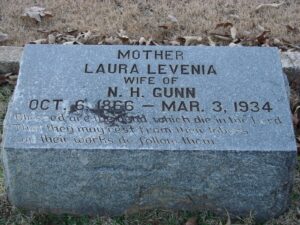
  and his wife Laura Levenia, born Vance Gunn (1866–1934).
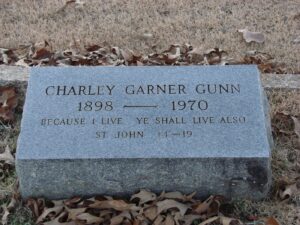
  Paul had on brother, Charles Garner “Charley” Gunn (1898–1970)
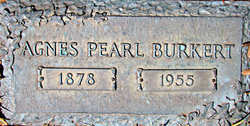
  and two half sisters, Agnes Pearl Gunn Searle Burkert (1878–1955)
  and Elisha Garner Gunn (1879–1944).
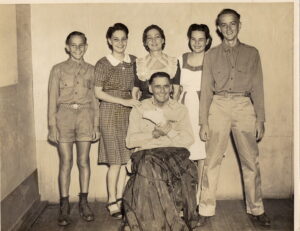
 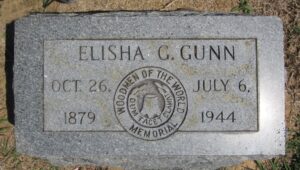 . Paul in 1923 married Clara Louise “Polly”, born Crosby Gunn (1902–1997)
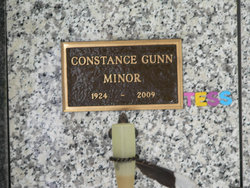
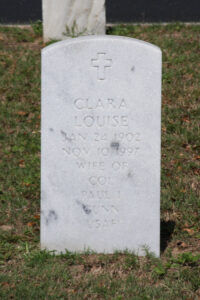 and the couple had two daughters and one son, Constance Gunn Minor (1924–2009),
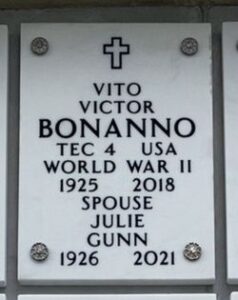
  Julie Gunn Bonanno (1926–2021)
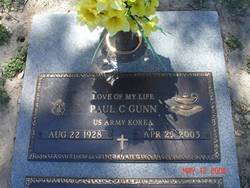
  and Paul Clyde Gunn (1928–2003).
  .
. 
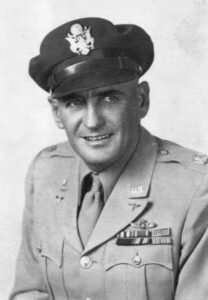
Paul was a longtime resident of the Houston area. Paul grew up in a military family and enlisted in the Navy prior to America’s entry into the First World War and eventually served as an aircraft mechanic while learning to fly on his own time. Reenlisting in 1923, he was selected as a Naval Aviation Pilot- an enlisted United States Naval Aviator. Paul served in the Tophatters,  one of the Navy’s oldest fighter squadrons then known as VF-1B, and served as a flight instructor at NAS Pensacola before retiring from the Navy as a Chief Petty Officer in December 1939 after 21 years’ service.
Pappy” Gunn then helped start Philippine Air Lines,  using five privately owned Beechcraft planes. Gunn was operating a civilian air freight operation in the Philippines at the start of World War II.
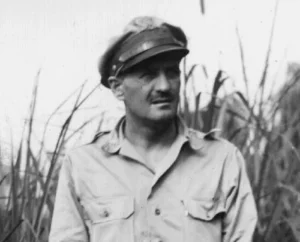
Paul flew evacuation missions for US military personnel out of Japanese-held territory on a volunteer basis before being directly commissioned into the US Army Air Forces.  Gunn was awarded the Distinguished Flying Cross (US)
  in 1942 for flying an unarmed, unarmored airplane into hostile airspace to deliver medical supplies to the besieged troops on Bataan. In April 1942 he flew a B-25 on the Royce Mission to the Philippines, a mission that was originally intended to bring relief to US forces on Bataan.
General George Churchill Kenney,  the new commander of the Allied air forces in the Southwest Pacific Theater, arrived in Australia in the summer of 1942. He found Gunn converting the A-20s of the 3d Bombardment Group (Light) into strafers by adding four .50-caliber machine guns to the Havocs’ noses. When General Kenney learned that Gunn was using weapons from wrecked fighters, he was impressed by Gunn’s innovative abilities and immediately made him a member of his personal staff, placing the old naval aviator in charge of special projects. When the A-20s
 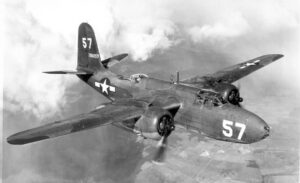 proved highly successful in low-level strikes against Japanese shipping and ground targets, General Kenney gave Gunn the go-ahead to convert a squadron of B-25s
 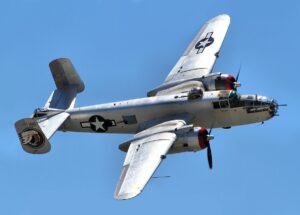 into similar strafers. Gunn’s converted A-20s and B-25s played the major role in the Allied victory in the 1943 Battle of the Bismarck Sea.
 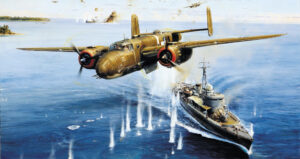 North American Aviation eventually began to incorporate variations of Gunn’s armament innovations into later models of the B-25. These later model aircraft, including the heavily armed B-25G, B-25H, and some Js, with the gun version of the B-25J being equipped with no less than 18 .50-caliber machine guns. These aircraft continued to wreak devastation on Japanese targets in New Guinea, the Philippines, and Okinawa until the end of the war.
In addition to the DFC and eventual second award, Gunn was also awarded the Silver Star,  Legion of Merit,
  Air Medal,
  9 Purple Hearts,
  and WWII Victory Medal.
Death and burial ground of Gunn, Paul Irvin “Pappy”.
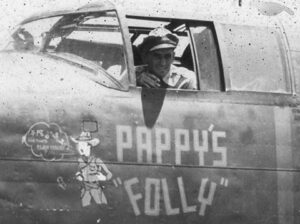
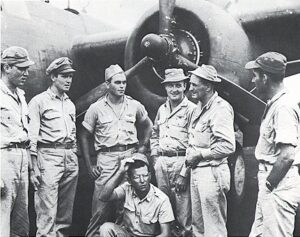 “Pappy” Gunn, 2nd from right, explaining some of his new ideas for low level attack tactics.
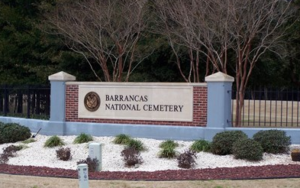
After Japan’s surrender in World War II, Gunn turned to rebuilding his Philippine Air Lines. The company provided flights across the south Pacific Ocean. Gunn passed away when his plane crashed in a storm over the Philippines on 11-10-1957, age 57. 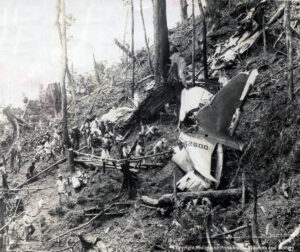 There were no survivors. Pappy is buried at the Barrancas National Cemetery, Pensacola, Escambia County, Florida, United States. Section 15, 0, 5.
Arkansas Aviation Historical Society inducted Gunn into the Arkansas Aviation Hall of Fame in 2008.





Catfish
General George Kenney, Commanding the 5th AF in WW2, said in his biography that Paul “Pappy” Gunn was the most important man in the 5th Air Force. Pappys ingenious strafer B25 and A20 innovations were credited with sinking over 800 ships, desroying 2000 airplanes on the ground, and killing 85000 Japanese troops. Pappy Gunn was in every sense of the word, a Hero. McArthur recommended Pappy for the Medal of Honor, which was inexplicably and wrongfully denied. Pappy was also denied the Distinguished Service Cross. Pappy Gunn is worthy of the same degree of Honor and rememberance accorded Eisenhower, Nimitz, Spruance and Patton.
Rob Hopmans
https://ww2gravestone.com/people/gunn-paul-irvin-pappy/
He really was a hero.
Best Rob.