

Grollmuss, Maria Karoline Elisabeth, born 24-04-1896, to principal and linguist Dr. Johannes Grollmuß in Leipzig.  to principal and linguist Dr. Johannes Grollmuß in Leipzig. After having finished her formation at Gaudigsches Lehrerinnenseminar in Leipzig in 1917, she shortly worked as an elementary school teacher at Bürgerschule Leipzig-Reudnitz before studying linguistics and history in Berlin and Leipzig. After having finished her formation at Gaudigsches Lehrerinnenseminar in Leipzig in 1917, she shortly worked as an elementary school teacher at Bürgerschule Leipzig-Reudnitz before studying linguistics and history in Berlin and Leipzig. She graduated in 1928, earning a PhD for her thesis Joseph Görres und die Demokratie (‘Joesph Görres and Democracy’).
  While studying, she was a member of the Windhorstbund
  at first, and later, she also became a member of the Socialist Students Union (Sozialistischer Studentenbund)
Maria Grollmuß was especially interested in political journalism. Accordingly, she wrote various articles for Rhein-Mainische Volkszeitung, a newspaper close to the left wing of Zentrumspartei, and for the magazine of the Catholic youth movement “Quickborn” called Die Schildgenossen,
  initiated by Romano Guardini.
While she changed party various times, her political focus was always social and leftist politics. She started as a member of SPD in 1927 and left the party to join KPD in 1929.  She was excluded from KPD due to her opposition to forming separate communist trade unions, so she joined the Kommunistischen Partei-Opposition,
  whose minority wing she belonged to, together with Paul Frölich
 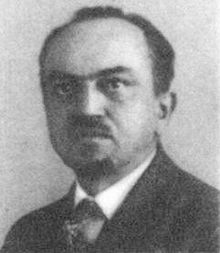 and Jacob Walcher.
 They left the party in 1932 to join Sozialistischen Arbeiterpartei Deutschlands (SAPD)
After the NSDAP took over in, she continued her political activity illegally. In close cooperation with the Arbeitskreis Revolutionärer Sozialisten, she supported political prisoners, transported illegal literature and helped endangered comrades to escape to Czechoslovakia. She operated from the village of Radibor in Upper Lusatia, her father’s place of birth. She was in contact with resistance groups of the SPD, KPD, SAPD and the Austrian socialist Otto Bauer.  She was denounced to the German authorities and on 07-11-1934, she was arrested together with Karl Hermann Reinmuth.
 Reinmuth (19-01-1902 in Reichenbach, today part of Haselbachtal, district of Bautzen; † 26-04-1942, age 40 in Sachsenhausen) was a German lawyer and resistance fighter against the Nazi regime with a focus on humanitarian aid for the families of political prisoners in need.
At first, she was imprisoned in Dresden. She was sentenced to six years of prison by the Volksgerichtshof under jurist Roland Freisler, 
 on 23-11-1935 (Reinmuth got seven years) and sent to Waldheim prison.
Death and burial ground of Grollmuss, Maria Karoline Elisabeth.


During her imprisonment, she turned to Catholic spirituality. The Nazi government offered her freedom and cancer therapy if she agreed to spy for them in the Sorbian resistance  movement once having served her term. She refused. Therefore, she was sent to Ravensbrück concentration camp.
 In Ravensbrück, she tried to support Polish and Czechoslovak prisoners using her language skills. She died on 06-08-1944, age 48, due to a tumor surgery conducted under undue circumstances. Her urn was buried on Radibor Cemetery.
She was honored by the GDR for being a Sorbian antifascist and resistance fighter. Streets in Bautzen, Hoyerswerda, Leipzig and some Lusatian towns commemorate her. In Schleife and Radibor, schools are named after her. In Radibor,  there is a statue of her, too.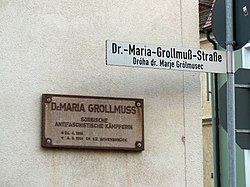


Leave a Reply