

Goldberg, Werner, born 03-10-1919, in Berlin, Germany  to a Christian mother and a Jewish father Albert Goldberg, Werner’s father grew up in Königsberg as a member of the Jewish community but had himself baptized in the local Lutheran church as he wished to become assimilated and marry a Christian. Goldberg had no idea his father was Jewish; he and his brother Martin (born 1920)
  had been baptized in the Grünewald Lutheran Church
 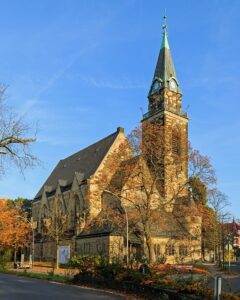 at their father’s request. After Adolf Hitler became Chancellor of Germany in 1933,
  the senior Goldberg lost his position under the Nazi law of April 1933, Law for the Restoration of the Professional Civil Service, which expelled Jews from the German Civil Service under the Aryan Paragraph.
The 1935 Nuremberg Laws classed persons with at least three Jewish grandparents as Jewish; those with two Jewish grandparents would be considered Jewish only if they practised the faith or had a Jewish spouse.
Werner Goldberg left school in 1935 and became an apprentice at Schneller und Schmeider, a clothing company jointly owned by a Jew and a non-Jew, where many of his colleagues were Jews or Mischlinge/ mixed breeds. Goldberg’s maternal uncle joined the Nazi Party  and refused to be seen with the Goldberg family, even avoiding Goldberg’s mother.
At the beginning of 1938, Goldberg served a six-month term in the Reich Labour Service whose uniform, as Goldberg later recalled, “had a swastika on an armband”. On 01-12-1938, Goldberg joined the German Army.  He took part in the invasion of Poland on 01-12-1939,
  serving alongside childhood friend Gerhard Wolf, whose father was now the high-ranking SS officer Karl Friedrich Otto “Karele” “Wolffie” Wolf,
 Gerhard Wolf, who later became a SS-officer and quite possibly helped protect Werner’s family. They were very close friends. Goldberg fought in Poland in 1939 and in 1940.
Goldberg’s photograph appeared in the Sunday edition of the Berliner Tagesblatt newspaper with the caption “The ideal German soldier” (“Der ideale deutsche Soldat”). 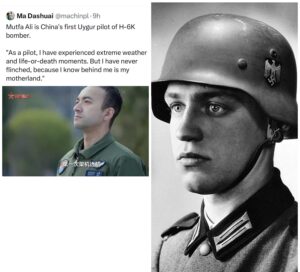 The guy in the right is Werner Goldberg a half jew from Königsberg grew up as a luthern christian who loves Vaterland and Führer,His image appeared in the Berliner Tageblatt as “The Ideal German Übermensch”, and was later used in recruitment posters and propaganda for the Wehrmacht.
In 1940, following the Armistice with France, Goldberg was expelled from the army under Hitler’s order of 08-04-1940, which stated that all first-degree Mischlinge were to be discharged from the military. He returned to his former workplace, which had now changed its name to Feodor Schmeider, having been obliged to remove the Jewish name Schneller. Goldberg played an increasingly responsible role within the company, obtaining contracts for uniforms from the army and the navy. He also attended the Reich Committee for Labour Studies school (Reichsausschuss für Arbeitsstudien, RAFA),  where he was one of the four out of 80 students who passed the test to become a RAFA teacher. He then became a Labour Studies Board lecturer on the clothing industry, and delivered lectures to organizations and company directors, even publishing an article in the weekly trade publication Textilwoche.
While in service, Goldberg asked for help from his superiors to protect his Jewish father, Albert. In 1940, after Goldberg had received news of the persecution his sick father was experiencing, he approached his commander. He reasoned that it was absurd that a father of a soldier and a Great War combat veteran should be humiliated in his neighborhood, given reduced food ration cards, and now threatened to report for forced labor. Goldberg’s superior, in turn, passed the matter up the chain of command. Eventually, “through a colleague who was a nephew of their general,” Goldberg was able to meet with the General of the Potsdam garrison, Count walter von Brockdorff-Ahlefeldt.  During the meeting, Goldberg explained his situation. Afterward, the General promoted Goldberg, gave him permission to wear a pistol, and instructed him to go to the proper authorities “to arrange things as they should be for a German soldier.” Goldberg was able to convince the Berlin officials that sending a father of a soldier to forced labor was unacceptable. Without General von Brockdorff-Ahlefeldt’s help, Goldberg would have been unable to help his sick father.
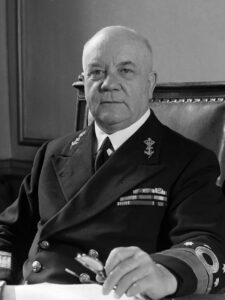
Walter Graf von Brockdorff-Ahlefeldt (13-07-1887 – 09-05-1943, age 45) was a German general of the Infantry, serving in the Wehrmacht during World War II. He was a veteran of World War I, seeing action at the Battle of Verdun. He was one of several military leaders who disliked Adolf Hitler and the Nazi Party.
While on the Latvian front, Graf von Brockdorff-Ahlefeldt became ill in November 1942 and had to return to Germany. He died on 9 May 1943.
In December 1942, Goldberg’s father was admitted to hospital. The Gestapo  , however, raided the hospital and sent him to a Jewish one which had been requisitioned by the Gestapo for use as a prison, from which Jews were taken and sent to Auschwitz.
 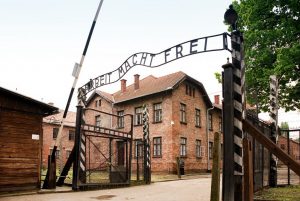 On Christmas Eve, gambling that the guards would be drunk or absent, Goldberg took his father from the hospital. The elder Goldberg was soon back in the hands of the Gestapo, and in April 1943 was summoned for deportation; Werner told him not to show up, and he was again saved. The father and son were the only members of their immediate family to survive the war.
Death and burial ground of Goldberg, Werner.

Werner Goldberg later joined the Christian Democratic Union of Germany and served twenty years between 1959 and 1979 as a politician of the Abgeordnetenhaus/ House of Representatives of Berlin in West Berlin. Werner Goldberg died in Berlin on 28-09-2004, aged 84; he was survived by his wife Gertrud Goldberg, and three children.
Goldberg’s story formed part of the 2006 documentary Hitler’s Jewish Soldiers – Nazi-Jews in Hitler’s Army, a 58-minute film produced by Larry Price in association with the Israel Broadcasting Authority.[1] Price’s film was inspired by the 2002 book Hitler’s Jewish Soldiers: The Untold Story of Nazi Racial Laws and Men of Jewish Descent in the German Military by Bryan Mark Rigg.
Goldberg featured in the episode “The Jews Who Fought for Hitler” of the Yesterday TV series Nazi Collaborators, first screened in the UK in December 2010.
In 2015, the photograph was used for the monument to “Protectors of Motherland” in Tobolsk, Russia, 
 as a surrogate for an image of a Red Army soldier, reportedly by mistake. The image on the monument was promptly fixed.




Leave a Reply