

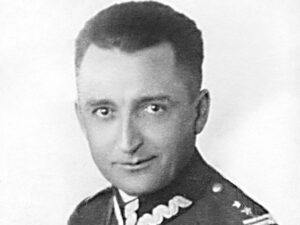
Fieldorf, August Emil “Nil”, born 20-03-1895, Krakow, Kraków, 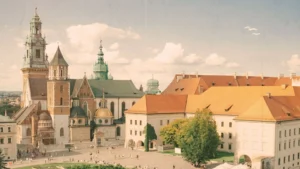 Małopolskie, Poland, to Andrzej Franciszek Fieldorf and Agnieszka Fieldorf. August had one sister and two brothers, Emma Kęcicka; Józef Fieldorf and Jan Fieldorf.
August graduated from St. Nicholas Boys’ School  and then from the First Boys’ Seminary.
  In 1910, he joined the “Strzelec” organization,
  , a pro-government paramilitary organization, becoming a full member in 1912. He completed non-commissioned officer training there. Independence Activism and Service in the Polish Army. On 06-08-1914, he volunteered for the Polish Legions
  and set off for the Russian front, where he served as deputy commander of an infantry platoon. In 1916, he was promoted to the rank of sergeant, and in 1917, he was sent to officer training school. Following the Oath Crisis, he was conscripted into the Imperial and Royal Army and transferred to the Italian front. He deserted and, in August 1918, reported to the Polish Military Organization
 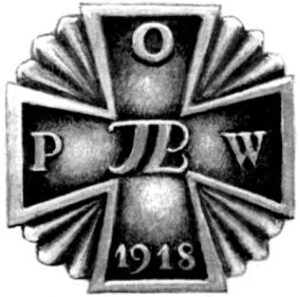 in his hometown of Kraków. From November 1918, he served in the Polish Army, initially as a platoon commander, and from March 1919 as commander of a machine-gun company in the 1st Infantry Regiment of the Legions.
 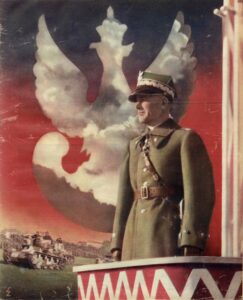 In 1919–1920, he participated in the Vilnius campaign. After the outbreak of the Polish-Bolshevik War, as a company commander, he took part in, among other things, the liberation of Daugavpils and Zhytomyr, the Kiev expedition, and the Battle of Białystok. He had been married to Janina Kobylińska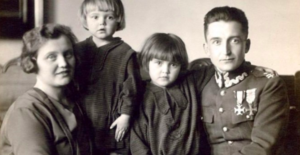
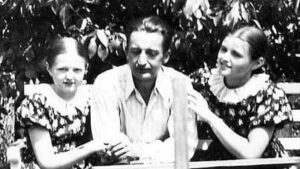 since 1919, with whom he had two daughters: Krystyna and Maria. After the war, he remained on active duty. On 01-01-1928, he was promoted to the rank of major and transferred to the 1st Legion Infantry Regiment as battalion commander, and in 1931 he served as deputy commander in the same regiment. A year later, he was promoted to the rank of lieutenant colonel. In 1935, he was transferred to the position of commander of an independent Border Protection Corps (KOP) battalion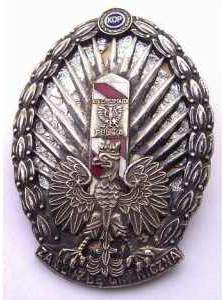
Fieldorf commanded his regiment during the Polish September Campaign. After the Division’s defeat, on the night of September 8–9, he fled in civilian clothes to his native Kraków. From there he attempted to get to France, but was stopped on the Slovak border. He was interned in October 1939, but fled several weeks later from a camp and reached France via Hungary, where he joined the newly-forming Polish Armed Forces in the West.
In France, he completed staff courses and was promoted to full colonel in May 1940. In September of that year, he was smuggled back to occupied Poland as the first emissary of the Polish government-in-exile, under the nom de guerre “Nil” which he had chosen for himself. His circuitous route back to Poland took him through South Africa, and by air, over Rhodesia, Sudan, and Egypt, then on to Romania, and by train to Poland. His aeroplane’s flight-path over Sudan and Egypt followed the Nile, hence his nom de guerre, “Nil” (Nile in Polish). He initially joined the Union of Armed Struggle  in Warsaw and from 1941 in Wilno and in Białystok. A year later he was given command of the Kedyw (special operations executive) of the AK,
 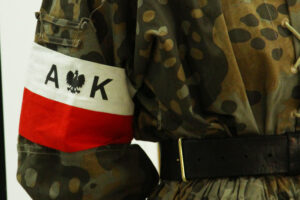 where he served until February 1944. It was on his order that the SS
 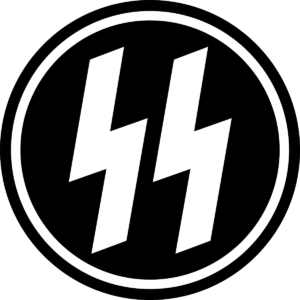 and Police Leader Franz Kutschera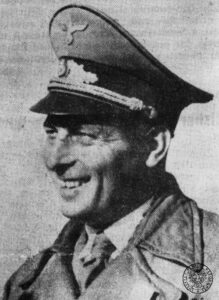
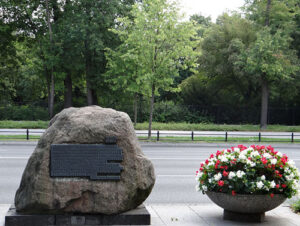 was assassinated on 01-02-1944 in Operation Kutschera by Szare Szeregi.
 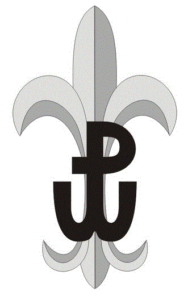 a codename for the underground paramilitary Polish Scouting Association during World War II.
Shortly before the collapse of the Warsaw Uprising on 28-098-1944, he was promoted to the rank of Brigadier General with an order from the Supreme Commander Kazimierz Sosnkowski. 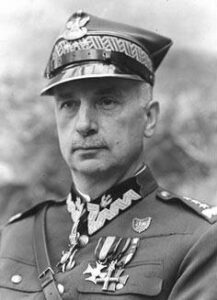
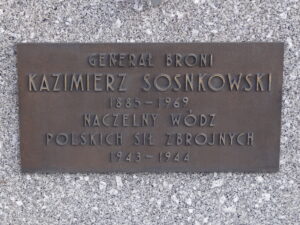 He became the deputy commander-in-chief of the AK under General Leopold Okulicki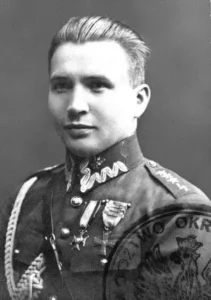
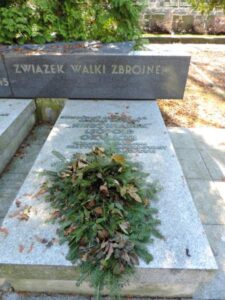 in October 1944. He was also nominated for future command of the NIE Organisation,
 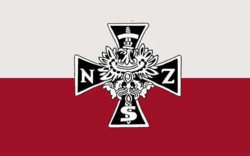 which was formed from the cadre of the AK with the intention of resisting the new Polish Stalinist government.
On 07-03-1945, Fieldorf was arrested by the Soviet NKVD  in the town of Milanówek. Initially, he was misidentified under the name Walenty Gdanicki and sent to a Gulag camp in the Ural Mountains.
 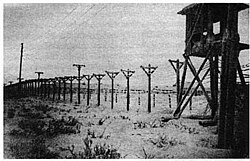 Released in 1947, he returned to new Poland ruled by the communist Polish Workers’ Party
  government and the increasingly repressive Ministry of Public Security. He settled in Biała Podlaska under his assumed name and did not return to underground activities. Moving between Warsaw and Kraków, he eventually settled in Łódź.
The government, which was persecuting former resistance members loyal to the London-based government-in-exile, offered an amnesty to them, in 1948. Not knowing that the amnesty was a sham, Fieldorf outed himself to the authorities. He was then placed under investigatory arrest in Warsaw. In prison, he refused to collaborate with the Communist security services, even under torture. General Fieldorf’s brutal interrogations were personally supervised by MBP  colonel Józef Różański. Kazimierz Gorski,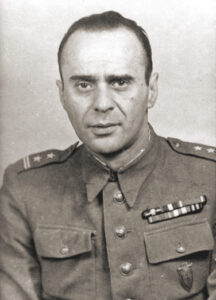
 Polish secret police, the UB interrogator, testified in 1997: “Józef Różański would stop by frequently during many of my interrogations of General August Fieldorf, and he would have conversations with him on many subjects. The prosecuting attorney Benjamin Wajsblech would show up frequently as well, and would, on many occasions, give me verbal instructions. I prepared a decision to refuse the general’s [defense] evidence materials. I wrote it under the dictation of Wajsblech. I didn’t decide as to whom, and how, I should interrogate”.
Fieldorf was accused by prosecutor Helena Wolińska-Brus 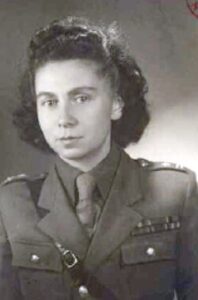
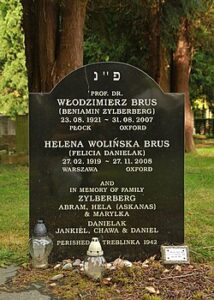 of being a “fascist-Hitlerite criminal” and having ordered an execution of Soviet partisans while serving in the AK. After a kangaroo court trial, he was sentenced to death on 16-04-1952 by the presiding judge Maria Gurowska. An appeal to a higher court failed, and the family’s plea for a pardon was denied by then the communist leader Bolesław Bierut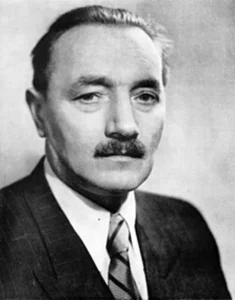
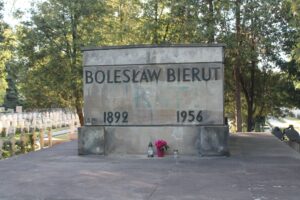 who refused to grant clemency. The sentence was carried out, by hanging, on 24–02-1953 at 3:00 pm in the Mokotów Prison in Warsaw.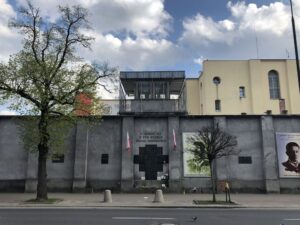
The Communist Prosecuting Attorney, Wiktor Gattner, described General Fieldorf’s last moments as follows:
I asked the condemned if he had any wishes. Fieldorf responded: ‘Please notify my family’. I stated that his family would be notified […] The condemned persistently looked straight into my eyes. He stood erect. No one was holding him. He made an appearance of a very strong man. One would almost admire his composure amidst such dramatic events. He neither screamed, nor made any gestures. I said: Carry out [the execution]! The executioner and one of the guards approached the condemned […] I went to see the warden afterwards, and then by my own hand I prepared the protocol of the execution.
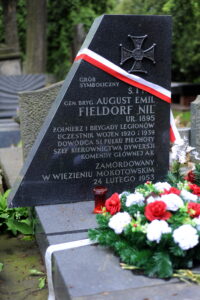
Death and burial ground of Fieldorf, August Emil “Nil”.
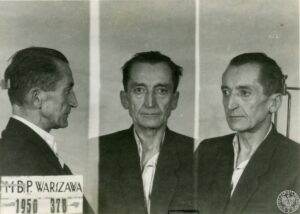
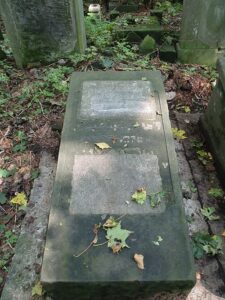
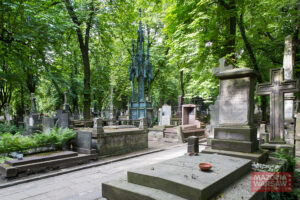
General Fieldorf’s body was never returned to his family, and was buried in a location which remains unknown. In 2009, an article in a British Telegraph newspaper suggested that Fieldorf was buried in a mass grave in a Warsaw cemetery, together with the remains of 248 other murdered Polish non-communists. Fieldorf’s cenotaph at Warsaw’s Powązki Cemetery
Fieldorf’s cenotaph at Warsaw’s Powązki Cemetery. In 1958, the prosecutor’s office discontinued any further investigations.
In 1972, a statue was erected on his symbolic grave. In 1989, following the collapse of Communist Poland, Fieldorf was officially rehabilitated. 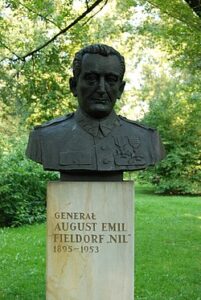
In 2006, President Lech Kaczyński posthumously awarded him the Order of the White Eagle. In 2012, the supposed mass grave site was to be searched for Fieldorf’s remains.


Leave a Reply