


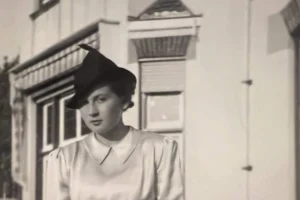
Eeghen, Esmée Adrienne van, born 07-07-1918, in Amsterdam,  Amsterdam Municipality, Noord-Holland, Netherlands. Esmée was a scion of the Dutch patrician family Van Eeghen. Her parents were Reginald Hendrik van Eeghen (1889-1936), director of the Amstel Brewery, and Minette Adrienne, born van Lennep (1892-1975), better known as Miesje van Lennep. Van Eeghen had a brother named David Hendrik (nickname: Dave)
  who was two years younger than her. Dave died died on 16-04-1945, age 24 in concentration camp Bergen-Belsen, Anna Frank
  would die there too.. Esmée didn’t have a good childhood. Her parents divorced when she was eight years old, and her father left for America after his divorce, where he died in San Francisco in 1936. In her youth, she moved frequently, which meant constantly changing schools. Her mother remarried Alphert Baron Schimmelpenninck van der Oye,
  (Bussum, 06-04-1880 – Baarn, 30-04-1943) who was a Dutch sports administrator and mayor. by whom she had a third child, Sander.
In 1935, the blended family moved to Stationslaan 14, later renamed Gerrit van der Veenlaan 14 in Baarn. 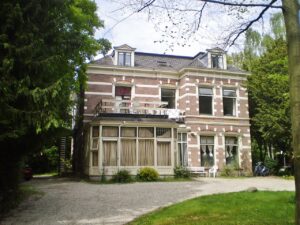 She went to the Baarnsch Lyceum, but in the fifth grade, she suddenly disappeared from school when she became pregnant. She was sent to Switzerland for an abortion. In 1939, she became a student nurse in Haarlem and then in Amsterdam. She was, as always, a well-dressed and made-up young woman who also smoked and drank heavily, a striking figure, and spoke fluent English, German, and French.
Her brother Dave joined the resistance after the Dutch capitulation. Field Marshal Wilhelm Keitel signs the unconditional surrender of the Wehrmacht at the headquarters of the Red Army in Berlin-Karlshorst.


Esmée also joined the resistance thru a friend, the later Bussum general practitioner Henk Kluvers. To arrange accommodation for students from Amsterdam, they both visited Leeuwarden frequently, which also gave them local contacts. After a raid by the Frisian resistance on the Labor Office on Zaailand in Leeuwarden on 25-06-1943, Van Eeghen decided to stay in Friesland for good.
The regional Knokploeg (KP), resistance, leader, Krijn van den Helm, 
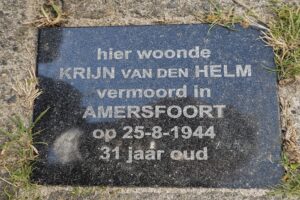 initially employed her in housing Jewish children, but over time she took on increasingly dangerous work, such as transporting several Allied pilots to hiding addresses and transporting weapons.On 25-08-1944, Krijn, age 31, was shot dead in a scuffle at his hiding place in Amersfoort by the Dutch SD officer Pieter Johan Faber.
 Faber passed away 10-07-1948 (Groningen, the Netherlands).
Pieter Gerk “Piet” Oberman in the middle with head, 
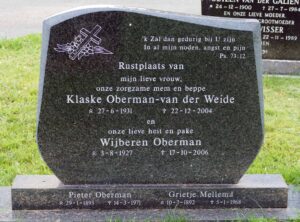
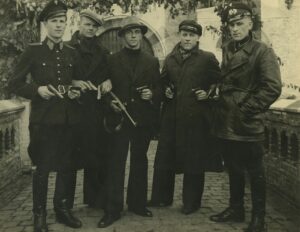 (resistance name: Piet Kramer), who succeeded Krijn van den Helm as KP leader in Friesland in the summer of 1944, stated after the war: Oberman survived the war and passed away age 64, Dokkum, 14-11-1972
Esmée was exceptionally well-informed about everything related to the resistance movement in Friesland, and as the chief courier, she came into contact with many leading illegal figures in other provinces. She attended important meetings at the KP headquarters on several occasions, which at that time was located at the home of Mr. Harm Kingma, the director of a carpentry factory in Leeuwarden, and his wife Annie. 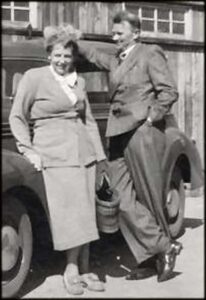 Completely alone, she was responsible for, among other things, transporting weapons to Limburg and Amsterdam.
Various stories circulate about Van Eeghen’s cold-bloodedness. For example, she is said to have had a suitcase of weapons carried past a checkpoint by a German officer, and during the transport of a suitcase containing ration cards, she is said to have opened the suitcase with a stern face, remarking that she was a representative of a paper mill and was traveling with paper samples.
Esmée van Eeghen was hired by Van den Helm and Pieter Wijbenga,  a member of the KP in Leeuwarden, to lure two SD members to Makkum, where they were to be liquidated. Due to circumstances, nothing ever came of this plan. However, Van Eeghen fell in love with a German officer, Hans Schmälzlein, a chief paymaster at the Supply Office in Groningen, and moved in with him. However, that only happened from 07-07-1944, just before her final departure from Leeuwarden; it couldn’t be combined with a role in the resistance.
There is uncertainty about her motives. Some say she was trying to get information about her brother Dave that way, who was arrested on a trawler in IJmuiden after being betrayed while trying to cross to England. Dave died shortly before the liberation, likely from exhaustion in Bergen-Belsen. [source?]
On 15-07-1944, the Germans raided the resistance headquarters, where they seized a number of important documents. Van Eeghen was suspected of complicity by the resistance and was no longer trusted (wrongly, as postwar research shows: she had not betrayed them, but the wounded resistance fighter “Ben” de Vries 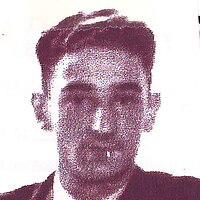 had fallen into the hands of the SD and had ‘turned’). Van Eeghen thus appeared before a ‘secret court’ established by the resistance, which ultimately gave her the choice: leave Leeuwarden or receive a death sentence. Benjamin de Vries died on 31-01-1943 in Auschwitz.
Death and burial ground of Eeghen, Esmée Adrienne van.
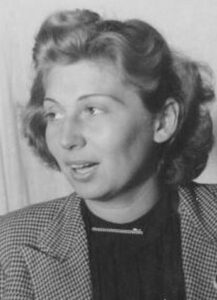

Van Eeghen left Leeuwarden and went into hiding with her mother. The SD  was hunting her, and the Resistance no longer trusted her either. Due to the betrayal of her supposed friend Ans Jaakke, she was arrested by the SD on 09-08-1944. The SD tried in vain to ‘turn her around’. On the evening of 07-09-1944, shortly after Mad Tuesday, she was shot dead by an execution squad led by Untersturmführer Ernst Knorr,
 along with Luitje Kremer, age 24,
 (from the KP North Drenthe), after which her body was dumped in the Van Starkenborgh Canal, where it was found the next day.
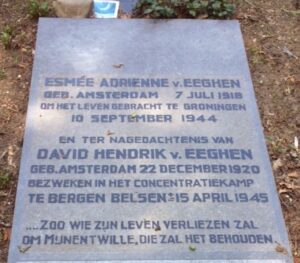
Esmée Adrienne van Eeghen is buried in Baarn. Her grave is also a memorial site for her brother David, who died in the Bergen-Belsen concentration camp. Her name and that of her brother David (‘Dave’) are listed on the Baarn War Memorial on Stationsplein.



Leave a Reply