


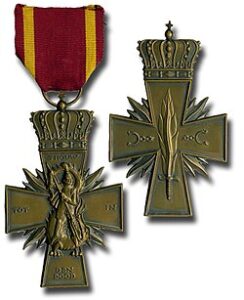


Brandligt, Walter (Wolter), born 14-05-1901 in Kampen, Netherlands 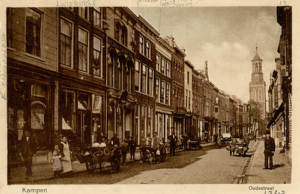 the son of Hendrik Aalt Brandligt and Jacoba Johanna, born Horst. The Brandligt family moved to Amsterdam not long after Walter was born. His first marriage was to Neeltje de Jager, with whom he had his daughter Elisabeth Brandligt. Four years after the divorce from Neeltje, Brandligt married Anna Wijbrandina Geertruida Brandligt-Mossel (nickname: Annetje) on 12-03-1936 and they moved to Cagnes-sur-Mer in France on the same day. Their son Cees (Constant) Brandligt (1937) was born from this marriage. Walter Brandligt had four grandchildren Stephan-, Jeroen-, Jorinde- and Arend Brandligt.
Brandligt had various jobs before he fully focused on literature. He was a sergeant, a bank clerk, an accountant for a greengrocer at the now defunct Amsterdam vegetable market, a representative for Palmolive and a partner in a wholesale company in southern fruits that went bankrupt with a large deficit. He also had various hobbies such as motorcycling, hunting, fishing, photography and filming. In 1934 he decided to devote himself fully to writing, because that was the only thing he was serious about. Before the German occupier made his work impossible, the following books by Walter Brandligt were published: Witte Gait (1933), Kerels in Grandel (1935) (1935), Concubinaat (1938), Gaalman’s carrière (1939), Het goede hart (1942) and De kromme voorzienigheid: a collection of posthumous works (published posthumously in 1947).
Cagnes-sur-Mer, located on the coast of southern France, is known as an artists’ colony where many Dutch artists settled. Brandligt also found his home here on the Rue Sainte-Anne, now known as the Rue du Planastel. From this community, Walter Brandligt and the sculptor Frits van Hall returned with their families, via Paris, to the Netherlands, where they later participated in the resistance. Suzy van Hall, Frits van Hall’s sister, started a relationship here with Gerrit Jan van der Veen,  with whom Brandligt worked intensively during the war. After the war, Brandligt-Mossel returned to Cagnes-sur-Mer where she moved in as a neighbor of Havank.
The Brandligt family settled in the house ‘De Tuinfluiter’ in Epse, Gelderland, 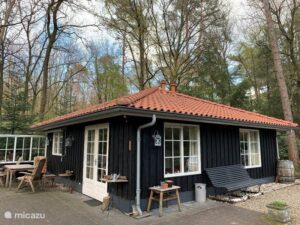 at the end of 1939. The choice for Epse was partly determined by the presence of A. Brandligt-Mossel’s sister, Co Mijnders, who lived in Deventer with her husband, Jan Mijnders, who was also involved in the resistance. However, Brandligt mainly stayed in Amsterdam, with a Dutch stage actress. Nelly Adele “Nell” Knoop.
 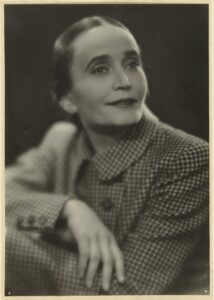 Knoop was the right hand of resistance fighter Gerrit van der Veen in the resistance. She saved the lives of the Jew, Heyman “Chaim Knorringa”
 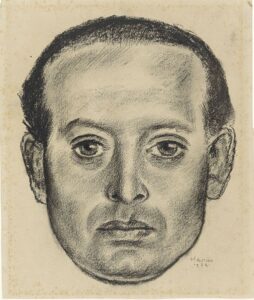 and his two children.
Walter lived there with Lucie Visser, with whom he had a relationship. Both Lucie Visser and Nell Knoop were active in the resistance. From Amsterdam, Brandligt sent Jewish people in hiding to ‘De Tuinfluiter’ in Epse, where Brandligt-Mossel stayed. This place served as an interim shelter. Brandligt-Mossel ensured that they could go into hiding elsewhere for a longer period of time. A few stayed longer at De Tuinfluiter, such as Chaim Knorringa (code name Uncle Nelis) and Fred Rodrigues, with his wife Grace, who also called himself Alfred Brent. With the latter, Brandligt-Mossel also wrote for the resistance newspaper “Op de Keper”. Resistance fighters also regularly stayed there to catch their breath.In Amsterdam, Brandligt had joined CS-6, a left-wing resistance group. The name could be derived from the address where the group was founded, Corellistraat 6, but others suggest that it stands for ‘Centre de Sabotage number 6’. The group was involved in collecting weapons and started with sabotage, later also with the liquidation of NSB 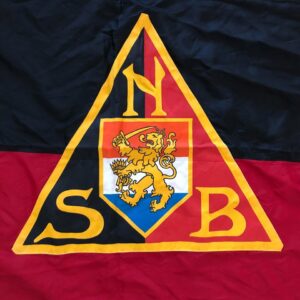 members and traitors. Brandligt took part in numerous resistance actions, for example, together with Gideon Boissevain
 and Maarten “Mik” van Gilse
 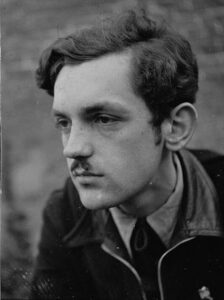 he made fire bombs in radios, which had to be handed in, in order to destroy buildings where radios were stored.
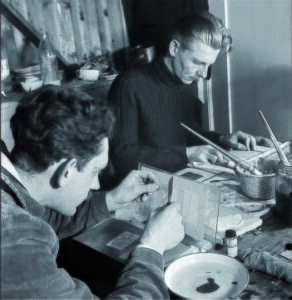
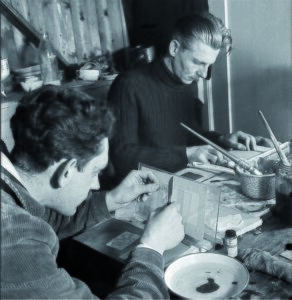 Maarten van Gilse (left) and Walter Brandligt (right) busy forging identity cards
Brandligt also helped with the attack on the Amsterdam Population Register. Mik van Gilse, age 27, was executed too on 01-10-1943 in the dunes near Overbeek. His older brother Jan Hendrik (Janric) van Gilse (Munich, 5 June 1912 – The Hague, 28 March 1944) was shot dead by the Germans six months later while attempting to escape.
From 1942 onwards, Brandligt was an active member of the Personal Identity Card Centre (PBC). Under the leadership of Gerrit van der Veen, Walter Brandligt, together with Violette Cornelius, 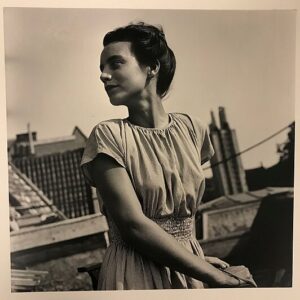 survived the war and died Saint-Maximin-la-Sainte-Baume, 24-01-1998, age 78, Maarten van Gilse, Kossen, Cornelia,
 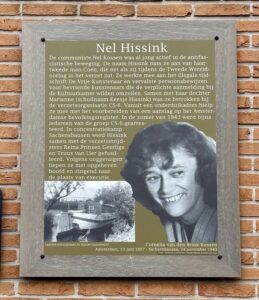 best known as Nel Hissink (b. Amsterdam 13-6-1897 – d. KZ Oranienburg, Germany 27-10-1943), active in the resistance, Dionisius Remiëns
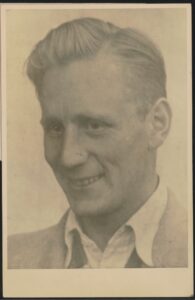
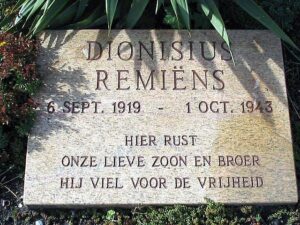 and Gustave “Guusje” Rübsaam,
 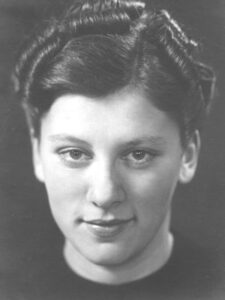 she survived the war, formed the core of this group, which produced a total of 80,000 false papers for resistance fighters and people in hiding. Brandligt’s task was to remove the “J” from Jewish identity cards and to copy the stamps. At Brandligt’s request, Violette Cornelius made the well-known photo series of the PBC in action; the negatives were buried and only dug up after the war. In addition to his involvement in the resistance actions of CS-6, De Vrije Kunstenaar and the PBC, Brandligt was also a member of the resistance group around Gerrit van der Veen.
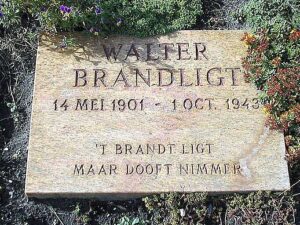
Death and burial ground of Brandligt, Walter (Wolter).
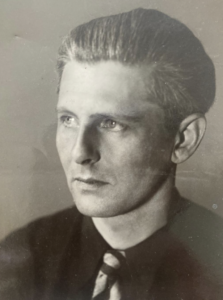
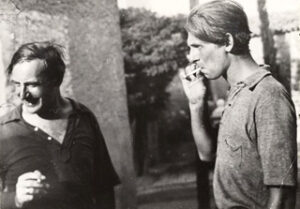
Brandligt had an appointment with the Black marketeer and SD informant, tobacco merchant F.H.F. Pas from Soest, to get information about the whereabouts of his arrested employees Antoine Theodore “Toon” Broeckman 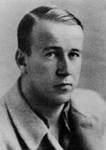 executed 01-10-1943, age 32, and Dionisius Remiëns. Brandligt did not trust the appointment, cancelled it, but decided to go ten minutes before the agreed time, driven by the hope of saving his friends. Immediately after this risky meeting with Pas, Brandligt was arrested by the Sicherheitsdienst, SD
  on 30-07-1943, in the Noord-Zuid Hollandsch Koffiehuis,
 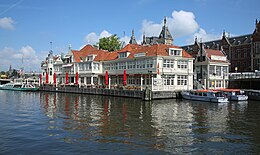 opposite the central station of Amsterdam. After being sentenced to death by a Polizeistandgericht, Walter Brandligt was executed by firing squad in the dunes near Overveen on 1 October 1943, together with 18 other members of CS-6. At the age of 42, Brandligt was the oldest of the convicts. His wife Annetje Brandligt-Mossel visited Brandligt in prison several times and brought him clean clothes. The last time she was not allowed to see him, but the guard assured her that he was fine. On the train back, her eye fell on a newspaper belonging to a passenger opposite her. There she saw her husband’s name in a list of 19 executed men. Completely distraught, she immediately travelled to Elisabeth de Meijier, a good friend from her time in Cagnes Sur Mer, who was now living in Bilthoven, to share the terrible news. Walter’s farewell letter only reached Annetje after his death; this letter was recently found. In mid-July 1945, several graves were discovered and opened up in the dunes behind the so-called Helm Monument on the Zeeweg, on the territory of the municipality of Zandvoort. The body of Walter Brandligt was found in one of these graves, identified by the indication of his initials ‘W.B.’ on his clothing.
Walter is reburied at the Cemetery of honor in Bloemendaal, in grave pit XI, under memorial Section: 33. Row: XI. Grave 5.
Walter Brandligt’s motto in life was: “It burns lightly but never goes out,” a sentence that can be found in his books and on his tombstone.
Message(s), tips or interesting graves for the webmaster: robhopmans@outlook.com


Leave a Reply