



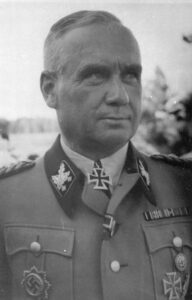
Jeckeln, Friedrich August, born 02-02-1895, in Hornberg, 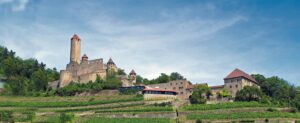 Grand Duchy of Baden, German Empire, the son of a textile factory owner in Hornberg in the Black Forest area. He attended the local Volksschule and the Realschule in Freiburg im Breisgau. He studied engineering at the Friedrichs-Polytechnikum [de] in Köthen
 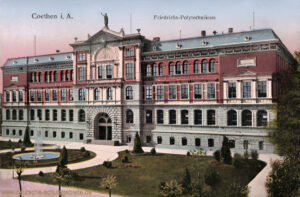 for a year before enlisting in the Royal Prussian Army as a one-year volunteer with the 76th (5th Baden) Field Artillery Regiment
 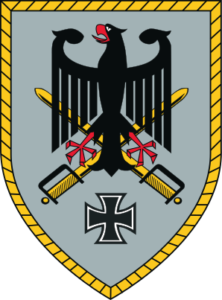 at Freiburg im Breisgau in October 1913. After the outbreak of the First World War, he engaged in combat on the western front. Promoted to Leutnant of reserves in March 1915, he was transferred to the 40th Fusiliers Infantry Regiment in the same month and became regimental adjutant. He was seriously wounded in March 1916
 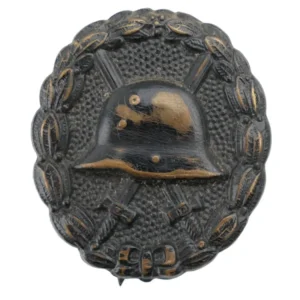 and transferred to the Luftstreitkräfte/Air forces where he trained as a pilot and served with Air Replacement Detachment 5 until the end of the war. He then briefly served in the Grenzschutz Ost/Border Protection East,
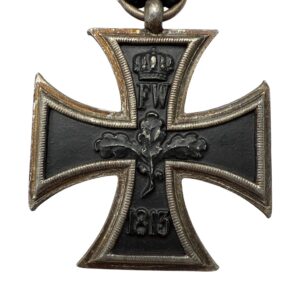
 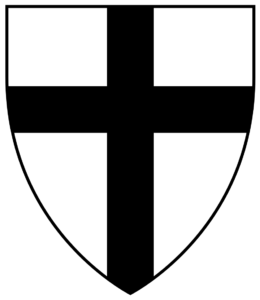 a Freikorps unit, and was discharged from military service on 20-01-1919, having earned the Iron Cross, 2nd class
 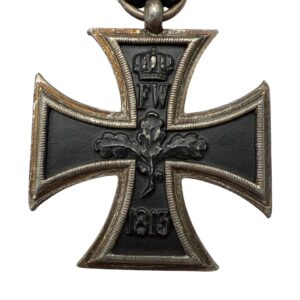 and the Wound Badge, in black.
Returning to civilian life Jeckeln, who had married in 1918, worked from 1919 to 1925 as an estate administrator near Danzig for his father-in-law Paul Hirsch, 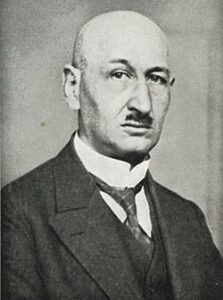 who was Jewish. Jeckeln subsequently separated from his wife in 1926 and failed to provide support for her and their three children. His increasing antisemitism was attributed to the breakdown of the marriage and his disagreements with Hirsch. He then worked as a self-employed engineering technician in Braunschweig until 1929. From 1922 to 1924, he was a member of the nationalist and antisemitic Young German Order,
  and he also joined the conservative German National People’s Party.
Jeckeln joined the Nazi Party  on 01-10-1929 (membership number 163,348) and was assigned full-time Party duties as a speaker and organiser. As an early Party member, he later would be awarded the Golden Party Badge.
  On 01-12-1930, he was accepted into the Schutzstaffel (SS)
  as member number 4,367. On 31-03-1931, he was given command of the 17th SS-Standarte
  in Harburg-Wilhelmsburg. On 22-06-1931, he was promoted to SS-Standartenführer
  and transferred to the command of the 12th SS-Standarte
 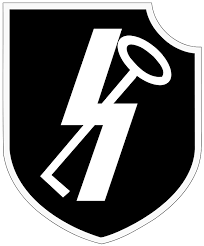 in Hanover. His next advancement came in September 1931, when he was promoted to SS-Oberführer
 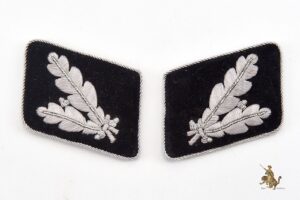 and named the leader of SS-Abschnitt (district) IV in Braunschweig. In October, he participated in the large Sturmabteilung (SA)
 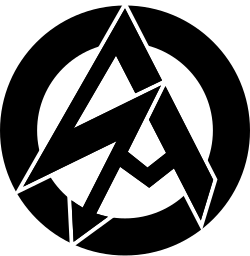 rally at Braunschweig for which he was awarded the Brunswick Rally Badge. In the end of January 1933, on the Nazi seizure of power, Jeckeln was put in charge of SS-Gruppe Süd in Munich and promoted to SS-Gruppenführer.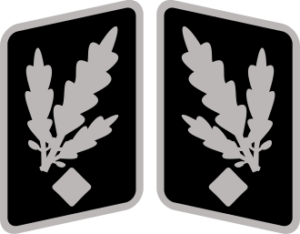
On 20-06-1933, Dietrich Klagges, 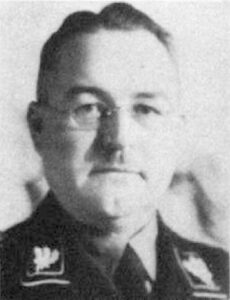
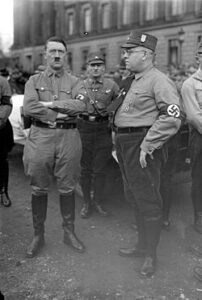 the minister-president of the Free State of Brunswick, appointed Jeckeln as the police president of the state police office in Braunschweig and police consultant to the state ministry with the rank of Regierungsrat (government councilor). Jeckeln took command of SS-Gruppe Nordwest in Braunschweig on 10-08-1933 and, in October, was made commandant of the Schutzpolizei of Brunswick. In April 1934, he was also given command of the political police (Gestapo)
  in Brunswick. Jeckeln was promoted to SS-Obergruppenführer on 13-09-1936. On 28-06-1938, he was appointed the first Higher SS and Police Leader Mitte, headquartered in Braunschweig, but with jurisdiction over all of Wehrkreis (military district) XI. During the Kristallnacht
 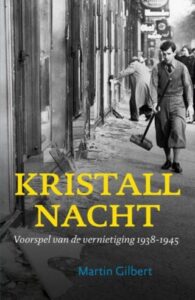 pogrom of 9-10 November 1938, Jeckeln organised anti-Jewish actions in Braunsweig and Hanover. The Kristallnacht (also known as the Nite of Broken Glass) was an organized action (pogrom) by the Nazis directed against the Jewish part of the German population. Kristallnacht took place on the nite of November 9 to 10, 1938. Throughout Germany, Jews and their possessions were attacked. 1400 synagogues were set on fire and demolished. Approximately 7,500 Jewish shops and businesses were destroyed. Jewish houses, schools, cemeteries, and hospitals also had to pay the price. The fire department was forbidden to extinguish the fires. According to initial reports, 96 Jews were murdered on the streets during Kristallnacht. Jews were also attacked in Austria and the Sudetenland, and their possessions were destroyed. More recent studies, however, estimate the number at over 400 Jews who were murdered or driven to suicide between November 7 and 13.
 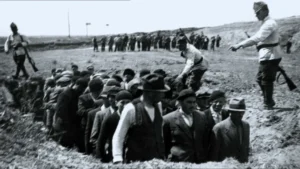 Adding to this the number of deaths in the concentration camps where approximately 30,000 younger and healthy Jewish men were imprisoned immediately after November 10, one arrives at a figure of more than 1400. Nazi propaganda minister Joseph Goebbels
 is seen as the mastermind behind Kristallnacht.
Throughout his police career, Jeckeln was known for ruthlessness and brutality. Political opponents, especially members of the KPD, SPD and the unions, were relentlessly persecuted and some were killed. Together with Hilfspolizei (auxiliary police) chief Friedrich Ludwig Herbert Alpers,  Jeckeln was responsible for the Rieseberg Murders of 11 Communists and labor organisers on 04-07-1933. He also used his position in the police establishment to ensure that the murders never were properly investigated. Alpers commited on 03-09-1944, suicide, age 43, near Mons in Belgium.
In addition to his SS and police duties, Jeckeln also pursued a political career. At the July 1932 parliamentary election, Jeckeln was elected as a deputy of the Reichstag from electoral constituency 16, South Hanover–Braunschweig. He was reelected to this seat in the two following elections and, in November 1933, he switched to constituency 15, East Hanover, which he represented until his capture in late April 1945. From March 1940 to April 1945, he also served as a Staatsrat (state councilor) in the government of the state of Brunswick.
From September 1944 to January 1945, Jeckeln held the post of HSSPF (Höherer SS- und Polizeiführer/ Senior SS and Police Leader), for Belgium and northern France but this was a “paper command”, as the area had already been largely liberated following the Normandy campaign. In January 1945, having been pushed out of Latvia by the Red Army, Jeckeln was given a new command as the HSSPF for Upper Silesia and was also named as the inspector for replacement troops in southwest Germany. On 15 February, he was appointed to command the V SS Mountain Corps, as the last command he was replacement to hold General Friedrich Wilhelm Krüger. 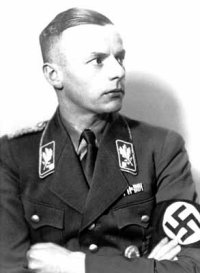 Fighting against the Red Army in the Battle of Halbe south of Berlin, his unit was encircled and Jeckeln was taken prisoner on 28-04-1945.
Trial and executionJeckeln (left, standing), at the Riga Trial, 1946 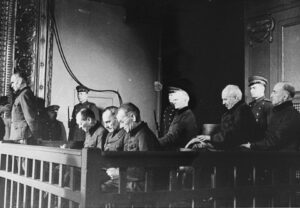
Along with seven other high-ranking German officers, Jeckeln was tried before a Soviet military tribunal in the Riga Trial from 26 January to 3 February 1946. Jeckeln admitted his guilt and agreed to bear full responsibility for his actions and those of his subordinates in Reichskommissariat Ostland. Concluding his address to the tribunal, he said:
I have to take full responsibility for what happened in the borders of Ostland, within SS, SD and the Gestapo. This greatly increases my guilt. My fate is in the hands of the High Court, and so I ask only to pay attention to mitigating circumstances. I will accept a sentence in full repentance which I will consider as worthy punishment.
Death and burial ground of Jeckeln, Friedrich August.
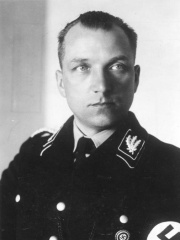
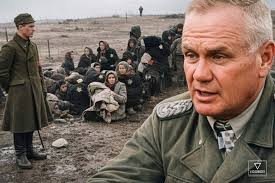
Jeckeln and the other defendants were found guilty and sentenced to death on 03-02-1946. Jeckeln, age 51, was hanged in Riga that same day in front of some 4,000 spectators. Contrary to popular misconception, the execution did not happen in the territory of the former Riga Ghetto, but in Victory Square (Uzvaras laukums). Friedrich Jeckeln’s body was cremated.


Leave a Reply