


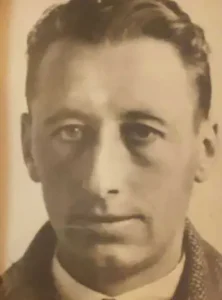
Schoonlingen, Jacob, born 15-12-1906, in Den Haag, 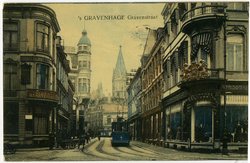 Netherlands a descendant of a Frisian couple who had moved to the big city with seven children. Jacob was married to Rosalie Seifert on 20-09-1933. She was a Czechoslovak from the new republic and, given her name, possibly a Sudeten German from Homberg in the Ruhr area. At the age of sixteen (31-01-1913), she had entered our country as a maid. Maybe she dared because many men had disappeared from the fields and villages worked by the Germans? Jacob and Rosalie were married on 20-09-1933. Subsequently, the married couple had acquired one of the many houses built by speculators and had moved to Beekplaan 69b. After two months, they had moved back in with his parents at Boylestraat 2. Via some detours, they had ended up in 1935 a few streets further on at Jasmijnstraat 55, just across from Valkenboskade 3.
Jacob was a freight forwarder, just like his father. The family also dealt in coal. Their storage shed was a newly built building that at the time was located at Loosduinsekade 94 near line 11 at the site of Groenesteijn. “Messy houses along a messy road,” according to the description by Commissioner Achterberg, pondering in his Dafje at the traffic light. The contact address changed from Weimarstraat 392 and 394 to Hofzichtlaan and Zeekant. “His father was a patriarch.” He decided whether they worked in the coal mines or did something else,” said a descendant.
Max appeared four years later at a session of the Special Court. The Special Court was an attempt by the state to prosecute collaborators. Five courts were established: in Amsterdam, Arnhem, den Bosch, Leeuwarden, and The Hague. The courts were established by the government in London in 1943. On 03-08-1945, the Hague court was installed. In September, Max Blokzijl, ‘in his own unique way, so well known from the radio,’ was sentenced.
At the hearing, presided over by Mr. D. Blijdendijk, the defendant acknowledged the act and expressed regret over the incident that ‘could no longer be made right for him.’ In his indictment, Prosecutor Mr. Harry van Doorn 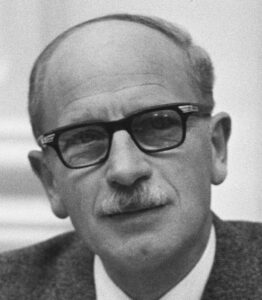 stated that he, as an N.S.B.
 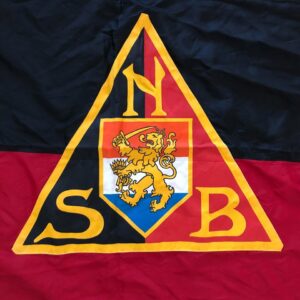 member and in his role as an inspector in the field at the Regional Employment Office, had displayed “great activity.” He added that it had all taken place “with calm deliberation.” He demanded fifteen years. The defense attorney Mr. Jan Willem van der Plas,
 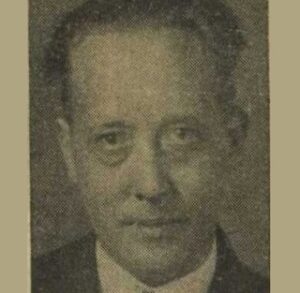 on the other hand, pointed out that there was “a fierce crowd and a nervous tension” in the square. When the land guards shouted “shoot then,” M. allegedly aimed his firearm at the crowd, hitting Schoonlingen. The defense attorney suggested taking into account the ‘mental turnaround’ that would have occurred in M.
Reports from the Special Court revealed how land guards were perceived. “He also shot at them indiscriminately,” he behaved like a “mad brute.” “What you did was more sordid than anything I’ve ever heard of here.” Trials of seven to fifteen years were common.
On a summer evening of 21-07-1944, another shooting took place at Valkenbosplein. ‘one of many incidents that were common at that time, where the civilian population came into conflict with the increasingly brazen land guards.’ Jacob Schoonlingen was the victim.
Nazified departments were established within the police apparatus to carry out the more sensitive tasks: political investigation and countering any potential political unrest. The ‘Schalkhaarders’, named after their training center, operated in the three major cities and especially in The Hague. The Landwacht was continued in the Auxiliary Police. The Dutch Landwacht 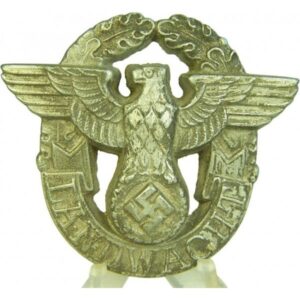 was a Dutch paramilitary organization that was established by the Germans on 12-11-1943. It should not be confused with the military volunteer corps ‘Landwacht Nederland’ which was established in March 1943 and renamed Landstorm Nederland in October, a part of the Waffen-SS.
  After Crazy Tuesday, the Volunteer Auxiliary Police was added to the Landwacht.
It was difficult to find capable National Socialists. These auxiliary agents were deployed to track down and deport hiding individuals for forced labor throughout the country. It is unclear whether the residents of The Hague were also deployed to round up Jews. They mainly focused on manning posts and keeping an eye on known individuals. “As Auxiliary Police, we can always deploy them,” says Teun de Vries, who has some German soldiers say this during a boisterous drink in his epic about the February Strike.
Blijdendijk spared no criticism of the former mechanical engineer. The man, as the head of the field service, had ‘fanatically chosen the side of the enemy’ and engaged in actions that were detrimental to those in hiding. And he had shot Schoonlingen with his shotgun. He was sentenced to twelve years with deduction and the removal of his voting rights for life.
A man, the Hague-based freight forwarder Jacob Schoonlingen, had clashed with the land guards. What had prompted him that evening to take a bike ride to the peripheral square with two meager green triangles along the tram track? He had thrown his bicycle in front of them in self-defense during the scuffle. Thereupon, gamekeeper J.B.M. had grabbed his shotgun loaded with pellets and hit Schoonlingen in the abdomen from about a meter away. Because he didn’t keep his hands ‘up properly.’ He had collapsed and died after some time.
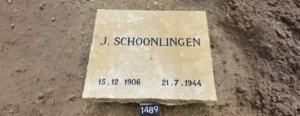
Jacob was laid to rest at Nieuw Eik en Duinen. In 2024, he was reburied at the National Cemetery Loenen by the War Graves Foundation. His wife Rosalie continued to live on Jasmijnstraat. Jacobs’ mother had come to live with her, as well as a sister.


Leave a Reply