


Förster, Sigismund Hans Eberhard von, born 23-06-1887, in Sonderburg/Alsen, 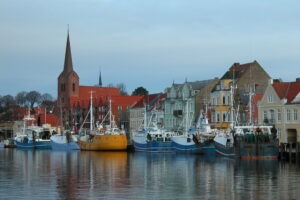 Germany, the son of the char. General of the Infantry Sigismund von Förster (1856-1931)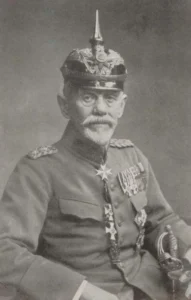
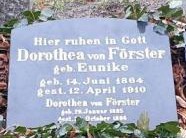
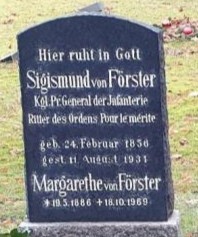 and his wife Dorothea, born Eunike.
  After his cadet training at the Cadet House in Potsdam and the Main Cadet Institute in Groß Lichterfelde, he joined the Royal Prussian Army
 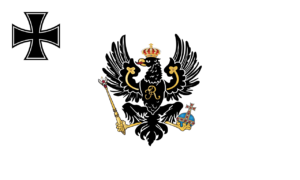 as a Fähnrich on 28-02-1907. Sigismund was then transferred from the Main Cadet Institute in Groß-Lichterfelde to the 1st Thuringian Infantry Regiment “Graf Bose” No. 31 in Altona. There he was then sworn in on 19-03-1907. After attending the war school, he was promoted to Leutnant on 27-01-1908. The patent was dated 22-06-1906. As such, he was initially assigned as a company officer in the 5th Company of his regiment in Altona. In the autumn of 1908, he was transferred to the 7th Company of his regiment at the same location in the same capacity. From 07-02-1910, he was granted a 3-month leave to restore his health and subsequently received an additional 45 days of leave to Switzerland and Italy.
He returned to the regiment on 16-06-1910. On 15-01-1911, he was appointed as the adjutant of the II Battalion of the 1st Thuringian Infantry Regiment “Graf Bose” No. 31 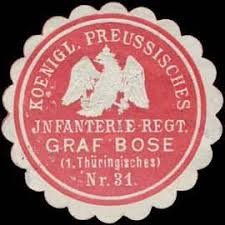 in Altona, succeeding Lieutenant Erich von Loewenich. Von Loewenich
Sigismund held this position until 31-03-1914. On that day, he was relieved by Lieutenant Kurt von Rauchfuß. 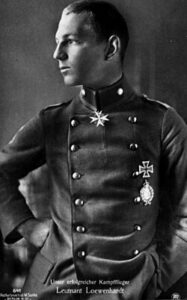 For this, he was transferred as a company officer to the 12th Company of his regiment in Altona. At the beginning of World War I, he was then sent to the front as the regimental adjutant of the Reserve Infantry Regiment No. 31. There, on 08-11-1914, he was promoted to first lieutenant. As early as 18-12-1915, he was promoted to Hauptman. At the end of 1916, he then transferred to the General Staff. For the remaining two years of the war, he was then assigned to various general staffs.
During the war, in addition to both Iron Crosses 
 and the Knight’s Cross of the Royal Prussian Order of the House of Hohenzollern with swords,
 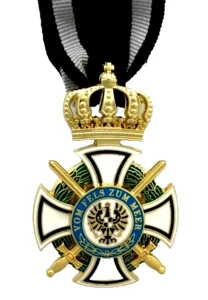 he was also awarded several other orders. After the end of the First World War, he was transferred as a Hauptman to the provisional Reichswehr.
  He first came to the Reichswehr Group Command 1 in Berlin as a defense officer. He was then detached to the Aviation Peace Commission (Luftfriko). When the 100,000-man army was formed, he was then assigned as a general staff officer to the staff of the 1st Division of the Reichswehr. In the autumn of 1923, he was then appointed as the chief of the 2nd Company of the 1st (Prussian) Infantry Regiment in Königsberg.
 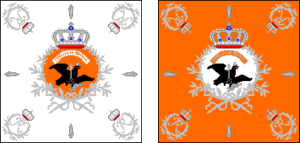 On 11-04-1926, he was then transferred to the General Staff of the Artillery Leader II in Stettin. There, he was promoted to Major on 01-02-1927. As such, he was transferred to the staff of the Infantry Leader III in Potsdam on 01-02-1928. On 01-10-1930, he was then appointed commander of the I Battalion of the 5th (Prussian) Infantry Regiment in Stettin. As such, he was promoted to leutenant colonel on 01-03-1931.
On 30-09-1932, he relinquished his command. He was appointed commander of Deutsch-Krone on 01-10-1932, for this. On 01-10-1933, he was promoted to colonel. In 1934, he was automatically appointed as the commander of the Border Protection Section Command Deutsch-Krone.
On 15-10-1935, he was appointed commander of Army Office 2 thru the renaming of his staff. At the end of the year, he relinquished this command.Sigismund was appointed as the Wehrersatzinspekteur Erfurt on 01-01-1936, for this. As such, he was promoted to Major General on 01-08-1936. On 01-04-1938, he was then promoted to Lieutenant general. As such, he was tasked with leading the 24th Infantry Division in Chemnitz  on that day. In the autumn of 1938, he was then appointed as the successor to Lieutenant General Fritz Kühne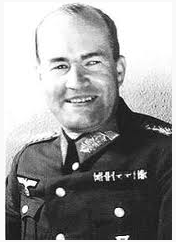
 as the commander of the 26th Infantry Division in Cologne. With this division, he then took up positions in the West at the beginning of World War II. He first led the division into battle during the Western Campaign. There, he was awarded both clasps to his Iron Crosses.

 In mid-January 1941, he handed over his command. For this, he was now appointed commander of the 97th Light Infantry Division.
 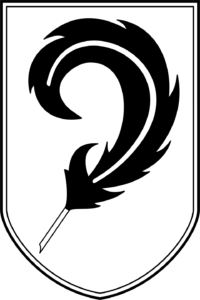 After only three months, he gave up his command again. He was then transferred to the Führer reserve.
  In the summer of 1941, he was then transferred to the staff of the Commander of the Rear Army Area South. On 01-10-1941, he was then appointed as the commander of the rear army area 550 (Korück 550). On 20-11-1942, he relinquished his command. He was now appointed as the Commanding General of the Command Staff z.b.V., also known as the General Command Förster, with the 17th Army.
  At the beginning of 1943, he was appointed Commander of Taman due to the renaming of the staff.
On 01-03-1943, he was then promoted to General of the Infantry. On that day, he was then appointed Commander of West Tauria. On 22-07-1943, he was awarded the German Cross in Gold.  On the same day, he was appointed Commander of Crimea. Due to the renaming of the staff, he was appointed Commander General of the LXXII Army Corps z.b.V. on 13-02-1944. In September 1944, he relinquished his command. He was again assigned to the Führerreserve OKH. As early as the end of September 1944, he was appointed as the Commanding General of the Higher Command Niederrhein. At the end of April 1945, he was taken prisoner of war. He was released from it in 1947.
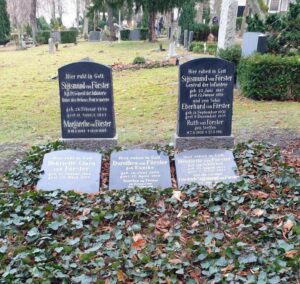
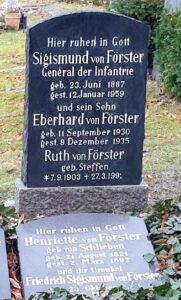
Death and burial ground of Förster, Sigismund Hans Eberhard, von.
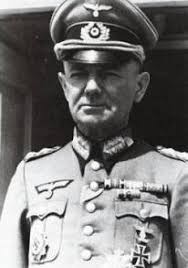
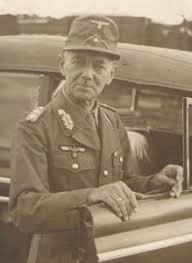
Förster von Sigismund Hans Eberhard, passed away 12-01-1959, age 71, in Bremen, Germany and is buried at the
Alter St. Matthäus Kirchhof in Berlin. Großgörschenstraße 12-14, 10829 Berlin, This is the historic cemetery in the district.




Leave a Reply