

Tronstad, Leif Hans Larsen, born 27-03-1903 in Sandvika,  Bærum, Akershus, Norway, the son from coachman Hans Larsen and his wife Josephine Amalie, born Christiansen. Tronstad. He was married with Edla Anna Solveig. Brother of Johan Tronstad; Thor Thimann Larsen Tronstad; Kristine Tronstad en Hans Tronstad.
Leif Tronstad grew up on Juliehøi in Løkke, Sandvika, Bærum. Leif graduated from high school in 1918 and then studied at the Department of Technical Chemistry at Kristiania University of Applied Sciences,  graduating in 1922. He graduated as a private student in 1923.
After completing his artium examination, Tronstad attended the Norwegian Institute of Technology in Trondheim, where he studied chemical engineering. He graduated with the highest marks in 1927.
After completing his chemistry degree, Tronstad briefly worked as a research assistant at the NTH,  after which he began working as a researcher at the nickel factory in Kristiansand. In 1928, he applied to return to the NTH on a university scholarship. After studying in Berlin and Stockholm, he received his Dr.Techn. degree in 1931. for his dissertation, “Optical Investigations into the Question of Passivity of Iron and Steel.” From 1931 to 1932, Tronstad worked at the University of Cambridge to continue his research. “Optical investigations of the passivity of iron and steel” refers to scientific studies that use optical methods, such as microscopy and spectroscopy, to investigate how a protective passive layer of iron oxide forms on the surface of iron and steel, protecting it from corrosion.
Tronstad was interested in deuterium oxide (heavy water), which is produced by electrolytic hydrogen production, and he proposed to Norsk Hydro the construction of a heavy water production plant in Vemork. 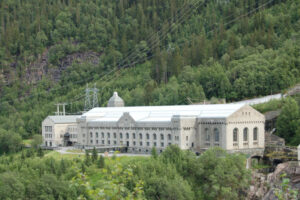 From 1934 onward, he served as a consultant for this project. The Norwegian heavy water sabotage was a series of Allied-led efforts to halt German heavy water (deuterium) production via hydroelectric plants in Nazi Germany-occupied Norway during World War II, involving both Norwegian commandos and Allied bombing raids. During the war, the Allies sought to inhibit the German development of nuclear weapons with the removal of heavy water and the destruction of heavy-water production plants. The Norwegian heavy water sabotage was aimed at the 60 MW Vemork power station at the Rjukan waterfall in Telemark.
 This photo depicts several of the true ‘Heroes of Telemark,” who carried out the Commando raid against the Norse Hydro facility in 1943, Operation Gunnerside. These individuals of the Gunnerside team, photographed in London, include Fredrik Kayser and Joachim Ronneberg on the front row and Hans Storhaug, Kasper Idland, and Birger Stromsheim behind, left to right.
In 1931, Tronstad  was appointed lecturer in inorganic chemistry at the NTH. In the autumn of 1934, he took over as director of the Department of Technical Inorganic Chemistry from Professor Thorvald Lindeman,
  and in 1936, he was appointed professor in this field himself.
After the German invasion in April 1940, Tronstad briefly participated in the campaign between Oppdal and Dombås before returning to Trondheim. In Trondheim, he actively participated in intelligence work for the British and Norwegian authorities in Great Britain, reporting on German activities in Norway, among other things. He became aware early on of the German interest in the production of heavy water at Vemork. Heavy water could become a key component in the development of a German atomic bomb.
Death and burial ground of Tronstad, Leif Hans Larsen.


After nearly being exposed and arrested, Tronstad fled to Great Britain in 1941, where he was appointed to the Norwegian High Command in London with the rank of major. He worked on strategic planning for the resistance in Norway and became a key figure in preventing the Germans from obtaining the heavy water from Vemork. In the winter of 1943, a small action group managed to reach the Vemork factory and blow up vital parts of it. Towards the end of 1944, Tronstad returned to Norway as leader of an expedition of Norwegian paratroopers from Compagnie Linge in the mountainous regions of Telemark (Operation Sunshine). A few months before the end of the war, he and Gunnar Bryde Syverstad

 age 35, an another Norwegian resistrance man, were killed by a Norwegian NS policeman, a Norwegian traitor in the Syrebekk hut in the municipality of Vinje. Just weeks before his 42nd birthday.
Major Tronstad, Leif Hans Larsen, age 41, is buried at Vestre Cemetery in Oslo, in a field containing several graves of veterans from World War II. Sørkedalsveien 66, 0369 Oslo.




Leave a Reply