

Mauser, Edward “Ed” A, born 18-12-1916 in La Salle, 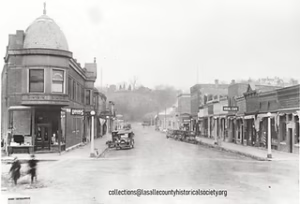 LaSalle County, Illinois, United States, to Joseph Mauser (1881–1958) and his wife Anna, born Janko, Mauser (1887–1977). Ed had two sisters,Gazella Mauser (1908–1922) and Mary Mauser Banko (1912–1944)
Ed began his military service on 15-01-1942, at Fort Bragg  when he was drafted shortly after Pearl Harbor.
 on 07-12-1941. Initially assigned to an Army Horse Cavalry unit, at Fort. Benning he observed the paratroopers in training
 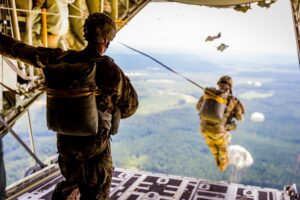 and volunteered. Following completion of jump school he joined the 101st Airborne
  at Fort. Bragg and Easy Company’s 2nd Platoon.
  On D-Day, Mauser parachuted into the hedgerows of Normandy with Chalk #69.
Ed Mauser never forgot the first thing he saw when he leaped from the doorway of his C-47 transport plane in the opening hours of D-Day, June 6, 1944. It was another plane, holding Lieutenant Thomas Meehan,


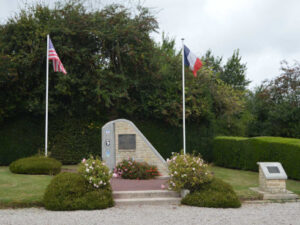 the commander of Easy Company, 506th Parachute Infantry Regiment, 101st Airborne Division, and 18 other paratroopers. “I thought the plane was going to make a landing, it hit the hedgerow and exploded. I knew all the fellows on it.”
Edward was one of the guys that had to listen to others brag about how tough Toccoa was. But Ed was tough too. A little older than the others, he was even keeled and didn’t get flustered. He was also strong as an ox and could carry heavy loads. They made him an assistant machine gunner because he could carry several heavy cans of ammunition, seemingly without bother. Ed jumped into Normandy and again into Holland. He helped rescue the Red Devils from across the Rhine, something he was immensely proud to have been a part of. He was wounded in Bastogne by the same screamin’ meemie that wounded Eddie Joint. 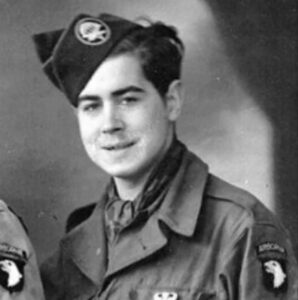 One thing about Eddie was his openness and gregarious nature. He was just one of the friendliest guys you could meet…and boy did he love the ladies! So take a moment and raise a glass for this proud Eagle Man, CURRAHEE!!!


Mauser had little time to think about what he had seen. After his parachute deployed, the strap of his leg bag yanked down to his ankle. “I thought I was going to break my legs,” he recalled. He reached down to adjust the strap, but the bag fell off. Within seconds he hit French soil. “It was one of my better landings.”
Immediately, a cow came by, which cheered him because it meant he was not in a minefield. Mauser noticed the cow moving its lips and imagined it was saying: “What’s this midnight stranger doing here?” He wasted no time getting out of his chute and climbing atop a hedgerow to get his bearings.
Ed landed alone before linking-up with Sergeant. Robert Burr “Smitty” Smith

 outside the town of Vireville. They soon found themselves in a vicious firefight around a farm house near the town. Although assigned to a machine gun squad, Mauser served primarily as a rifleman throughout the war, trusting his M-1
 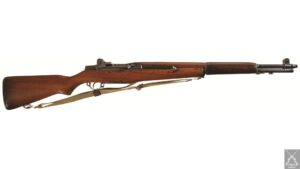 from the initial fight on D-Day to the Alpine forests of Austria. During Market Garden in Holland , Mauser was one of 23 E-Company men who participated in the famous mission to cross the Lower Rhine on the night of 22-10-1944 to rescue 120 British paratrooper survivors of the 1st British Airborne Division “Red Devils“
 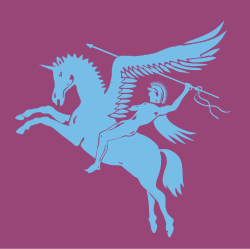 under command of Major-General Robert Elliot “Roy” Urquhart,

 , after their battle at Arnhem. That night rescue in German-occupied territory electrified the Allied Command, then reeling after the loss of over 7,000 men killed, wounded, and missing in the Arnhem assault. This daring mission remains one of the most successful operations of the entire war with not one casualty recorded. Mauser remembers guarding the left flank of the river beach, expecting an imminent attack that thankfully never came. His job was to protect the withdrawal of the survivor at all costs. Following Holland, Mauser made the truck ride to Bastogne
 , clad in his regular fatigues. He endured the “toughest” battle of the war, “thanks to good fortune and the brotherhood that was Easy Company.” He reports being blessed by having a foxhole complex built by “someone who knew what he was doing.” The sturdy structure with a roof saved his life. Mauser vividly recalls the breakout battle at Foy.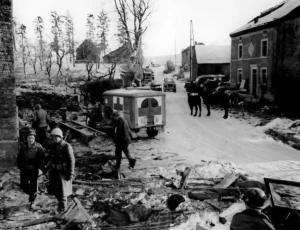
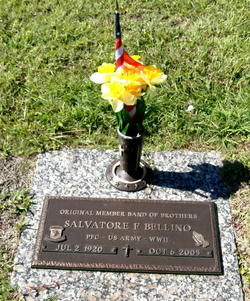
Prior to the fight he, Sal Bellino, 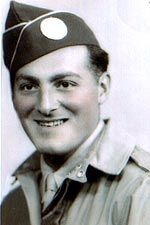
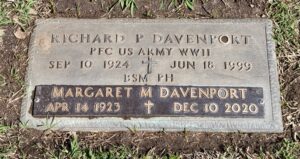
 Richard Paul Davenport,
  and Corporal John “Johny” Plesha right
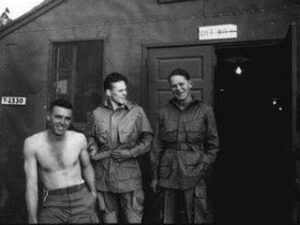
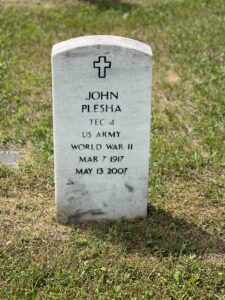 were sent on a night recon patrol of the town that was successful because “nobody was injured.” Davenport survived the war and died 18-06-1999 (age 74) and Johny Plesha also survived the war and died 13-03-2007, age 90.
Mauser remembers that the battle for the town, which followed, was memorable in that Lieutenant Ronals Sparks Speirs  demonstrated that his reputation as a fierce combat warrior was true. After Foy was taken, the fighting moved to Noville, where Mauser was wounded in the hand
  and sent to a hospital in France. Mauser rejoined the unit as it moved along the autobahn toward Adolf Hitler’s alpine home in Berchtesgarden.
  Mauser spent his time there securing homes and farms and enjoying the beauty of the area in the absence of combat. Later, in Kaprun, Austria, Mauser was awarded the 85 points he had earned and shipped back to the states. On 17-09-1945 he was discharged from the army in Chicago. Today, Mauser enjoys his retirement, proud of the fact that he is the oldest survivor of Easy Company at age 94. Ed Mauser, One of the famed ”Band of Brothers,” 101st Airborne, Ed was a decorated veteran, always humble and as he said, ”just one of the guys.” He was always an inspiration and a good source of historical information.
 We will miss him and thank him for his life and service.
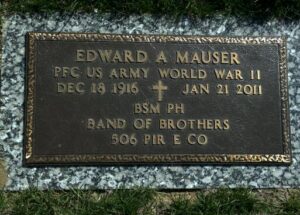
Death and burial ground of Mauser, Edward “Ed” A.
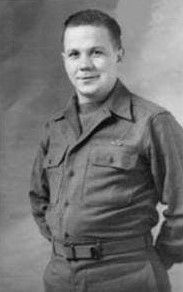
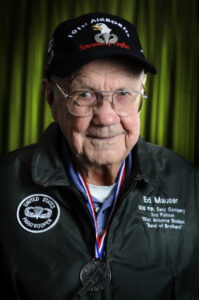
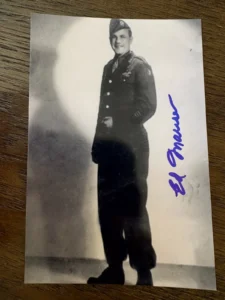
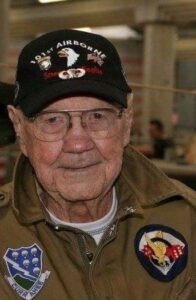
Edward “Ed” A , died 21-01-2011 (age 94) in Omaha, Douglas County, Nebraska, USA, surrounded by his family, fighting pancreatic cancer, in Omaha, Douglas County, Nebraska, USA. He is buried at the Calvary Cemetery, Omaha, Douglas County, Nebraska, United States. 7710 W Center Road, Omaha, NE 68124..


Leave a Reply