

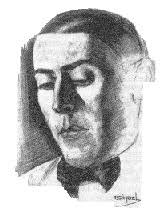
Johan Aaldrik “Han” Stijkel, born 08-10-1911, Rotterdam,  the son of Aaldrik Stijkel and Neeltje, born Eerland. Johan Aaldrik Stijkel must have been a complex personality. His life story shows all sorts of contradictions. He was very religious – certainly not unusual in the Netherlands in the 1930s and 1940s. He was also a freemason. And homosexual. Above all, he was very ambitious and apparently saw himself as a leader of people from a young age.
His father was a cutter and apparently had a successful business, which continued to operate during the war.The young Han went to the Christian HBS and then had to take an additional state exam to be able to go to university. He went to study English language and literature at the University of Amsterdam  (this was not yet possible at the VU). According to a series of commemorative articles published after the war in the Haagsche Courant, he studied pedagogy and sexology as minor subjects. The latter is particularly remarkable. Sexology was not yet a university subject at that time. In close contact with the Germans, Dutch sexologists were mainly concerned with homosexuality during that period. Schorer formed the most important link with German sexologists such as Hirschfeld. Both shared the opinion that science and knowledge were an important means of combating prejudices and legal inequality with regard to homosexuality. In the year that Stijkel started studying, 1932, the Stijkels moved to Haagschestraat 113 in The Hague.
  Schorer sent copies of the Annual Reports of the NWHK to students and also lived in The Hague. Perhaps the contact between Stijkel and Jhr Jacob Anton Schorer
  already arose in 1932. After Stijkel had obtained his bachelor’s degree in 1937, we suddenly find him in Portugal, according to his own statement to contribute to the Spanish Civil War
  under Franco, Bahamond Fransisco Paulino Teódulo Hermenegildo.


 from there. It is not clear what exactly he did there; he did receive a Portuguese medal for it in 1938. (Het Vaderland 13-10-1938). That reference to the barely neutral Portugal at that time is also a contradiction. Whose side was he on there? Not the communists, because Stijkel told his fellow prisoner Willem Harthoorn
  in Scheveningen prison that he was the first communist he had ever met. He called himself an anti-revolutionary. During his stay in Portugal, Stijkel is said to have developed the resistance strategy he called triumvirates. If Germany were to invade – and after what he had seen in Spain he had no doubt that it would happen – he would develop small cells everywhere, under the local leadership of a triumvirate, with representatives of the military, civil administration and police. Stijkel was able to get to work immediately after the German invasion. As already indicated, he helped destroy the archives of the NWHK together with Joannes François Schorer. The actual destruction was actually done by the maid, who stoked the stove with the papers. Soon after, he visited a large number of national celebrities to whom he presented his network plans, starting with Prime Minister Colijn.
 How did he, a young man of relatively humble origins, do this and also have success?
The Stijkel group, named after Johan Aaldrik. Stijkel, was aimed at transferring information about the German occupation to England. In doing so, the necessary ‘beginner’s mistakes’ were made, which caused the occupier to start following the resistance group. Among others, the notorious traitor Anthonius “Anton” van der Waals 
 managed to infiltrate.
Antonius van der Waals (Rotterdam, 11-10-1912 – Scheveningen, 26-01-1950) was a spy for the German Sicherheitsdienst (SD) during the war. He made at least 83 victims and played a leading role in the Englandspiel, which cost the lives of many Dutch secret agents from England.
Death and burial ground of Johan Aaldrik “Han” Stijkel.

On 02-04-1941, the group was arrested when they wanted to sail out of the port of Scheveningen. It was not until September 1942 that the group was tried before the Reichskriegsgericht in Berlin, and eight months later, on 04-06-1943, the sentences were carried out. Han Stijkel was the first to be killed 04-06-1943, age 31, excecuted by the Germans in the prison of Scheveningen (Oranjehotel),  Han Stijkel shared a cell with Willem Harthoorn. In his book Forbidden to Die, Harthoorn describes his own imprisonment in the Oranjehotel and in concentration camps and thus the last six months of Han Stijkel’s life in the Netherlands. A monument was erected at the Westduin cemetery to commemorate the members of the Stijkel group. It has 43 sandstone crosses. The remains of 33 people who were shot in Berlin are buried there. The remains of 10 people were never found. Van Stijkel is named in various places. Including in the Noordoostpolder: the Han Stijkelweg, the Han Stijkeltocht (a waterway) and the Han Stijkel rest area along the A6.In the Duttendel district of The Hague is the Han Stijkelplein. Surrounding streets there are named after other resistance heroes.Until 2003, a school building named Han Stijkel, part of Dalton Den Haag, stood at the Laan van Meerdervoort 1764.


Leave a Reply