


Horstmann, Gunther, born 25-03-1894 in Kiel, Germany.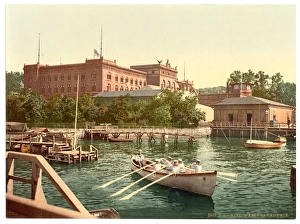 Günther Horstmann joined the Kaiserliche Marine
 on 01-04-1913, served as an ensign on the SMS Kaiser
  and was promoted to lieutenant on 18-09-1915. Gunther then joined the naval airship detachment for training from June 1917 to November 1917. He then served as a watch officer on the military airships LZ 87 (L47) und LZ 110 (L63), until the end of the war.) Horstmann joined the Herman Ehrhardt naval brigade
 and was later transferred to the Reichsmarine. The Marinebrigade Ehrhardt, also known as the Ehrhardt Brigade, was a Freikorps unit of the early Weimar Republic. It was formed on 17-02-1919 as the Second Marine Brigade from members of the former Imperial German Navy under the leadership of Hermann Ehrhardt.
  The Marinebrigade Ehrhardt painted Swastikas on their helmet in 1920 before Adolf Hitler
  seized control of the Deutsche Arbeiterpartei in 1921
Here he became Oberleutnant zur See  on 07-01-1920 and Kapitänleutnant on 01-04-1925. In 1931 he was a consultant at the Inspectorate of Torpedoes and Mines in Kiel. On 01-10-1936 he was promoted to Frigate Captain and served as first officer on the light cruiser Königsberg.
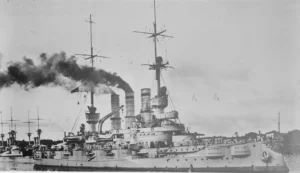
  From February 1937 he was head of the Stettin Naval Service. In November 1939, he relinquished the command and took over the liner Schlesien
  until 30-07-1940. At the end of July 1940, he was appointed head of the newly established naval service station Le Havre,
  which was ultimately not carried out. However, this was not established until August 1940 and was not placed under his command. From July 1940 to January 1941, he was head of the Antwerp Naval Station.
When the German Naval Transport Command Italy was established as the new command authority of the Kriegsmarine  in January 1941, Horstmann was appointed commander. He was promoted to Rear Admiral in 1942. He remained German Naval Transport Chief Italy until March 1943. He was then commander of the 5th Security Division until September 1944. On 08-11-1944 he was awarded the German Cross in Gold.
  In December 1944 he became commander of the Wehrbezirkskommando Hamburg IV. Shortly before the end of the war, in February 1945, he became head of the Stettin military replacement inspectorate and became a Russian prisoner of war after the end of the war. He was sent to the Russian prisoner of war camp 5110/48 Woikowo and returned to Germany in October 1955.
Death and burial ground of Horstmann, Gunther.
 Horstmann, Gunther died 09-02-1993, age 99, in Basel, Switzerland
Horstmann-Burchardt family grave on the Hörnli (grave slab) Horstmann found his final resting place at the Hörnli cemetery in Riehen, Switserland.Friedhof am Hörnli, Hörnliallee 70, 4125 Riehen,


Leave a Reply